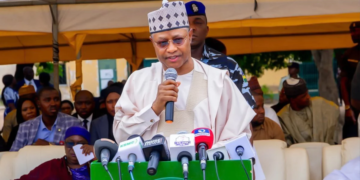
Alhaji Abubakar Alhaji entered the Federal Civil Service in 1964 as a young Assistant Secretary in the Ministry of Finance and left it, decades later, as one of the most respected names in the history of Nigerian public administration. He died on Thursday at an advanced age, reported variously as 85 and 88 depending on the source.
Nigerians knew him as Triple A, a nickname born of his initials and the esteem in which colleagues across government held him, and by the time he was turbaned Sardaunan Sokoto in 1990, succeeding a title left vacant since the death of Sir Ahmadu Bello in 1966, he had already earned a second reputation as one of the last surviving members of a class of civil servants Nigeria no longer produces in any meaningful number.
That class had a name once, the Super Permanent Secretaries, and it is worth pausing on what the title actually described. These were bureaucrats whose technical mastery and institutional memory were meant to hold government steady across changes in political leadership, offering objective policy guidance regardless of who occupied the seat above them and refusing to let the machinery of the state bend to whichever administration happened to be in power.
Triple A rose to Permanent Secretary in the Ministry of Trade in 1975 and returned to the Ministry of Finance in that capacity four years later, occupying the centre of Nigeria’s economic policymaking during a period of industrial expansion and growing international engagement. He helped negotiate the Lomé Convention that anchored trade cooperation between Europe and the African, Caribbean and Pacific states, and he sat at the table for the agreements that produced the Ajaokuta Steel Complex and the Delta Steel Company, projects meant to anchor Nigeria’s industrial ambitions even where their execution later disappointed those ambitions. Colleagues who worked under him describe a man who studied government files with what amounted to forensic patience, insisting on precision in policy documents in an era when few political appointees demanded it of themselves, let alone of their aides.
His later service as Minister of State for Budget and Planning and then Minister of Finance under General Ibrahim Babangida placed him at the centre of one of the harder chapters in Nigeria’s economic history, a period of falling oil revenue, mounting external debt and structural reforms that generated the kind of national argument Nigeria has never fully finished having. Whatever verdict history eventually settles on that period’s policies, those who served alongside him credit Triple A with steady, calm stewardship through it, the sort of professionalism that outlasts the political fortunes of whichever government happens to be asking for it.
He went on to represent Nigeria as High Commissioner to the United Kingdom, and even after formal retirement, he remained an elder statesman whose views on governance continued to carry weight, including a willingness to publicly question aspects of Nigeria’s privatisation programme and to argue that competent leadership and strong institutions mattered more to the country’s progress than another round of political restructuring. That is not a small thing to say plainly, in public, as a former minister rather than a partisan critic, and it reflects the same independence of judgement that defined his years inside government.
President Bola Tinubu, in a statement, called the late Sardaunan Sokoto a titan of public service whose fiscal discipline and diplomatic skill left an imprint on the nation’s economic and political development. The Northern Nigeria Governors’ Forum, through its chairman and Gombe State Governor, Muhammadu Inuwa Yahaya, described his death as a loss to Northern Nigeria and the country as a whole. The Emir of Ilorin, Alhaji Ibrahim Sulu-Gambari, called him a bridge between government, tradition and the people. Vice President Kashim Shettima attended his burial in Sokoto alongside the Sultan and other dignitaries. These are the tributes a country pays to a life well lived, and Triple A earned every one of them.
But a tribute of this kind means little if Nigeria treats it as a closing ceremony rather than a standard to measure itself against. The country, currently working its way through a fake presidential council scandal, an unresolved International Monetary Fund(IMF)finding of trillions in unreported federal expenditure, and a civil service too often described by ordinary Nigerians as an obstacle to good governance rather than its guarantor, is not the civil service Triple A helped build.
Somewhere between his generation of Super Permanent Secretaries and the present one, Nigeria lost the institutional culture that made a title like “Super Permanent Secretary” mean something more than seniority, a culture built on the expectation that a bureaucrat’s loyalty belonged to the country’s institutions first and to whichever minister he served second.
We have said on this page before that Nigeria’s recurring failures rarely stem from a shortage of talent, and Triple A’s life is the proof of that claim rather than an exception to it. The country that produced him also has the capacity to produce his successors, if it is willing to reward the same discipline, independence and technical seriousness that carried him from a junior desk in the Ministry of Finance to the title of Sardaunan Sokoto.
The most fitting tribute Nigeria can pay Alhaji Abubakar Alhaji is not another condolence message. It is a civil service that once again produces men who study the files, tell the minister an uncomfortable truth when the numbers demand it, and outlast the politics of the moment on the strength of their integrity alone.
We’ve got the edge. Get real-time reports, breaking scoops, and exclusive angles delivered straight to your phone. Don’t settle for stale news. Join LEADERSHIP NEWS on WhatsApp for 24/7 updates →
Join Our WhatsApp Channel