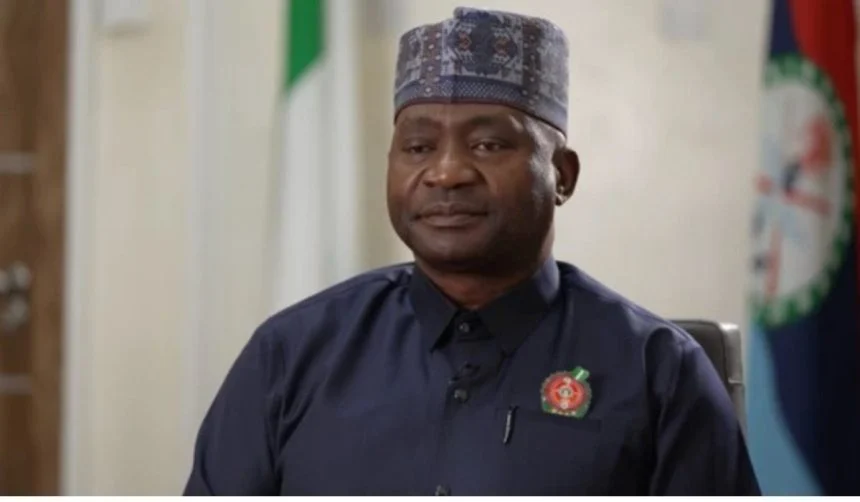
Minister of Defence Gen. Christopher Musa is once again at the centre of controversy.
In October 2024, he was sacked as Nigeria’s Chief of Defence Staff by President Bola Tinubu following reports of an attempted coup allegedly led by disgruntled officers.
According to an alternative account, Gen. Musa, along with the chiefs of the Army, Navy and Air Force, was removed, while disgruntled officers were arrested amid growing dissatisfaction within the military over inadequate funding for the Armed Forces.
Earlier this month, the Defence Minister disclosed during a television interview that the government had raised the minimum salary of Nigerian soldiers from N49,000 to N100,000.
Former Chief of Defence Staff Lucky Irabor and former Chief of Army Staff Tukur Buratai enjoyed the confidence of late President Muhammadu Buhari, yet they never pushed for a review of soldiers’ salaries, even though recent reports rank Nigerian military personnel among the worst-paid in Africa.
But the failure did not belong solely to Abayomi Olonisakin, Lucky Irabor, Tukur Buratai, and Farouk Yahaya. It was equally a policy failure and a reflection of weak political leadership under the previous administration.
There was no coherent vision for transforming the Armed Forces into a technology-driven defence force fit for the 21st century. Beyond procuring military hardware and funding overseas courses for senior officers, the political leadership appeared to lack a comprehensive policy on investing in the institution and its personnel.
But was Musa’s statement a Freudian slip, or was it a calculated attempt to introduce a politically and nationally sensitive security issue that could not be presented directly to the President without provoking a backlash?
Either way, for someone who lost his position as Defence Chief amid unrest within the military hierarchy, the minister displayed considerable courage by drawing attention to the poor welfare of personnel in the lower ranks of the Armed Forces.
More recently, the minister publicly denied reports that he intended to resign after meeting privately with the President.
While dismissing the reports as mere rumours and insisting he did not know who was behind them, Musa still could not escape the central message conveyed by his earlier remarks and the speculation surrounding his alleged resignation.
That message is one of deep poverty within the ranks of the Armed Forces—a reality that cannot be separated from the worsening insecurity confronting much of the country.
Although there has been no official account of what the President and the minister discussed during their private meeting, the very fact that it took place without the service chiefs, and amid widespread speculation, suggests the urgency of the moment.
The Nigerian military was once regarded as the country’s most disciplined and functional institution. Today, recruits reportedly have to pay for their own uniforms.
Soldiers deployed to highways in conflict-prone areas are increasingly adopting practices long associated with the police. The concern is that a sustained collapse of discipline and morale within the Armed Forces would reverberate across the entire society.
At that point, Nigeria would struggle to survive the scale of corruption within its military. Ultimately, though, the buck stops at only one table.
We’ve got the edge. Get real-time reports, breaking scoops, and exclusive angles delivered straight to your phone. Don’t settle for stale news. Join LEADERSHIP NEWS on WhatsApp for 24/7 updates →
Join Our WhatsApp Channel