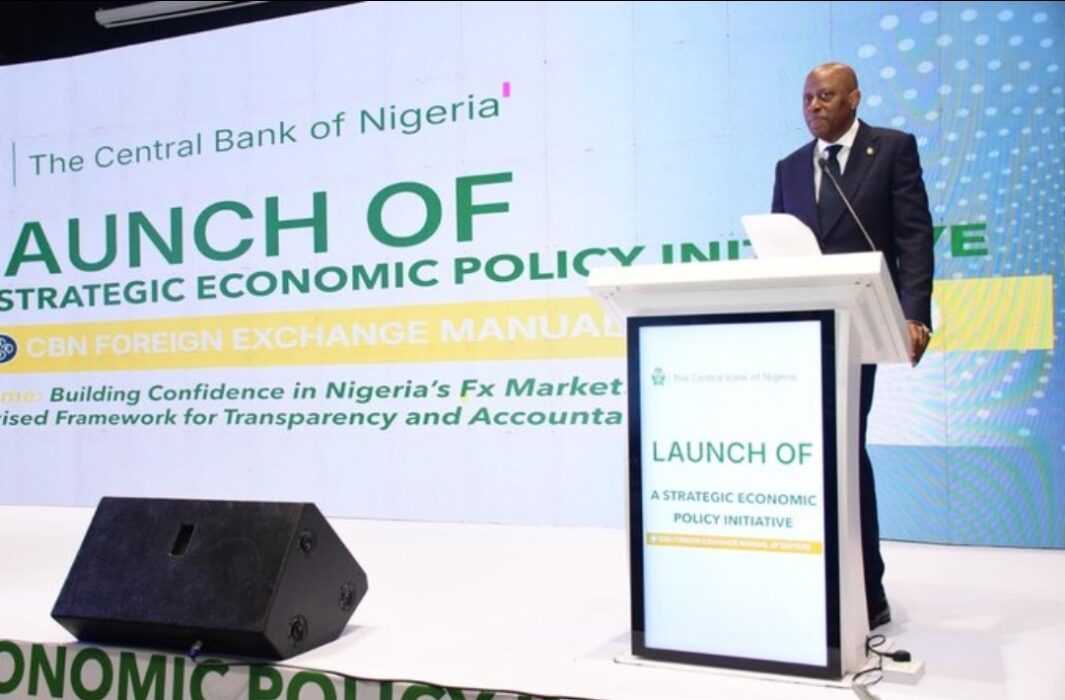
Governor of the Central Bank of Nigeria, Olayemi Cardoso, on Friday said Nigeria’s average daily foreign exchange market turnover has risen from about $100 million at the beginning of the current administration to between $400 million and $600 million, amid ongoing reforms aimed at improving transparency, liquidity, and investor confidence.
Cardoso disclosed this in Abuja during the launch of the fourth edition of the Foreign Exchange Manual issued by the Central Bank of Nigeria.
According to him, the market has also achieved daily turnover of about $1 billion on several occasions in recent months, reflecting increasing confidence and participation in the official foreign exchange market. “When this administration took over, the average turnover per day was about $100 million. Now, it has gone to an average between $400 million and $600 million per day,” Cardoso said.
He added that the apex bank’s broader objective was to build a deeper and more liquid foreign exchange market capable of supporting economic stability, investment inflows, and efficient price discovery.
The CBN governor said the revised Foreign Exchange Manual was part of broader reforms targeted at strengthening Nigeria’s macroeconomic foundations and modernising foreign exchange administration.
According to him, the foreign exchange market remains critical to international trade, industrial development, capital flows, and investor sentiment, making transparency and regulatory clarity essential.
Cardoso said the revised manual would provide clearer operational guidelines, standardise procedures, strengthen compliance, and reduce ambiguities in foreign exchange transactions.
The last review of the manual was carried out in 2018. CBN said changing domestic and global economic realities made the latest review necessary. Cardoso said the manual would take effect from June 1, 2026, and would be made available free of charge to authorised dealers.
The governor also warned against market abuse and non-compliance, saying the apex bank would strengthen monitoring mechanisms to ensure accountability, fairness, and consistency across the system.
Cardoso said the revised framework reflected the CBN’s commitment to building a transparent, rules-based, and market-responsive foreign exchange system capable of enhancing investor confidence and supporting sustainable growth.
He stressed that the success of the framework would depend on the commitment of banks, corporates, exporters, importers, regulators, and other market participants to comply with its provisions.
Group managing director/CEO of United Bank for Africa, Oliver Alawuba the revised manual enforces a clear policy direction of the Central Bank. “A policy exchange that anchors transparency, ethical conduct, credible foreign exchange, stronger documentation, improved oversight and greater confidence,” he stated.
Alawuba who is the chairman of bank MDs said “The table has indeed turned and so much greater confidence in the Nigerian economy thanks to the reforms that have been conducted by the Central Bank of Nigeria. This manual comes with discipline that operators and regulators and all stakeholders will need to imbibe as we continue to have a sustainable foreign exchange market.
“And I would like to assure the Central Bank of Nigeria that we in the banks will do everything to have that discipline and ensure that contents of this manner are executed.”
CBN’s deputy governor, economic policy, Sani Abdullahi, said the revised manual is designed to restore confidence and improve the efficiency of Nigeria’s foreign exchange market. Abdullahi said the manual was designed to harmonise procedures, clarify rules, strengthen accountability, and provide stakeholders with a single authoritative reference point for foreign exchange operations.
According to him, the revised manual adopts an “Ease of Doing Business” approach aimed at reducing transaction delays, eliminating ambiguities, and encouraging broader participation in the formal foreign exchange market.
Abdullahi said the CBN’s long-term objective was to build a stable, transparent, liquid, and globally competitive foreign exchange market capable of recording average daily turnover above $1 billion.
Among the major changes introduced in the revised manual are the harmonisation of Personal Travel Allowance and Business Travel Allowance disbursement structures with revised Bureau de Change guidelines, requiring 75 per cent of such transactions to be processed electronically and 25 per cent in cash.
The manual also increased allowable advance payment for imports from 15 per cent to 30 per cent and introduced provisions allowing imports with shortfall or excess delivery margins of plus or minus 10 per cent of the Cost and Freight value on Form M.
Other changes include free processing of Form NXP, new documentation requirements for service exports and technology company remittances, provisions for PAPSS transactions to support intra-African trade, and the introduction of non-resident investment and ordinary accounts.
The revised framework also permits payments for services in foreign currency where receipts are earned in foreign currency, allows transfers between export proceeds domiciliary accounts and ordinary domiciliary accounts, and grants 100 per cent repatriation of export proceeds for foreign companies operating in the extractive sector.
In addition, the manual removed the mandatory requirement for Form A in remittances conducted through ordinary domiciliary accounts while retaining banks’ responsibility to verify the legitimacy of such transactions.
We’ve got the edge. Get real-time reports, breaking scoops, and exclusive angles delivered straight to your phone. Don’t settle for stale news. Join LEADERSHIP NEWS on WhatsApp for 24/7 updates →
Join Our WhatsApp Channel