
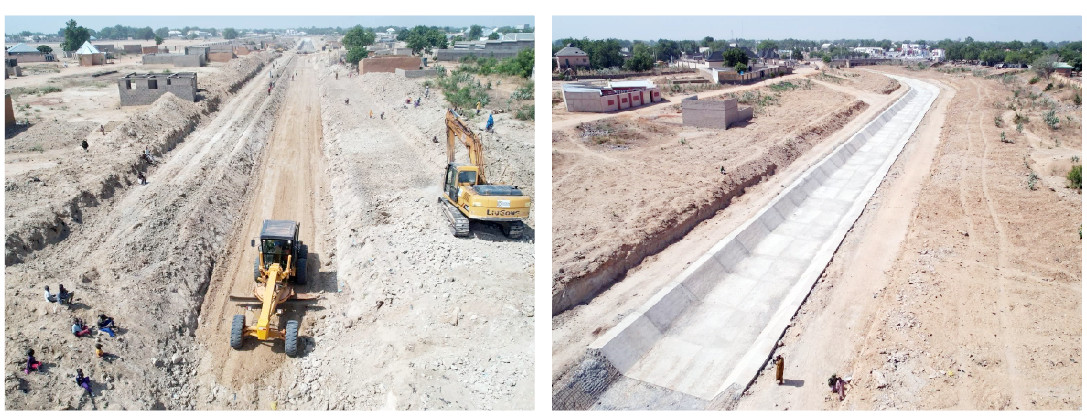
The rainy season has always been a problem for residents of Damaturu, the capital of Yobe State. However, KAMAL IBRAHIM reports that the state government has now changed the narrative with the construction of regulated channels to tackle the incessant flooding in the city
In the semi-arid heart of the capital city of Yobe State, Damaturu, the arrival of the rainy season was once less a blessing than a source of fear for residents, given the recurring disasters it brought. For decades, the river stream cutting through the city transformed into a raging force each year, unleashing floods that devastated homes, farms, and livelihoods.
As dark clouds gathered and heavy rains began, fear settled over communities along the riverbanks, measuring about 4km. The stream appears calm but destructive, trapping the city in a cycle of annual loss. Many residents feared their land and future would eventually be washed away.
LEADERSHIP Weeked reports that today, the long-standing reality is changing. Under the leadership of Governor Mai Mala Buni, with support from the World Bank through the ACReSAL project, a massive flood and erosion control project has reshaped the waterway. What was once a source of destruction is now a regulated channel, redefining the relationship between Damaturu residents and their environment.
For farmers like Umar Alhaji Umaru, the transformation is deeply personal. A longtime resident whose livelihood depends on the fertile but fragile land along the stream, Umaru describes the river as a seasonal thief that repeatedly robbed him of his harvest.
Before the intervention, months of hard labour could disappear overnight. He recalls one particularly devastating year when floodwaters swept through his entire farmland, destroying every crop. His family was left without food, income, or food security.
Beyond crop losses, erosion posed an even greater threat. Each flood ate away the land itself, shrinking farm boundaries year after year. Eventually, many farmers abandoned their ancestral lands, unable to cope with the steady loss.
Standing by the newly reinforced canal, Umaru now speaks of renewed hope. The project, he says, has not only controlled water but restored confidence. For the first time in years, farmers can plan without constant fear of ruin.
Along the stream, Ibrahim Adamu recalls how floods shaped daily life in Damaturu. The damage, he says, went beyond economics. It was psychological. At the first sign of heavy clouds, communities slipped into anxiety.
Nights were spent awake, listening to rising waters and fearing displacement. Roads and footpaths were often washed away, cutting off access to schools and markets and isolating entire neighbourhoods.
Adamu also narrates the hidden cost farmers endured. Each planting season began with repairing damage from the previous year, rebuilding ridges and irrigation channels they knew would soon be destroyed again.
The new erosion control project has ended what he describes as a “tax on survival.” With stabilised riverbanks, farmers like Adamu can now invest in expansion rather than repairs. Adamu is already planning for dry-season farming, something he once considered impossible.
He believes the project will usher in a new era of food production in Damaturu, turning the city from a flood victim into a model of resilience.
For Aisha Goni, a petty trader and mother of four, the floods once meant repeated displacement. She recalls how, every rainy season, her family would pack their belongings in haste, unsure whether their home would survive the night.
“We used to raise our beds with blocks and keep our clothes in nylon bags,” she says. “Sometimes the water still entered the house, destroying foodstuffs and school materials for the children.”
To her, the fear of losing shelter was constant, and rebuilding after each flood drained the family’s meagre savings.
She says the new canal has brought relief not just to her household, but to women traders across the area.
“Now, when it rains, we sleep. We don’t run outside at midnight anymore,” Aisha adds, noting that stable access roads have also allowed her to return fully to her small trading business.
Similarly, Musa Abdullahi, a motorcycle mechanic whose workshop is located near the former flood path, describes years of repeated losses. He says floodwaters routinely submerged his tools, damaged engines under repair, and forced him to shut down his shop for weeks. “One night of heavy rain could wipe out everything I worked for in months,” Musa recalls.
Before the project, he says, many artisans along the stream were trapped in a cycle of repair and recovery. “We were not growing; we were just surviving,” he explains.
With the erosion control measures now in place, Musa says he has reopened his workshop with confidence and is considering taking on apprentices. “For the first time, I feel my business has a future here,” he says.
Providing technical insight into the project is Shehu Muhammad, Project Coordinator of the Agro-Climatic Resilience in Semi-Arid Landscapes (ACReSAL) in Yobe State.
He explains that Damaturu previously faced recurring flood and erosion challenges that overwhelmed both residents and authorities.
To Muhammad, the intervention involves constructing and reinforcing a multi-kilometre canal to collect, control, and safely redirect stormwater across the city.
“It is not just a drainage system but a comprehensive water management solution,” he says.
Crucially, the excess water is being redirected to Sunsuma, where a reservoir has been prepared to store it for irrigation use. Instead of causing destruction, the water will now support irrigation, enabling year-round farming.
This approach aligns with broader efforts to build climate resilience and protect the environment amid increasingly unpredictable weather patterns.
As the project nears completion, Damaturu’s changing landscape tells the story of a river that once symbolised fear and loss, now represents stability. For the first time in living memory, residents can watch the rain fall without dread, confident that the water will follow a safer, controlled path.
We’ve got the edge. Get real-time reports, breaking scoops, and exclusive angles delivered straight to your phone. Don’t settle for stale news. Join LEADERSHIP NEWS on WhatsApp for 24/7 updates →
Join Our WhatsApp Channel