
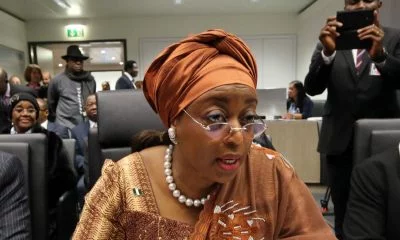
Lawyers to the embattled former Petroleum Minister, Diezani Alison-Madueke, on Thursday told Judge Michael Snow of Southwark Crown Court in England that his client had no powers to influence the award of government contracts.
The lawyer, Jonathan Laidlaw, who made the claim in his opening address to the jury in the ongoing trial of Alison-Madueke over allegations of bribery, said that the former Minister was merely a ‘rubber stamp’ while in office.
He also told the jury that none of the other individuals named in the charges against Alison-Madueke had been charged, nor had Britain attempted to have them extradited for trial.
The 65-year-old former Minister was arraigned before the court on a five-count charge of accepting bribes and an additional count of conspiracy to commit bribery, relating to her tenure as Nigeria’s Minister for Petroleum Resources from 2010 to 2015, under the Goodluck Jonathan administration.
Alison-Madueke is accused of accepting “financial or other advantages” from individuals linked to the Atlantic Energy and SPOG Petrochemical groups between 2011 and 2015.
The prosecution also alleged that the defendant was carrying out refurbishment work on several London properties and incurring staff costs, furniture, chauffeur-driven cars, a private jet flight to Nigeria, and £100,000 ($137,000) in cash.
Two others, Doye Agama and oil industry executive Olatimbo Ayinde, are also being prosecuted on bribery charges related to the case.
When the case came up for hearing on Thursday, Laidlaw told the London-based court that properties were bought on her behalf because Nigerian ministers can’t hold bank accounts abroad.
The defence lawyer also stated that Alison-Madueke, 65, disputes the extent to which properties were allocated for her use and the amount of goods she received, but that “all that was spent on her personally, in one way or another, was reimbursed.
Laidlaw further claimed that Alison-Madueke repaid personal expenses in Nigeria, and that expenses related to official business were “reimbursed from government coffers,” insisting that Alison-Madueke received no financial advantage.
“If there was any financial advantage, it was to Nigeria, enabling the Minister for Petroleum Resources to undertake her ministerial duties, and … there was, of course, nothing improper about it,” the lawyer stated.
Laidlaw explained that Alison-Madueke’s role as a minister involved approving oil and gas contracts awarded by the Nigerian government.
He urged the jury to consider whether the former Minister truly had the power to influence the awarding of these contracts or if she was simply a rubber stamp, approving recommendations made by her civil servants.
The lawyer further maintained that Nigeria, one of the world’s top oil producers and Africa’s biggest, has historically struggled with corruption.
He argued that perceptions of government and business practices might differ between Britain and Nigeria.
“What might seem uncomfortable or extravagant to us in Southwark could feel very different to a group of 12 people sitting together in Nigeria,” Laidlaw stated.
We’ve got the edge. Get real-time reports, breaking scoops, and exclusive angles delivered straight to your phone. Don’t settle for stale news. Join LEADERSHIP NEWS on WhatsApp for 24/7 updates →
Join Our WhatsApp Channel