The news arrived with the kind of fanfare usually reserved for moon landings, scientific breakthroughs or the end of wars. Elon Musk, already the wealthiest man in modern history, has reportedly become the world’s first trillionaire, with an estimated net worth exceeding $1 trillion following SpaceX’s public listing. The figure is almost impossible to comprehend: $1,000,000,000,000. A number so large that it ceases to have any real meaning to most people.
To put it in perspective, Musk’s personal fortune is now larger than the annual economic output of many countries. It exceeds the GDP of dozens of nations and dwarfs the national budgets of countries struggling to provide basic healthcare, education, electricity and security for their citizens. While one individual accumulates wealth on a scale previously thought unimaginable, billions of people across the world continue to live in poverty, uncertainty and deprivation. Something about this picture feels profoundly wrong.
This is not an attack on Elon Musk. Nor is it a condemnation of entrepreneurship, innovation or wealth creation. Musk has undoubtedly built remarkable companies, pushed technological boundaries and transformed entire industries. Society benefits when innovators create value, solve problems and take risks. Wealth creation is not the problem. Although social justice advocates fault his politics and ideology towards the poor.
The real question is whether the current scale of wealth concentration is compatible with any meaningful notion of fairness, social justice or democratic stability.
When Inequality Becomes Absurd
For decades, economists warned about growing inequality. The gap between rich and poor was widening, they said. Governments acknowledged the concern but largely treated it as an unfortunate side effect of economic growth.
Today, “gap” is no longer the right word. A gap suggests two sides that remain connected by some visible distance. What we are witnessing now is something far larger. It is a chasm.
According to global development agencies, hundreds of millions of people still lack access to clean water. Millions of children remain out of school. Entire communities live without reliable electricity. Preventable diseases continue to kill people simply because they cannot afford treatment. Food insecurity affects large parts of Africa, Asia and Latin America.
At the same time, the combined wealth of the world’s billionaires continues to rise at extraordinary rates. The number of billionaires has reached record levels, while their collective wealth has grown into the tens of trillions of dollars. The contrast is jarring.
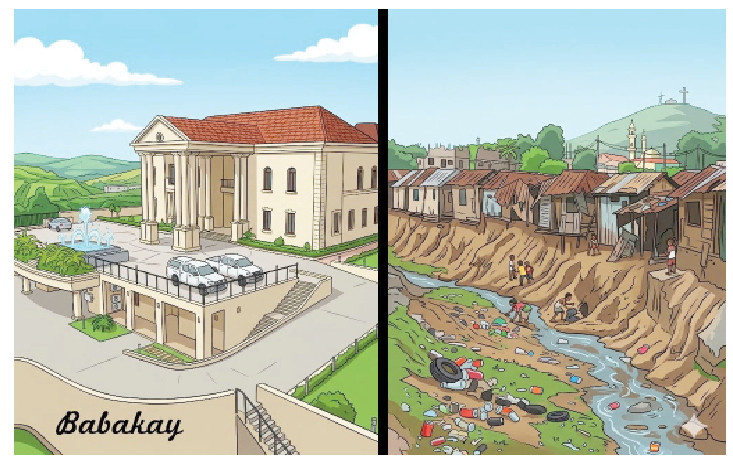
In many cities, luxury skyscrapers stand a few kilometres away from sprawling slums. Private jets crisscross the globe while millions cannot afford a bus ticket. A handful of individuals possess more wealth than entire populations. This is not merely an economic issue. It is a moral one.
A society can tolerate differences in income and opportunity. It cannot indefinitely sustain a situation where unimaginable abundance exists alongside avoidable suffering. Social media has been agog with those admiring Elon on one side and others dismissing his wealth as a sign of a bigger global problem of inequality.
The Myth of Trickle-Down Prosperity
Defenders of extreme wealth often argue that billionaires create jobs, stimulate innovation and drive economic growth. There is truth in that argument. Companies create employment. Investments generate economic activity. Entrepreneurs frequently solve problems that governments cannot. Yet the evidence increasingly suggests that wealth does not automatically trickle down in ways that significantly reduce inequality.
Over the past forty years, global productivity has risen dramatically. Technological advances have transformed industries and created enormous value. But the benefits have not been distributed evenly. Wages for many workers have stagnated while returns on capital have soared. Asset ownership has become the defining factor in wealth accumulation.
In other words, if you own shares, platforms, patents and financial assets, your wealth grows exponentially. If you rely solely on wages, you are often running in place.
Technology has amplified this dynamic. Digital platforms allow a small number of companies and individuals to reach billions of customers with relatively limited labour costs. Wealth that once would have been distributed across thousands of businesses and workers can now accumulate in the hands of a few founders and investors. The result is an economic system that increasingly rewards ownership over participation. This is how trillionaires emerge.
The Threat to Democracy
Extreme inequality is not merely an economic concern. It poses a direct challenge to democratic governance. Political equality becomes difficult to maintain when economic inequality reaches extreme levels.
One person may still have one vote. But wealth translates into influence, access and power. It shapes media narratives, funds political campaigns, influences public policy and determines whose voices are heard.
When a small group of individuals possesses resources greater than those of many governments, questions inevitably arise about accountability and democratic legitimacy. Who ultimately shapes public priorities? Who decides what technologies are developed, which problems receive attention and which communities are left behind? Who benefits when economic systems are designed primarily around the interests of capital rather than citizens?
History offers numerous warnings. Societies marked by extreme inequality tend to experience greater social unrest, political instability and declining trust in institutions. When people perceive that the system is fundamentally rigged against them, faith in democracy erodes, populism flourishes, polarisation deepens and social cohesion weakens.
Rethinking What Progress Means
We should ask uncomfortable questions about what we consider success. Have we built economies that measure prosperity correctly? If stock markets reach record highs while millions remain hungry, can we genuinely call that progress? If technological innovation creates extraordinary wealth but leaves vast numbers of people behind, have we solved humanity’s challenges or simply rearranged them?
The issue is not whether someone should be allowed to become wealthy. The issue is whether any economic system can justify levels of wealth concentration so extreme that one individual possesses resources beyond the imagination of entire generations while billions struggle to meet basic needs.
A trillion dollars is not merely a financial milestone. It is a symbol both of the extraordinary capacity of modern economies to generate wealth and their equally extraordinary failure to distribute its benefits fairly.
The world does not need fewer innovators, entrepreneurs or dreamers. What it needs are economic and political systems that ensure prosperity is shared more broadly. Systems that reward innovation without allowing inequality to become grotesque. Systems that recognise that human dignity should not depend entirely on market outcomes.
The growing divide between the rich and the poor demands more than wealth redistribution; it requires a renewed sense of collective responsibility. When the wealthy pay their fair share of taxes, governments can better fund healthcare, education and infrastructure that benefit all. The rise of trillionaires is not simply a story of individual success but a reflection of global systems that concentrate opportunity and reward a few while leaving many behind. For Africa, despite its vast resources and youthful population, this reality is especially stark. Addressing it requires reimagining economic systems around shared prosperity, inclusion, care and justice rather than wealth accumulation alone.
The celebration or condemnation of the world’s first trillionaire should therefore be accompanied by a moment of collective reflection. Not because Elon Musk became a trillionaire, but because billions of people remain poor. The existence of one fact alongside the other should trouble us all.
A world capable of creating trillionaires is surely capable of ensuring that no child goes hungry, no family lacks healthcare and no community is left without hope.
We’ve got the edge. Get real-time reports, breaking scoops, and exclusive angles delivered straight to your phone. Don’t settle for stale news. Join LEADERSHIP NEWS on WhatsApp for 24/7 updates →
Join Our WhatsApp Channel