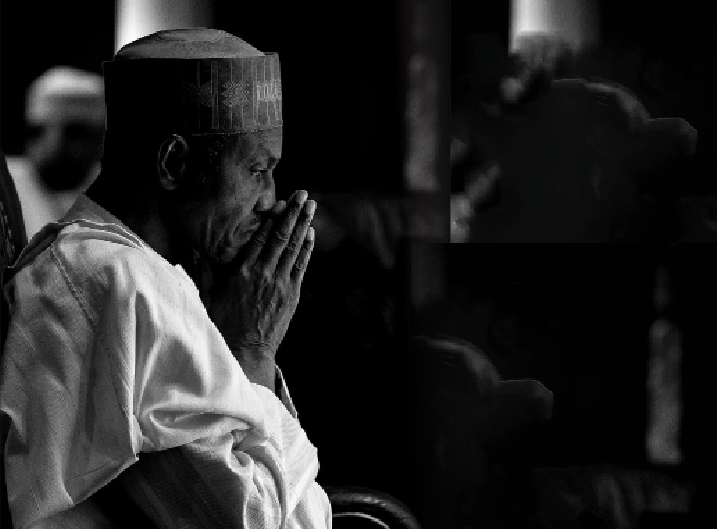
There are moments in history when a man’s departure echoes louder than his presence. The death of former President Muhammadu Buhari on Sunday, July 13, 2025, was one of those moments. A nation stood still—not just in grief, but in reckoning. In the slow march of his casket at the Umaru Musa Yar’Adua International Airport, in the full military honours rendered under a blazing Katsina sky, Nigeria came face to face with the contradictions and clarity of a man we thought we knew.
For eight years, I had the privilege of covering Muhammadu Buhari as a State House correspondent. In that time, I saw the rigid general, the austere democrat, the misunderstood patriarch, and the man who joked often—but was rarely understood. What I saw last Tuesday in Daura, as Nigeria laid him to rest beside the home he built and the earth he loved, was the final act of a life that defied simplification.
Buhari, like many consequential figures, was not universally adored. But few leaders in Nigeria’s post-independence history have elicited the kind of complex respect he did—from friend and critic alike. Whether one stood with him or stood against him, it was hard to ignore the sense that here was a man anchored by a singular compass: duty.
The Federal Executive Council’s tribute session on Thursday offered more than a ceremony—it testified. President Bola Tinubu’s voice was steady as he renamed the University of Maiduguri in Buhari’s honour. Yet, in his tribute, there was something heavier than respect—there was a recognition of kinship. The two had fought political battles side by side, ushering in Nigeria’s first peaceful transition of power between parties in 2015. Tinubu called him “Mai Gaskiya” — the honest one — not as a campaign slogan, but as a summation of character.
“He stood ramrod straight,” Tinubu said, “unmoved by power, unseduced by applause, and unafraid of the loneliness that comes with doing what is right.”
It is that loneliness—chosen, not forced—that defined Buhari’s public life.
He was, as Senate President Godswill Akpabio noted, a soldier who didn’t flinch under fire. “His toughness,” Akpabio said, “was not born of pride but of patriotism.” And while many will debate his record—as is the right of any free people—the integrity of his intentions remains intact. “He did not pilfer the nation’s purse, nor pander to its pleasures,” Akpabio added.
In an age of performative politics, Buhari preferred silence. In a country of strongmen, he governed with restraint. In a region often held hostage by patronage, he challenged governors to pay salaries before sleeping soundly. And in the Villa, he was a man of time—never late, never excessive. Meetings with him rarely exceeded 15 minutes. Say what you must, say it with clarity, and be on your way. And yet, beneath the stern exterior was a man who laughed more often than was known.
He lived modestly, shunned luxury, and carried the burdens of office without seeking to be loved. His governance style drew criticism. But even his critics knew he wasn’t in it for personal gain. “Tell him it’s to help the poor,” Villa insiders would say when pushing proposals. That was his soft spot. That was his mission.
At his burial, it was Yusuf Buhari, his son, who finally broke the stoicism. He struggled to complete his vote of thanks. “Thank you, Daddy. Thank you, daddy…” his voice trailed off in tears. In that moment, the soldier became a father. The President became a man. And the myth gave way to memory.
What Buhari leaves behind is not just roads, policies, or institutions. He leaves behind an ethos. One that insists on personal integrity. One that measures leadership by sacrifice, not soundbites.
Yes, he was not perfect. No leader is. But his flaws did not mask his principles. He may have been hard to access, slow to speak, but his decisions were rarely motivated by greed or malice. He believed in Nigeria. Not just as a country, but as a covenant.
And perhaps that is why his death struck a chord deeper than expected. We didn’t just lose a former president. We lost a rare kind of leader: one who came with nothing, left with little, and carried only the burden of history.
In the end, he asked not to be buried in a national monument, but at home, beside his courtyard in Daura. And there, wrapped in the colours of a flag he served for six decades, Muhammadu Buhari now rests.
But for those of us who walked the corridors of the Villa during his tenure, and those who watched him from afar, his imprint lingers—in our memory, in our debates, and in our aspirations.
Mai Gaskiya is gone. But the question he posed, in silence and in action, remains:
What does it mean to serve without seeking reward?
We may spend a lifetime answering that. He spent a lifetime living it.
We’ve got the edge. Get real-time reports, breaking scoops, and exclusive angles delivered straight to your phone. Don’t settle for stale news. Join LEADERSHIP NEWS on WhatsApp for 24/7 updates →
Join Our WhatsApp Channel