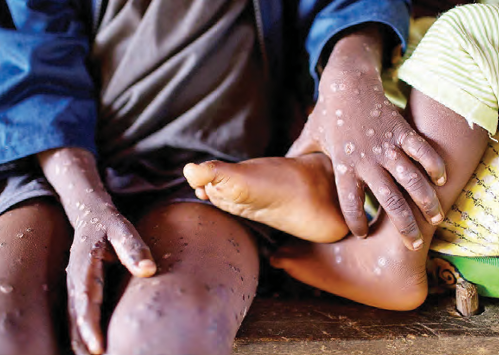
Despite being endemic in Nigeria and some African nations for years, recent mpox outbreaks have intensified concerns about the already strained healthcare system.
Mpox is a zoonotic disease transmitted from animals to humans, primarily through direct contact with infected animals like rodents or contaminated materials. While the disease has a lower fatality rate, it poses significant health risks. Human-to-human transmission, though less frequent, can occur via respiratory droplets, bodily fluids, or contact with lesions.
The disease, which primarily spreads through close contact, poses serious health risks, especially to vulnerable populations. This article explores Mpox health implications, the factors contributing to its resurgence, and the urgent measures needed to combat its spread and safeguard public health.
The Africa Centres for Disease Control and Prevention (Africa CDC) declared Mpox a public health emergency of continental security on August 13, 2024.
The World Health Organisation (WHO) also declared the Mpox outbreak a Public Health Emergency of International Concern (PHEIC) on August 15, 2024.
On August 30, 2024, the Nigeria Centre for Disease Control and Prevention (NCDC) confirmed 48 Mpox cases out of 868 suspected cases across 35 local government areas in 20 states, and the Federal Capital Territory (FCT).
The centre disclosed this in its Mpox situation report for week 34 (August 25) posted on its website. The report, however, showed that no death has been recorded from the disease so far this year.
“57 new suspected cases were reported in Epi week 34, 2024, compared with 25 cases reported in the previous week (Epi week 33). Eight confirmed cases were reported in week 34 compared with one (1) confirmed case reported in week 33, 2024.
“Twenty States and the FCT have recorded at least one confirmed case across thirty-five (35) Local Government Areas in 2024″, the report stated.
The report also revealed the age distribution of the cumulative number of confirmed Mpox cases showing that 17 cases were recorded among ages 0-10, seven cases were recorded among ages 11-20, nine cases were recorded among 21-30, eight cases were recorded among ages 31-40, and seven cases were recorded among ages 41-50.
The cases were recorded in Lagos (one), Rivers (two), Bayelsa (six), Abia (one), Delta (two), Imo (one), Edo (one), FCT (two), Anambra (two), Cross River (five).
Others were Plateau (two), Akwa Ibom (four), Nasarawa (one), Oyo (one), Kaduna (one), Ebonyi (one), Benue (three), Enugu (eight), Osun (two), Kebbi (one), and Zamfara (one).
Meanwhile, the director-general of NCDC, Dr. Jide Idris, however, said that the NCDC plans to focus efforts on the affected states to reduce the number of cases.
The spread of Mpox in Nigeria has been exacerbated by several factors, including poor surveillance, limited access to healthcare in rural areas, and insufficient public awareness.
The social impact of Mpox in the country cannot be overstated. The stigma surrounding the disease has complicated efforts to control the outbreaks. Myths and misinformation about the disease have spread rapidly, fueled by a lack of accurate information and a general mistrust of healthcare authorities.
This misinformation has sometimes led to panic and harmful practices, such as the unnecessary killing of wildlife, which disrupts local ecosystems.
The psychological impact on those affected by mpox, especially survivors, is profound. Many grapple with fears of reinfection, facing discrimination, and coping with the trauma of a serious illness, which often leads to neglected mental health concerns in public health strategies.
He stated that in response, the Nigeria Centre for Disease Control (NCDC) is dedicated to enhancing laboratory services to boost testing capabilities. “All confirmed cases have been detected through genomic sequencing at two laboratories: the National Research Lab in Abuja and another in Lagos. However, due to the virus’s spread, we are expanding testing to include additional facilities such as NIMA, LUTH, and others across Africa.”
Dr. Idris emphasised the importance of boosting laboratory capabilities, particularly in the South-South and South-East regions, noting that while many laboratories in the network can perform PCR testing, they may lack the capacity to test specifically for Mpox.
He said that the spread is based on contact with infected animals or infected humans, stressing that “Once you can reduce, stop that contact, the transmission can easily be controlled. Although there are some cases, especially those that were caused by clade 1B, have sexual transmission, also some airborne.”
He identified poor data collection and lack of accurate data as a challenge while also stating that stigma and discrimination are part of the reasons some people don’t report cases.
“There are some challenges we have, in terms of data collection, for instance, we know that there were three states we have not collected, we have not reported anything, but investigators will see what has happened. Of course, again, generally, with most of these diseases, some people may not report these cases, some states may not report these cases because of stigma issues, or we consider it as not visible to them,” he said.
However, he said that the centre has created an active surveillance and hope to get more cases. “We hope, but the objective is to reduce the number of cases.
“So, but we need to intensify those active searches so that at least we know that, for sure, we don’t have any of these cases. The last bit is that all the cases we have here are the clade 2B type, the less serious type. but we also have to be on the alert for clade 1B.
That is why we’re working on those genomic, those labs that have genomic sequencing capabilities. All cases we see, specimens we see, subject to genomic sequencing, we need to determine which links they are,” he explained.
According to him, the NCDC plans to address this by providing necessary training, reagents, and consumables, he added.
Meanwhile, as part of efforts to contain the spread of Mpox in the country, the Government of the United States of America has donated 10,000 doses of the Jynneos vaccine to Nigeria.
The coordinating minister of health and social welfare, Prof Muhammad Pate, said the vaccine will be of great help to Nigeria while thanking the US Government for the donation.
Assessing Nigeria’s risk level. WHO has said that Nigeria is at moderate risk, not high.
WHO country representative in Nigeria, Dr Walter Kazadi Mulombo, underscored the need for continued vigilance and monitoring of the microbes responsible for the disease.
“So, we were able to show the picture in Africa, also outside Africa, where we have observed already cases in Europe and now in Asia. And of course, Nigeria is not at high risk, it’s at moderate risk, but we need to continue to remain vigilant because we have cases reported as far as Europe or Asia and Nigeria is not safe until this overall event is safe.
He reaffirmed WHO’s commitment to supporting the Nigerian government in strengthening public health measures to control the outbreak.
Public health experts have stressed that to effectively combat Mpox in Nigeria, a multi-faceted approach is required. Strengthening the healthcare infrastructure, particularly in rural areas, is essential. This includes improving surveillance systems, ensuring timely access to vaccines, and providing adequate training for healthcare workers to manage outbreaks effectively.
Public health campaigns aimed at educating the populace about Mpox, its transmission, and preventive measures are also crucial. Addressing the stigma associated with the disease will encourage more people to seek early medical intervention, which is key to controlling its spread, they added.
The impact of Mpox in Nigeria is a stark reminder of the vulnerabilities in the country’s public health system. While progress has been made in managing the outbreaks, much work remains to be done.
We’ve got the edge. Get real-time reports, breaking scoops, and exclusive angles delivered straight to your phone. Don’t settle for stale news. Join LEADERSHIP NEWS on WhatsApp for 24/7 updates →
Join Our WhatsApp Channel