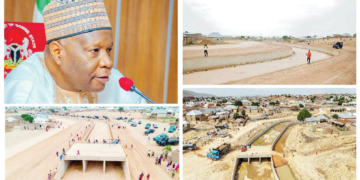
As climate change, deforestation and desertification threaten millions of livelihoods across northern Nigeria, the National Agency for the Great Green Wall is pursuing one of Africa’s most ambitious ecological restoration projects. But can trees alone stop the desert, and what more must be done?
Every year, the desert moves a little farther south. It does not arrive with fanfare. There are no explosions or dramatic headlines. Instead, it advances quietly, swallowing farmland, drying up streams, stripping communities of vegetation and forcing families to abandon livelihoods built over generations.
For thousands of villages across northern Nigeria, climate change is no longer a future threat. It has become an everyday reality.
Farmers harvest less than they once did. Herders travel longer distances in search of pasture. Women walk farther to gather firewood and fetch water. Young people leave their communities in search of opportunities elsewhere, while those who remain struggle in an increasingly hostile landscape.
According to experts, desertification now threatens millions of hectares of productive land across northern Nigeria, placing food security, economic development and national stability under increasing pressure. This is the crisis the National Agency for the Great Green Wall (NAGGW) is striving to combat.
Originally established as Nigeria’s implementing agency for the African Union’s Great Green Wall Initiative, NAGGW has gradually transformed from a tree-planting institution into a national agency focused on ecological restoration, climate adaptation and rural development.
Its work spans the eleven frontline states: Adamawa, Bauchi, Borno, Gombe, Jigawa, Kano, Katsina, Kebbi, Sokoto, Yobe and Zamfara. Where the effects of climate change are among the most severe in the country, yet the scale of the challenge remains enormous.
Environmental degradation in northern Nigeria is driven by a combination of prolonged drought, deforestation, overgrazing, unsustainable farming practices, and rapidly changing weather patterns. The consequences extend well beyond damaged ecosystems.
Shrinking agricultural land has intensified competition over natural resources, contributing to farmer-herder conflicts, food shortages, migration and worsening poverty. For security analysts, environmental degradation has increasingly become a national security concern.
Recognising this reality, NAGGW has adopted a strategy that combines ecological restoration with economic empowerment. The agency’s flagship initiative, a five-year programme to plant 50 million date palm trees across the frontline states, represents far more than an afforestation campaign. The programme seeks to create sustainable income for rural households while restoring degraded landscapes.
Date palms are particularly suited to arid environments. They withstand harsh climatic conditions, improve vegetation cover and generate economic value through fruit production, processing and commercial trade.
Director-General of NAGGW, Saleh Abubakar, recently disclosed that implementation has already commenced with the distribution of five million seedlings.
He said the agency intends to significantly expand annual tree planting in the coming years as part of efforts to restore degraded ecosystems across northern Nigeria.
But experts argue that planting trees alone cannot solve the region’s environmental crisis.
Professor Aliyu Ibrahim, an environmental management specialist, believes ecological restoration must be supported by stronger policies on forest protection, sustainable agriculture and rural development.
“Tree planting is important,” he says, “but protecting existing forests is equally critical. Communities need economic alternatives so that environmental conservation becomes beneficial rather than burdensome.”
That thinking appears to be shaping NAGGW’s evolving approach. Beyond afforestation, the agency has expanded interventions in shelterbelt development, water harvesting, integrated farming systems, community woodlots and climate-smart agriculture.
Across several frontline states, rural communities are benefiting from projects designed to restore degraded land while improving agricultural productivity.
The agency has also embraced community participation as a cornerstone of its restoration strategy.
Instead of relying solely on government-driven projects, NAGGW increasingly involves traditional institutions, farmers’ associations, women’s groups and youth organisations in planning and maintaining restoration projects.
Officials argue that environmental programmes succeed only when communities see themselves as owners rather than beneficiaries.
Another major shift has been the agency’s decision to relocate its headquarters from Abuja to Kano.
The relocation was widely interpreted as a strategic effort to move decision-making closer to the ecological crisis confronting northern Nigeria. Being closer to project sites, officials say, enables quicker responses, improved monitoring and stronger collaboration with state governments.
Environmental observers consider the move both symbolic and practical. It reflects an acknowledgement that climate challenges require local engagement rather than remote administration.
NAGGW is also strengthening partnerships with the Federal Ministry of Environment, development agencies and international organisations working on climate resilience. Recent collaborations have focused on ecosystem restoration, sustainable land management and the empowerment of women and young people.
One notable initiative is the Green Women Platform, developed to place women at the centre of environmental restoration and green enterprise development. Women, particularly in rural communities, often bear the greatest burden of climate change. They are responsible for gathering fuelwood, sourcing water and supporting household food production.
Environmental advocates, therefore, argue that empowering women economically through climate-smart agriculture and environmental entrepreneurship could significantly improve adaptation efforts.
Youth engagement is receiving similar attention. With unemployment rising across northern Nigeria, experts believe land restoration projects can create thousands of green jobs through tree nurseries, irrigation schemes, agroforestry and environmental services. Such investments, they say, could reduce rural poverty while strengthening ecological sustainability.
Despite these interventions, major obstacles remain. Funding continues to limit the scale of restoration activities, and insecurity in parts of the North-East restricts access to some project locations. Other limitations include illegal logging and charcoal production, which continue to destroy forests faster than many restoration programmes can replace them. Climate change itself is making restoration increasingly difficult, as well as longer dry seasons and erratic rainfall, which reduce seedling survival rates and increase the cost of maintaining newly planted forests.
Experts insist that Nigeria’s response must therefore go beyond environmental agencies alone. State governments must strengthen enforcement against indiscriminate tree felling, communities require access to cleaner cooking energy to reduce dependence on fuelwood, farmers need improved irrigation systems and climate-smart farming techniques, while private investors must also see forestry not merely as conservation, but as a viable economic sector capable of generating employment, carbon credits and export earnings.
The stakes could hardly be higher if land degradation continues unchecked, millions more Nigerians may lose productive farmland, increasing food inflation, displacement and pressure on already overstretched urban centres.
Conversely, successful restoration could unlock new opportunities in agriculture, renewable natural resources and green enterprise. That is why many environmental experts believe the Great Green Wall initiative represents more than an environmental project: it is a development strategy, an anti-poverty programme, a food security intervention, and an investment in peace.
For communities living on the front lines of climate change, every restored hectare represents another chance to farm, earn a living, and remain rooted in ancestral lands.
The race against the desert has begun; whether Nigeria wins will depend not only on the millions of trees planted by NAGGW, but on the nation’s willingness to protect those trees, restore degraded landscapes and recognise that environmental security has become inseparable from economic prosperity and national stability.
We’ve got the edge. Get real-time reports, breaking scoops, and exclusive angles delivered straight to your phone. Don’t settle for stale news. Join LEADERSHIP NEWS on WhatsApp for 24/7 updates →
Join Our WhatsApp Channel