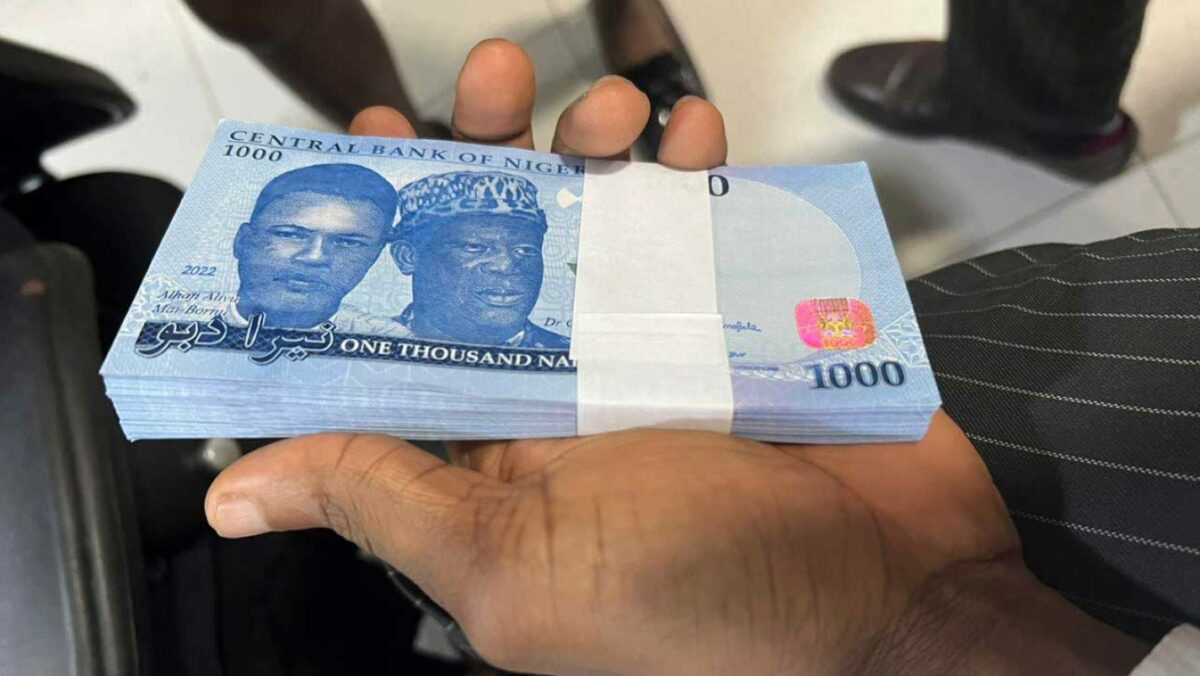
The naira recorded a marginal decline against the United States dollar at the official foreign exchange market on Friday as demand for foreign currency outpaced available liquidity.
Data released by the Central Bank of Nigeria (CBN) showed that the local currency closed at N1,362.21/$ at the Nigerian Foreign Exchange Market (NFEM), compared with N1,358.75/$ recorded at the previous trading session.
The depreciation came amid a significant drop in trading activity at the official market, reflecting tighter foreign exchange liquidity conditions.
According to the apex bank’s daily market report, exchange rates during the session traded within a band of N1,360 and N1,366 to the dollar, underscoring continued pressure on the local currency.
Market turnover also declined sharply, with the total value of transactions falling by more than 37 per cent. A total of $73.57 million was traded across 90 deals on Friday, compared with $128.17 million exchanged in the preceding session.
Analysts attributed the softer performance of the naira partly to reduced dollar inflows from foreign portfolio investors, whose participation in the domestic money market remained subdued.
The absence of recent Open Market Operations (OMO) auctions also limited investor demand for naira-denominated assets, contributing to weaker support for the local currency.
Despite the pressure in the foreign exchange market, Nigeria’s external reserve position continued to strengthen, supported by inflows from crude oil earnings, diaspora remittances and other foreign exchange sources.
Latest reserve data indicated that the country’s gross external reserves surpassed the $50 billion mark, representing the highest level recorded since the implementation of the foreign exchange reforms.
Financial market analysts said the reserve build-up reflects improved foreign exchange inflows and stronger external buffers. They noted that, barring significant debt service obligations in the near term, the reserves could rise further and approach $51 billion before the end of June.
The improvement in external reserves is expected to enhance the CBN’s capacity to support exchange rate stability and bolster investor confidence in the country’s foreign exchange market.
We’ve got the edge. Get real-time reports, breaking scoops, and exclusive angles delivered straight to your phone. Don’t settle for stale news. Join LEADERSHIP NEWS on WhatsApp for 24/7 updates →
Join Our WhatsApp Channel