
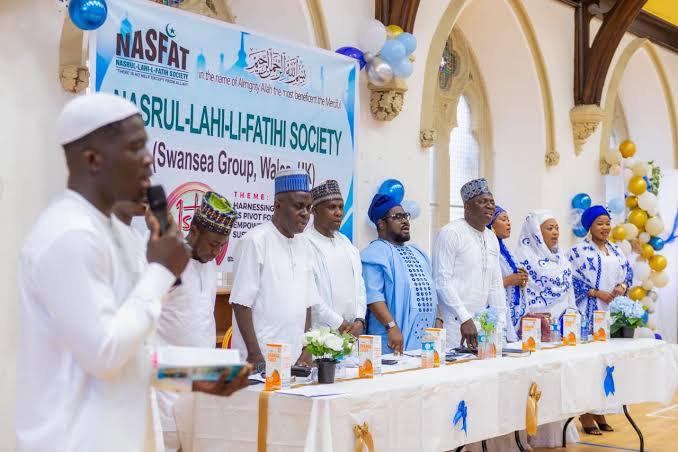
The chief missioner of the Nasrul-Lahi-l-Fatih Society (NASFAT), World Headquarters, Imam Abdul-Azeez Morufu Onike, has urged NASFAT missioners and imams to pursue Da’wah with prudence without compromising their health, family responsibilities and long-term capacity to serve.
Onike made the call in Cotonou, Benin Republic, when he welcomed participants to NASFAT Missioners’ Conference, held under the theme, “The Overstretched Missionary: Burnout, Boundaries, and Sustainability in Da’wah Work.”
He said the central challenge facing missioners was not whether they should serve Allah, but how they could remain faithful to their calling without destroying themselves in the process.
“The real question is: How do we serve Allah faithfully without destroying ourselves? How do we remain passionate without burning out, neglecting our families, compromising our health, or diminishing the quality of our service?” he asked.
According to him, Islamic leadership requires neither exhaustion nor complacency, but “consistent, sincere, and sustainable excellence” in the service of Allah.
Onike stressed the importance of self-examination, noting that not every missioner experiencing pressure was necessarily overstretched.
“Not all of us are overstretched,” he said. “Some are genuinely overstressed and overstretched. Some are working sustainably and effectively. Others, if we are honest with ourselves, may actually be performing below their potential.”
He challenged the missioners to examine their level of engagement, productivity and time use, urging them to honestly assess whether their Da’wah activities could be reduced by half without anyone noticing.
He also asked them to consider how much meaningful Da’wah they had personally initiated in the preceding three months and whether claims of being “too busy” reflected genuine responsibilities or ineffective prioritisation.
The Chief Missioner further encouraged Missioners to assess whether they were making effective use of the knowledge, skills, opportunities and time entrusted to them by Allah.
The NASFAT Chief Missioner also drew attention to the economic challenges confronting many Imams and Missioners, including irregular income, rising living costs, family responsibilities, healthcare expenses, retirement insecurity, limited institutional support and children’s education.
He said the realities required Missioners to look beyond immediate survival and deliberately plan for the future.
“Every Missioner should ask: What will sustain my family if I die today?” he said, citing the Prophetic guidance that leaving one’s heirs financially secure is better than leaving them dependent on others.
He challenged Missioners to consider what would happen when they could no longer actively preach, what income would sustain their families and what assets they were intentionally building.
“These are not merely financial questions; they are questions of amānah, stewardship, and responsible leadership,” Imam Onike said.
The Chief Missioner also highlighted the Pre-Conference Capability Assessment Test administered to registered participants as an important innovation at the conference.
He explained that the assessment reflected NASFAT’s commitment not only to discussing capacity development but also to measuring it, reflecting on the findings and taking appropriate action.
He congratulated Missioners who sincerely completed the assessment and encouraged them to study their results and act on the insights provided.
Quoting advice attributed to Sayyidina Umar ibn al-Khattab (RA), Imam Onike emphasised the importance of muḥāsabah — self-examination and accountability — before one is called to account.
They described sincerity as the first step towards excellence, warning that dishonest responses to an assessment would ultimately deny individuals an opportunity for improvement.
Reflecting on his own experience of illness in 2009 and a sarcastic comment from a member, Imam Onike observed that society might initially praise people who work beyond their limits as “dedicated,” “tireless,” or “indispensable.” Still, he may later question why they failed to take care of themselves when exhaustion eventually took its toll.
He cautioned, however, that sustainability must not be used as an excuse for reduced commitment.
“The goal of Islamic leadership is neither exhaustion nor comfort, but consistent, sincere, and sustainable excellence (Iḥsān) in the service of Allah,” he said.
He cited the Prophetic teaching that the most beloved deeds to Allah are those performed consistently, even when they are small.
Imam Onike said the objective of the conference was not to reduce Missioners’ commitment to Da’wah but to make that commitment sustainable.
“We are here to ensure that our zeal is guided by wisdom, our service is strengthened by balance, and our sacrifice is sustained by proper stewardship of the body, mind, and soul that Allah has entrusted to us,” he said.
He encouraged Missioners to establish healthy boundaries without becoming complacent and to develop the resilience and wisdom required to remain effective in Da’wah for decades.
“Our mission is not merely to start well; it is to finish well,” he declared.
He said the conference was timely and necessary, providing Missioners with an opportunity to examine the causes and consequences of burnout and to explore practical approaches to healthy boundaries and sustainable Da’wah.
Imam Onike thanked Dr Salaudeen Jibreel, the invited resource person, for accepting the invitation to guide participants through the subject.
He prayed that the conference would not merely diagnose the challenges confronting Missioners but would equip them with the spiritual resilience, practical wisdom and sustainable strategies needed to continue serving Allah with excellence for many years.
The 11th edition of the conference was attended by approximately 300 Missioners from the United Kingdom, Ghana, Togo, Côte d’Ivoire, Nigeria and other parts of the world.
We’ve got the edge. Get real-time reports, breaking scoops, and exclusive angles delivered straight to your phone. Don’t settle for stale news. Join LEADERSHIP NEWS on WhatsApp for 24/7 updates →
Join Our WhatsApp Channel