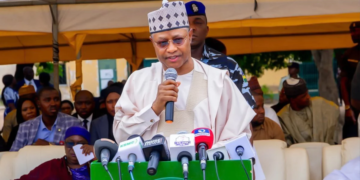
By Dr. Kabir Adamu
The most ambitious reform effort in Nigeria’s recent policing structuring is being recorded. On June 11, 2026 Nigeria’s the two chambers of Nigeria’s National Assembly, the House or Representatives and Senate, made remarkable progress in the Tinubu Adminstration’s desire to decentralise Nigeria’s current federal policing structure. The bill as passed by the House of Representatives has gone a long way to assuage some of our concerns regarding decentralised policing. However, there remains legitimate fears that are rooted in Nigeria’s governance realities and the history of security institutions being weaponised or under-resourced.
I have shifted from primarily highlighting risks to recognising the strong political momentum and practical necessity for state police, especially given the adaptive threats we face of insurgency, banditry, kidnappings, farmer-herder conflicts, ethnic militias, cultism and intercommunity violence. Local knowledge, faster response times, and improved grassroots intelligence are real advantages if the structures are designed and resourced correctly.
In the House of Representatives, it voted overwhelmingly in favour of a bill on the necessary constitutional amendments required to achieve a dectralised policing structure. The proposed amendments cover the establishment of a federal police and a state police (New Section 214) with a tranistion plan and delineatate roles of the execttive and legislative arms of government; the responsibilities of the two police structures and non-Interference and safeguard against federal overreach (Section 214); leadership and command (New Section 215); removal of top officers (New Section 216), funding support (New Section 216A); National Police Council (restructured and renamed from the old Nigeria Police Council; new composition and expanded functions in Third Schedule, State Police Service Commission (new body established for each State in Third Schedule, Part II) and the Legislative Framework (Second Schedule – Concurrent Legislative List) as well as other related changes including updates to various constitutional provisions (e.g., Sections 34, 35, 39, 42, 84, 89, 129, 153) to replace references to “Nigeria Police Force” with appropriate “Police”, “Federal Police”, or “State Police” terminology, exclusive legislative list adjustments (e.g., light arms for policing purposes; fingerprints/biometrics/forensics shared with State Police; Federal Police listed separately) and consequential amendments to the Third Schedule for the new bodies and their compositions/powers.
The Senate also made progress when it considered for second reading Constitution of the Federal Republic of Nigeria (Sixth Alteration) Bill, 2026. The Senate agreed in principle to the bill’s objectives, which is to amend the constitution to decentralise police powers, allowing each state to create and manage its own police force. The lead debater, Senate Leader, Senator Opeyemi Bamidele (who was the bill sponsor) argued that current centralised police system struggles with localised threats such as banditry, kidnapping, farmer-herder clashes etc and that State police would improve intelligence gathering and response times. He cited successful federal models in the United States and Germany among others. The senate referred to the Senate Committee on Constitution Review for detailed scrutiny. As a constitutional amendment, final plenary vote postponed to July 2026 to allow for committee report and ensure required quorum. Legally the bill will require approval of at least two-thirds of Nigeria’s 36 state Houses of Assembly to become law.
In my view, the constitutional amendment is a necessary foundation, but it is not sufficient on its own. Success will be determined by the quality and speed of the implementing legislation, particularly the National Assembly’s Act prescribing detailed minimum standards, and the political will to enforce professionalism, independence, and accountability at both federal and state levels.
Critics’ concerns have been partially but not yet sufficiently addressed by the guardrails inserted in the bill. The bill introduces important framework safeguards that directly speak to some of the risks. Some of these guardrails include:
- No state police formation can commence operations until it is established by a law passed by the relevant State House of Assembly and certified as meeting national minimum standards prescribed by an Act of the National Assembly. This certification requirement, backed by the Federal Police Service Commission’s oversight role, is a critical guardrail against the creation of substandard or rogue forces.
- The mechanism allowing a State Commissioner of Police to refer a gubernatorial directive he or she considers unlawful or inconsistent with professional policing standards to the Nigeria Police Council — whose decision is final and binding, which provides a meaningful check against blatant political abuse.
- Federal intervention in state policing matters is now constitutionally limited to cases of complete breakdown of law and order, upon a governor’s request, or where a state force is incapacitated by administrative, financial, or operational challenges. This respects federalism while retaining a national backstop.
- The bill also provides for regulation of equipment, forensic systems, biometric databases, and information-sharing , areas that can help address equipment standardisation and interoperability if properly implemented.
These are genuine improvements over the previous unitary structure and reflect lessons from years of advocacy for decentralised, intelligence-driven, and community-responsive policing.
However, significant gaps remain that mean the core fears have not been fully allayed:
- Abuse and politicisation: While the referral mechanism to the Nigeria Police Council is welcome, its effectiveness will depend entirely on the independence, composition, and resourcing of that body, as well as the detailed rules in the forthcoming National Minimum Standards Act and state-level legislation. Without strong, independent State Police Service Commissions (with civil society, professional, and retired judicial representation) and robust, accessible complaints and accountability mechanisms, the risk of governors using state police against political opponents or for narrow interests persists.
–Dr Kabir Adamu, Managing Director of Beacon Security and Innovations Limited (BSIL), writes from Abuja.
We’ve got the edge. Get real-time reports, breaking scoops, and exclusive angles delivered straight to your phone. Don’t settle for stale news. Join LEADERSHIP NEWS on WhatsApp for 24/7 updates →
Join Our WhatsApp Channel