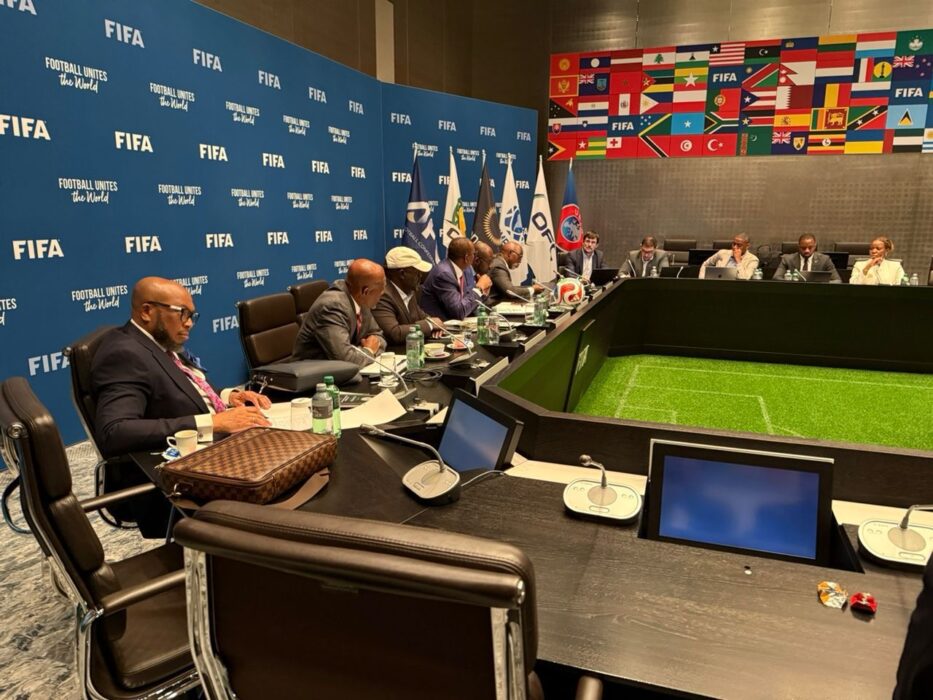
The deepening crisis in the Nigeria Football Federation (NFF) has reached a point where FIFA’s intervention is becoming increasingly necessary, with the global football governing body expected to engage Nigerian football authorities and congress members on Monday in Abuja over the federation’s leadership, governance and electoral processes.
Here are seven major reasons why FIFA is coming to Nigeria:
1. To resolve the NFF leadership crisis
The resignation of NFF President Ibrahim Gusau and several members of his executive board has created a leadership vacuum at a critical moment for Nigerian football.
With the federation’s elected leadership weakened by multiple resignations, FIFA is expected to assess the circumstances surrounding the departures and determine how the NFF can continue to function within its statutes.
2. To address the disputed NFF election
The planned NFF elective Congress has become one of the biggest flashpoints in the crisis.
Questions surrounding the electoral process, delegates, eligibility and the legitimacy of any proposed timetable have made FIFA’s involvement increasingly important.
FIFA will want assurances that any future election is conducted in accordance with the NFF statutes and FIFA’s governance requirements.
3. To examine government interference in football administration
The intervention of the National Sports Commission (NSC) has generated considerable controversy, particularly after the commission became directly involved in changes affecting the NFF and the country’s professional leagues.
FIFA’s statutes generally require member associations to manage their affairs independently and without undue interference from government or other external bodies.
The governing body’s visit will therefore provide an opportunity to establish whether recent government actions are compatible with that principle.
4. To determine the way forward for NFF reforms
There has been growing pressure for fundamental reforms of Nigerian football administration.
The Federal Government and the NSC have argued for changes to the way Nigerian football is governed, while different stakeholders have raised competing proposals over elections, representation and accountability.
FIFA’s role will be crucial in determining which reforms can be accommodated within international football’s governance framework.
5. To clarify the status of the NFF Congress
The NFF Congress remains central to resolving the crisis because it is the federation’s supreme decision-making body.
However, disagreements over the composition of the Congress, the status of delegates and the proposed electoral process have complicated efforts to return the federation to normalcy.
FIFA is expected to engage the relevant stakeholders to establish a lawful and acceptable route back to a functioning Congress.
6. To prevent a prolonged governance crisis from affecting Nigerian football
The NFF crisis comes at a particularly sensitive time for the country’s football teams.
The Super Eagles are already dealing with the consequences of failing to qualify for the 2026 FIFA World Cup, while the Super Falcons and other national teams have major international assignments ahead.
A prolonged administrative crisis could affect preparations, funding, technical appointments and the day-to-day running of the national teams.
FIFA therefore has a strong interest in ensuring that the dispute does not paralyse Nigerian football.
7. To prevent a possible FIFA sanctions scenario
Perhaps the biggest reason for FIFA’s intervention is the need to prevent the situation from escalating into a formal dispute that could trigger sanctions.
FIFA has historically insisted that national associations operate according to their statutes and remain free from improper external interference.
Rather than allowing the Nigerian situation to deteriorate into a confrontation, FIFA’s engagement could provide a negotiated pathway involving the Federal Government, NSC, NFF Congress and other stakeholders.
The bigger question
FIFA’s arrival will therefore be about much more than the future of individual officials.
At stake is who controls Nigerian football, how the NFF is governed, who has the authority to organise its elections and how far government can go in restructuring the country’s football administration.
The immediate challenge for all sides will be to find a solution that restores an elected and functional NFF while satisfying FIFA’s governance requirements.
In essence, FIFA is coming because the NFF crisis has moved beyond an internal power struggle and become a question of football governance that the global body can no longer afford to ignore.
We’ve got the edge. Get real-time reports, breaking scoops, and exclusive angles delivered straight to your phone. Don’t settle for stale news. Join LEADERSHIP NEWS on WhatsApp for 24/7 updates →
Join Our WhatsApp Channel