Ahead of Monday’s meeting of football stakeholders with FIFA in Abuja, the Advocacy for Nigeria Football Reform Initiative has demanded equal representation for the Players Union bloc and State Football Association chairmen, warning that any imbalance could undermine efforts to reform Nigerian football.
Prince Harrison Jalla, chairman of the advocacy group, said the Players Union bloc would attend the 14 September 2026 FIFA meeting with a six-member delegation, despite the Nigeria Football Federation (NFF) allocating the bloc only three slots in its invitation for the meeting.
Jalla described the allocation as “an anomaly” that must be corrected, arguing that the Players Union bloc should not be outnumbered by State Football Association chairmen in discussions concerning the restructuring of Nigerian football.
According to him, the NFF’s invitation dated 9 September allocated six places to State Football Association chairmen but only three to representatives of the Players Union bloc.
“The Players Union bloc would attend the FIFA meeting slated for 14th September 2026 in Abuja with six members, same as allocated to the State Football Association chairmen,” Jalla said in a chat with LEADERSHIP Sports.
“The NFF is laying a foundation for another structural imbalance from the beginning of a new era, and this is unacceptable.”
The latest dispute comes amid the wider crisis engulfing Nigerian football administration following the resignation of NFF president Ibrahim Gusau and several members of his board, and subsequent disagreements over the federation’s restructuring and electoral process.
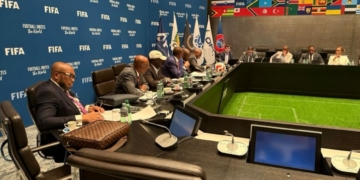
FIFA is expected to engage key stakeholders in Abuja as efforts continue to find a way out of the governance crisis. Jalla insisted that the meeting should reflect equality among the various constituent groups of Nigerian football, rather than giving one bloc numerical superiority over another.
“We can’t rebuild our football on a faulty foundation,” Jalla said. “The F.A. chairmen cannot outnumber the Players Union bloc in the new dispensation, whether in meetings, reconstitution of the Congress, standing committees, etc.”
The reform advocate also challenged the NFF’s authority to determine who should represent the various federating units, arguing that the groups themselves should select their representatives.
“And it is not the duty of the NFF to pick and choose those to represent the federating units,” Jalla said.
“That is the responsibility of the members themselves, who know those that can best represent their interests.”
Jalla further cited FIFA’s letter of 7 September, which he said made it clear that the world football governing body wanted to meet with the statutory members of the NFF.
He argued that this made it inappropriate for the NFF to manipulate the composition of the meeting in a manner that could give one group an advantage.
“The FIFA 7th September letter was clear and unambiguous: they want to meet with the statutory members of the NFF,” he said.
“It’s unfair to manipulate and skew attendance in favour of one group to outnumber the other. Representations must be equal.”
‘Jettison old tricks’
Jalla called on the NFF to abandon what he described as old practices and approach the transition with greater transparency and fairness.
“We advise the NFF to jettison old tricks and start the rebuilding and transition process in a fair, just and transparent manner,” he said.
He based his argument on the NFF 2010 Statutes, as amended, which, according to him, recognise the federation’s five federating units as equal.
“The NFF 2010 Statutes, as amended, is very clear on the status of its five federating units as being equal,” Jalla added.
The controversy over representation adds another layer to the already contentious process of rebuilding the NFF following the collapse of its previous leadership structure.
With FIFA now directly engaging Nigerian football stakeholders, the composition of the Abuja meeting is likely to attract considerable attention, particularly as discussions could influence the framework for the federation’s eventual return to an elected leadership.
For Jalla and the Players Union bloc, however, the issue is bigger than Monday’s meeting, insisting that they want equal representation to become a fundamental principle in any subsequent reconstitution of the NFF Congress, standing committees and other decision-making structures, rather than allowing the State FA chairmen to dominate the process. The demand also reflects the broader battle over who should have a voice in determining the future structure of Nigerian football.
We’ve got the edge. Get real-time reports, breaking scoops, and exclusive angles delivered straight to your phone. Don’t settle for stale news. Join LEADERSHIP NEWS on WhatsApp for 24/7 updates →
Join Our WhatsApp Channel