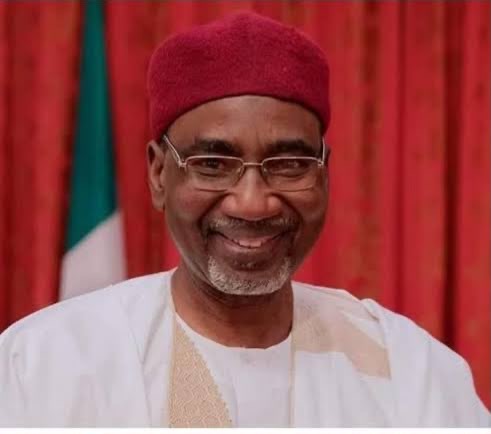
Former Director-General of the National Intelligence Agency (NIA), Ambassador Ahmed Rufai, has recounted how a rescued Chibok schoolgirl expressed a desire to return to her Boko Haram husband despite being reunited with her family.
He revealed this while highlighting the complexities of rescuing and reintegrating victims of terrorism at an international security forum in Qatar.
You would recall that Boko Haram insurgents abducted 276 schoolgirls from the Government Girls Secondary School in Chibok, Borno State, on April 14, 2014, triggering national and international outrage. Although some of the girls escaped or were subsequently released, many remained in captivity for years, with some forced into marriages with insurgents.
Speaking still, Rufai explained that terrorist abductions were motivated by different factors, including ideology, political objectives and financial gain, requiring different approaches from security agencies.
Recounting the case of the rescued Chibok schoolgirl, the former intelligence chief said the woman had been married to three Boko Haram fighters, with her first two husbands killed in combat.
He said she was eventually rescued and taken to Abuja, where she underwent medical examinations and debriefing.
According to Rufai, the woman spoke positively about a Boko Haram zonal commander who had taken her under his care and arranged new marriages for her following the deaths of her previous husbands.
He said, “She had a godfather who was a zonal commander of the terrorist group, who adopted her as a daughter. Each time she lost her husband in the fight, he would be the one to get her a new husband.”
Rufai said the woman’s response after her rescue was particularly striking, as she wanted to see her parents but did not want to remain with them.
“She loved them. She wanted to see them, and so on. And then the third interesting thing is that we subjected her to medical checks and found her to be very healthy. But the interesting thing is that she wanted to go back,” he said.
The former NIA director said the experience demonstrated the complicated circumstances security agencies encounter when dealing with victims who have spent years in captivity and developed relationships within terrorist groups.
On the motivations behind terrorist abductions, Rufai said some groups kidnapped victims to draw attention to their causes rather than to demand ransom.
“In most cases, it was political, to make their case known,” he said.
He explained that where abductors were primarily motivated by financial gain, discreet negotiations could be necessary to secure the release of hostages.
“In a situation where they really needed money, they would let it be known, and there, in that kind of situation, you have to use what we discussed yesterday: hostage diplomacy, and it has to be through back channels,” he said.
Rufai added that such negotiations could involve trusted intermediaries who had established relationships with the abductors.
He said the process required discretion, with negotiations conducted without publicising sensitive details.
The former intelligence chief also distinguished ideologically motivated terrorist groups from criminal gangs involved in kidnapping for ransom, noting that the latter were primarily driven by financial gain.
“They are not ideologically driven. They have no ideology. They want to enjoy life. They are not looking forward to dying and going to paradise. Their paradise is here,” he said.
Rufai described kidnapping for ransom as a major security challenge in Nigeria, adding that the government was making efforts to address the problem.
He further disclosed that some criminal networks were involved in other activities, including arms trafficking, vehicle theft and attacks on security personnel.
We’ve got the edge. Get real-time reports, breaking scoops, and exclusive angles delivered straight to your phone. Don’t settle for stale news. Join LEADERSHIP NEWS on WhatsApp for 24/7 updates →
Join Our WhatsApp Channel