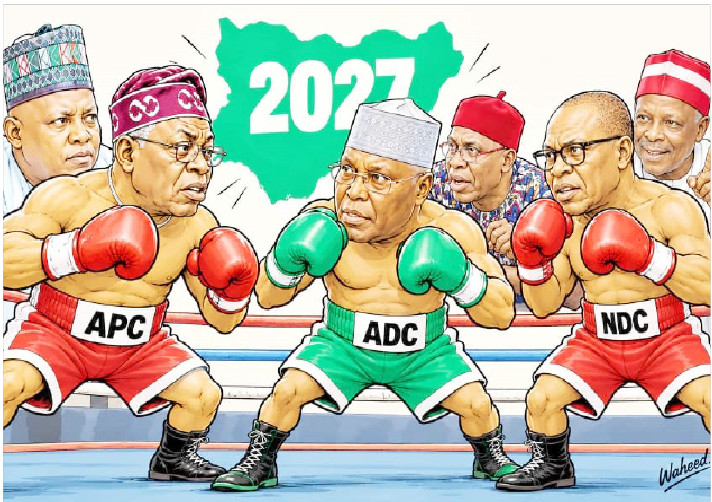
The ‘Rumble in the Jungle’ was a heavyweight championship boxing match on October 30, 1974, in Kinshasa, Zaire (now D. R. Congo), between undefeated and undisputed heavyweight champion George Foreman and Muhammad Ali.
We all know how it ended. It was one for the ages.
January 16, 2027, will be our own Rumble in the Political Jungle. Right now, we are in the season of internal wrangling in the political parties. After the nomination wars and INEC validation, gladiators have honed their claws to fight the customary internal battles to ensure that in the event of victory, they, too, will have something to celebrate. If you’re not relevant now, who will remember you when the party coasts home to victory?
APC
Internal squabbles across major political parties typically stem from leadership disputes, factional rivalries, candidate selection disputes, and regional power dynamics. I gave the example, in an earlier piece, of Delta State and how a former deputy senate president, Ovie Omo-Agege, left the ruling APC to find his fortunes in NDC.
His case typifies how politicians roam freely between the parties in pursuit of their interests. Omo-Agege started his political journey in the Peoples’ Democratic Party (PDP). From there, he moved to the Labour Party. After Labour, he joined the APC and was made the deputy senate president. He was reputed to be close to the then president, Muhammadu Buhari. But when his state governor, Rt Hon Sheriff Oborevwori, joined the ruling APC, it seemed the pond was no longer big enough to contain the two mammoth fishes. So, Omo-Agege bailed out to swim in the waters of NDC.
You can replicate that story regarding the fortunes of scores of politicians across all the parties.
In the APC, tensions have reportedly arisen between northern political factions and southern leadership. Key party figures have warned against internal contradictions where state-level stakeholders undermine governors or presidential interests.
With the near-wholesale defection of opposition governors and various regional potentates to the ruling APC, the party has been blessed with its expected share of crises regarding managing the unprecedented inflows. There have reportedly been tensions over rewards, appointments, and campaign office allocations between founding APC loyalists and newcomers.
On the larger plain, although in whispers, some disgruntled elements are criticising the various parallel organisations campaigning for the president on behalf of his son, Seyi ,and his wife, Remi. They argue that the resources being deployed by those two family members ought to have been given to the party to do the job.
When you scratch their argument a bit, you discover that all those critics really want is a piece of the action.
The noisiest rumble in the APC camp now is the self-styled rainbow coalition put together by the FCT minister, Nyesom Wike, to campaign for President Tinubu in Rivers State and the Federal Capital Territory. The tension between the APC leadership and the Progressive Governors’ Forum on the one hand, and Wike and his contraption on the other, is palpable.
Wike’s Rainbow Coalition is a cross-party political alliance to mobilise support across party lines for the re-election of President Tinubu in 2027. The coalition allows members—including PDP figures, APC factions, APGA, and other regional actors—to unite for President Tinubu at the presidential level while competing against one another under their respective party banners for other elective seats.
Because of his gruff and triumphalist style, Wike, though apparently devoted to the cause of Tinubu’s re-election, is viewed with suspicion and disdain. President Tinubu has deftly managed the situation so far, but in the run-up to the elections, a lot of fence-mending will have to be done so as to approach the elections as one team.
ADC
On their own part, the African Democratic Congress (ADC), together with former Vice President Atiku Abubakar and the broader opposition coalition associated with the party, face a series of complex internal, structural, and political challenges.
There is the problem of party discipline across state chapters, leading to localised crises, suspensions, and disputes over party hierarchy.
In addition, there is coalition friction—the problem of integrating diverse political interests, former PDP members, and third-force elements into a unified structure under the ADC platform. This is compounded by funding and logistics disputes: The party has faced intense public exchanges and media scrutiny regarding campaign logistics, venue access, and party administration.
Opponents have targeted the party’s operational health, alleging financial strain and salary issues among administrative staff—claims the ADC has vehemently denied. There is also the question about what ADC stands for, aside from being a vehicle to take Atiku to Aso Rock.
The ADC made its voice heard on the subsidy issue but does not seem to have alternative narratives on exactly how it will manage the economy differently if it wins the presidential election in 2027. Its messaging, so far, is disjointed. The party must balance criticising current economic realities with convincing voters that their platform offers a practical, distinct roadmap for national reform.
NDC
The internal wrangling surrounding Peter Obi and the Nigeria Democratic Congress (NDC) stems from the complex dynamics of merging distinct political factions, grassroots movements, and establishment leadership.
There is the Obi-Kwankwaso (OK) Movement, which has taken on the party hierarchy. The OK Movement openly criticised the composition and late release of the NDC’s Presidential Campaign Council list. Spokespersons for the movement questioned the party’s readiness, strategy, and organisational capacity, arguing that the leadership delayed deploying necessary campaign machinery.
Friction exists between the organic, decentralised grassroots support networks (the Obidient Movement and Kwankwasiyya structure) and the institutional leaders of the NDC.
Grassroots supporters often express concern that traditional party figures may marginalise the volunteer networks that drive Obi’s movement, leading to power struggles over campaign management and strategy.
Neither Peter Obi nor Rabiu Musa Kwankwaso can be solely blamed for the inability of NDC to integrate politicians from diverse backgrounds—such as former PDP, LP, NNPP, and ADC members—into a unified NDC structure.
There is real tension over conceptual differences. Should the NDC operate under a centralised command or as a mass movement? While the traditional party leadership favours a conventional top-down political hierarchy, Obi’s campaign ethos relies heavily on broad civic engagement and decentralised mobilisation.
Aligning these two contrasting approaches continues to cause operational friction within the coalition.
The other smaller parties have their own problems too. It is how those problems are addressed that will determine the eventual outcome.
ROPE-A-DOPE
If we can pinch a lesson from the Rumble in the Jungle in 1974, Mohammed Ali was fighting a man who could have literally decapitated him with one punch. He couldn’t adopt his usual float-like-a-butterfly style. He invented rope-a-dope.
Speaking metaphorically regarding the 2027 presidential elections, could social media and AI be the rope-a-dope combination that will define the contest?
We’ve got the edge. Get real-time reports, breaking scoops, and exclusive angles delivered straight to your phone. Don’t settle for stale news. Join LEADERSHIP NEWS on WhatsApp for 24/7 updates →
Join Our WhatsApp Channel