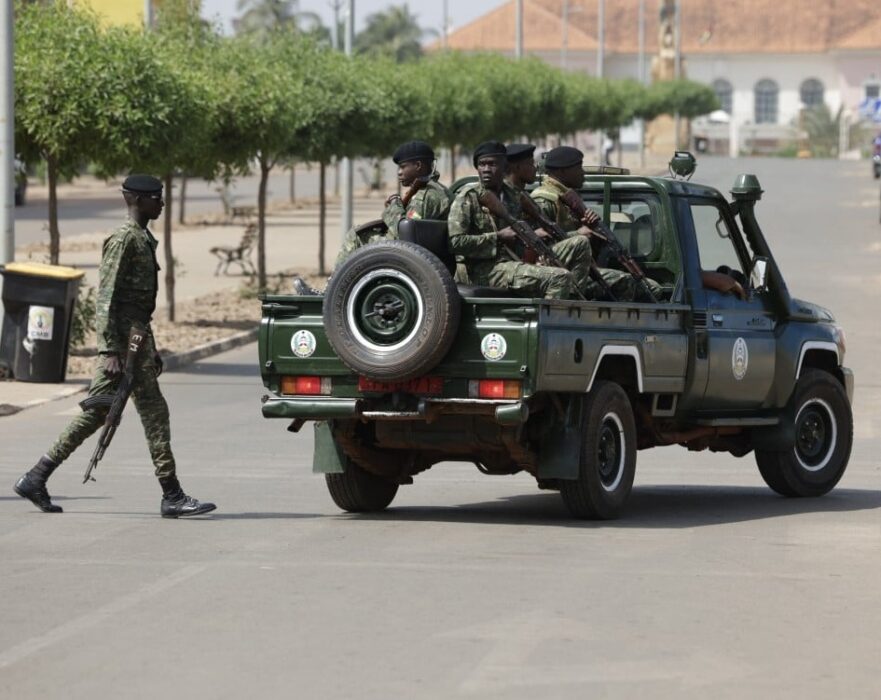
Africa and,indeed, the whole world woke up to the news of a regime change in Guinea-Bissau, where the military launched a forceful takeover of power midway through the presidential election process.
While citizens, election monitoring and observer teams comprising various leaders, including Nigeria’s former President Goodluck Ebele Jonathan, and the world at large, were waiting for the formal announcement of the presidential poll winner, the military, led by General Denis N’Canha, head of the presidential military office, struck.
Like Mali, Niger, Burkina Faso, Chad, Sudan, Guinea, Gabon, and Madagascar, Guinea-Bissau has fallen to anti-democratic forces, fueling fears about the possible receding, again, of democracy on the continent.
There are clear signs indicating that, after years of progress that were made leading to the collapse of militarism on the continent, democracy is at risk in Africa. The recent coup, which turned Guinea-Bissau into the ninth African country under military rule in the past four years, strongly supports these concerns.
Africa and indeed the world must rise to combat the continent’s gradual descent into militarism. Without prevarication, we believe that Guinea-Bissau’s situation arose because the continent, and indeed the world, appeared helpless when the military forcefully took over power in Sudan, Mali, Chad, Niger, and other countries.
The continent may elect to play the ostrich, for all its worth, but the signs are clear: the military takeover of power, which has been on a slow increase since 2020, is suggestive of the fact that the continent is relapsing to the days of coups, as witnessed in the decades after independence.
If the latest incident in Guinea-Bissau teaches us any lesson, it is that we should brace for more forceful takeover of power by the military of other countries, who may be emboldened by the brazen and unchallenged assault on democracy in these nine African countries.
The resurgence of coups on the continent makes us wonder whether democracy has failed, whether the world is helpless, and whether the African Union (AU) and the Economic Community of West African States (ECOWAS) have outlived their relevance. What is the world doing to address this troubling situation?
In fairness to them, the AU and ECOWAS have not minced words in condemning these coups and insisting on the restoration of democratic order. We recall that the AU suspended Mali, Guinea, Sudan and Burkina Faso. The ECOWAS issued a 7-day ultimatum to the Niger military junta and demanded that it released and reinstated President Mohamed Bazoum or face economic sanctions. Four years and counting, military regimes are still in place in these African countries, with the latest coup in Guinea-Bissau, extending the queue.
Although politics in Africa appear to have failed the people who languish in abject poverty, despite the continent’s rich mineral endowment and other potential, there is still no substitute for democracy. To that extent, we urge the global community to vehemently condemn the forceful takeover of power anywhere, under any justification.
While the world strives to ensure the restoration of full democratic structures in not only Guinea-Bissau but also in other African countries where the military has taken over power, concerted efforts must also be made to ensure credible elections that provide a platform for the voices of the people to be heard at all times.
Democracy in Africa is threatened by poor leadership in the midst of the ‘sit-tight’ attitude of leaders who have not only drifted far from public service but also consistently acted in ways that undermine the drive towards credible elections. Elections, as the hallmark of democracy, are not conducted transparently on the continent.
Increasingly, the continent is witnessing a steep increase in attacks on opposition leaders and a deliberate attempt to muzzle dissenting voices. This has far-reaching implications, including the potential for a gradual return to military rule, even though militarism is no better.
In our opinion, the continent’s regional bodies, critical stakeholders and indeed leaders across the globe must do all it takes to deepen democracy and accountable governance on the continent.
It is disheartening to note that, despite having the world’s most youthful population, Africa has become home to one of the world’s oldest and longest-serving leaders, who have needlessly stayed in power for decades without achieving anything tangible and despite being too old to withstand the challenges and rigours of modern-day governance.
We’ve got the edge. Get real-time reports, breaking scoops, and exclusive angles delivered straight to your phone. Don’t settle for stale news. Join LEADERSHIP NEWS on WhatsApp for 24/7 updates →
Join Our WhatsApp Channel