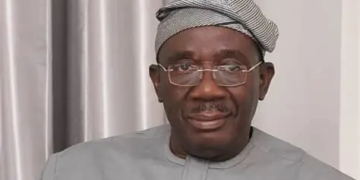

A Professor of Strategy and Development, Anthony Kila, has cautioned the Independent National Electoral Commission (INEC) to carefully consider the implications of its decision to delist the leadership of the African Democratic Congress (ADC) led by David Mark.
Kila gave the warning on Wednesday during an appearance on The Morning Brief on Channels Television.
“I think that when INEC decides to remove the name of the chairman and secretary of an opposition party, it should think about the consequences,” he said.
“You cannot claim technical correctness and ignore practical implications. That is not commonsensical—and I mean common sense in its real sense.”
According to him, decision-making should reflect reality and take into account likely outcomes rather than rely solely on technical justifications.
His comments follow INEC’s decision to stop recognising correspondences from both factions of the ADC—one led by Mark and the other by Rafiu Bala—after reviewing a Court of Appeal judgment delivered on March 12.
Kila, however, faulted the electoral body’s handling of the matter, stating that regardless of whether the situation arose accidentally or intentionally, “INEC is not doing well.”
Speaking further, he criticised the commission’s broader approach to electoral management.
“The other thing that needs to be said is this: INEC—so far, so bad. The way it is handling this issue reveals both structural and contingent problems. One relates to the institution itself, the other to how it is currently being managed,” he said.
He also argued that the commission often focuses on outcomes rather than process.
“One of the problems we have in this country is that we look at consequences instead of sequence. There is a flaw in the approach and process through which INEC operates.”
Kila maintained that INEC should function beyond being a mere announcer of decisions, stressing the need for consultation and stakeholder engagement.
“They should bring political parties together, consult, and jointly take decisions before acting,” he added.
Drawing comparisons with electoral bodies in other countries, Kila said effective institutions tend to operate with minimal public attention.
“In many countries we seek to emulate, electoral bodies are almost invisible. Their leaders are hardly in the spotlight because the system works efficiently.
“You only hear about them when something goes wrong. That is the standard we should aspire to,” he said.
In a statement signed by its National Commissioner and Chairman of Information and Voter Education, Mohammed Kudu, INEC said it would no longer engage with either ADC faction or monitor their meetings, congresses, or conventions pending the determination of the case before the Federal High Court.
The commission also announced the removal of Mark’s name from its official portal.
We’ve got the edge. Get real-time reports, breaking scoops, and exclusive angles delivered straight to your phone. Don’t settle for stale news. Join LEADERSHIP NEWS on WhatsApp for 24/7 updates →
Join Our WhatsApp Channel