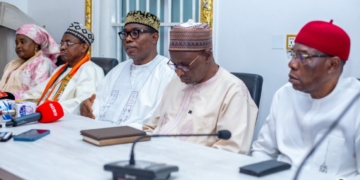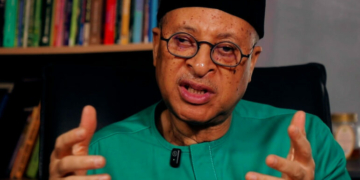

After years of political rivalry and shifting alliances, Rivers State is once again witnessing the return of two of its biggest political gladiators, Nyesom Wike and Rotimi Amaechi, to the trenches, setting the stage for another fierce battle for influence and control ahead of the 2027 election, writes ADEMU IDAKWO.
The political rivalry between former Rivers State governors Nyesom Wike and Rotimi Amaechi has entered another potentially decisive phase as the 2027 general elections draw nearer, with both men now on opposite sides of an emerging presidential contest.
Wike, the immediate past governor of Rivers State and Minister of the Federal Capital Territory, has thrown his weight behind President Bola Tinubu’s re-election bid. At the same time, Amaechi, his former political ally and one-time boss, is Atiku Abubakar’s running mate for the African Democratic Congress (ADC) presidential ticket.
Their rivalry, which dates back more than a decade, has survived changes of political parties, elections, court battles, political realignments and a succession crisis that shook the Rivers State government.
But the latest chapter has taken the contest to a new level.
On 5 September 2026, while Amaechi was in his hometown of Ubima for his mother’s burial, Dame Ezinne Mary Orduah Amaechi, Wike attended a civic reception in Omagwa, also within the Ikwerre Local Government Area.
Rather than allowing the occasion to pass without a political message, Wike used his speech to launch one of his most direct attacks yet on his former political ally.
“On election day, before 11 am, Amaechi will tell his people to boycott the election, knowing there’s no way he’ll defeat us,” Wike said.
“If he (Amaechi) wins his village, Ubima, then he has won the election. That’s if he wins his own polling unit,” he added.
Wike also dismissed the possibility of the former governor relying on security influence, recalling the political atmosphere surrounding previous elections.
“No more battalions of soldiers to be with him, no more battalions of police to be with him; it’s now that we, the battalion of people, will come out,” he said.
The remarks prompted an immediate response from the Rivers State chapter of the ADC, which accused the FCT minister of attempting to intimidate the opposition ahead of the election.
The state ADC chairman, Chukwudi Dimkpa, said elections were not won by political boasts or by announcing results before voting.
“Elections are not won by boasts, intimidation or by political strongmen announcing results in advance. Rivers people will vote, the votes will be counted, and INEC, not Wike, will declare the winner,” Dimkpa said.
He described Wike’s conduct at Omagwa as “political rascality taken too far”, alleging that the reception had been held along the same route as Amaechi’s mother’s funeral and had caused unnecessary traffic.
Dimkpa said the party deliberately refrained from responding to the provocation on the day of the burial because its attention was focused on the deceased.
“We refused to dignify the provocation with a response that day because we were focused on giving Mama, Dame Ezinne Amaechi, a fitting burial,” he said.
The ADC chairman added, “Wike should understand that Rivers State belongs to all of us. Nobody owns the people, nobody owns their votes, and certainly nobody can declare an election result by 12 noon.”
From Allies To Rivals
The rivalry is striking, as Wike and Amaechi were once political allies.
Wike served as Amaechi’s Chief of Staff during Amaechi’s tenure as governor of Rivers State, before he became Minister of State for Education under the Goodluck Jonathan administration.
Their political relationship later deteriorated as the battle for control of the Peoples Democratic Party’s Rivers State chapter intensified.
The disagreement was not merely personal. It was about who controlled the party structure, who determined candidates and who ultimately controlled the political machinery ahead of elections.
Before the 2015 election, the two men had become political rivals.
Amaechi had defected from the PDP to the All Progressives Congress, while Wike was the PDP candidate.
The election became an important test of whether Amaechi’s political structure could survive his departure from the PDP and whether Wike could build a machine strong enough to defeat the incumbent governor’s camp.
Wike Won Overwhelmingly
He polled 1,029,102 votes, representing 87.77 per cent, against APC candidate Dakuku Peterside’s 124,896 votes, or 10.65 per cent.
Wike’s winning margin was therefore 904,206 votes. The result established Wike as the dominant political figure in the state and demonstrated the strength of the PDP machinery he controlled at the time.
But the figures were from a governorship election in which Wike himself was a candidate. They do not automatically establish that he can replicate the same level of support for Tinubu in a presidential election 12 years later.
2019: Wike Consolidates His Machine
Four years later, Wike again demonstrated his electoral strength. In the 2019 governorship election, Wike secured 886,264 votes, accounting for 80.36 per cent of the valid votes.
His closest challenger, Biokpomabo Awara of the African Action Congress, received 173,859 votes, representing 15.76 per cent. Wike’s margin was therefore 712,405 votes.
The election was marred by controversy and violence, with voting disrupted in several areas before the process was completed and the results declared.
Nevertheless, the final figures reinforced Wike’s dominance of Rivers governorship politics.
In two consecutive elections, he won by enormous margins.
Those figures are now part of the argument advanced by Wike’s camp as the 2027 presidential election approaches. But the political equation has changed.
Wike is no longer seeking the governorship. Amaechi is no longer merely an opposition figure outside the state power structure.
The 2027 contest will also not be a straightforward PDP-APC contest. It will feature Tinubu and the APC facing a broader opposition field, including the ADC ticket of Atiku and Amaechi.
The question is whether Wike’s governorship-era machinery can be transferred to a presidential candidate who is not from Rivers State, and whether Amaechi can convert his longstanding political network into votes for the ADC.
2023: The Proxy Battle
The rivalry resurfaced during the 2023 gubernatorial election. By then, Wike had completed his second term and was backing Siminalayi Fubara as his successor.
Amaechi’s political camp, meanwhile, was linked to Tonye Cole, the APC candidate.
The election was consequently seen as another proxy contest between the two political camps.
Fubara won with 302,614 votes, compared with Cole’s 95,274.
The result again appeared to demonstrate the strength of the structure controlled by Wike.
But what followed Fubara’s emergence as governor would eventually create another major fracture in Rivers politics.
Wike And Fubara: The Succession Crisis
Fubara’s relationship with Wike deteriorated after Wike assumed office. The dispute centred on political control and the relationship between the governor and the political structure that had produced him. The disagreement escalated into a major political crisis in Rivers State, eventually leading to the suspension of the governor, his deputy and members of the state House of Assembly under the emergency rule imposed in March 2025.
The emergency administration lasted six months until the elected government returned.
Although Wike later declared that the political disagreement with Fubara had ended, the episode raised a significant question about the durability of the structure he had built.
Could Wike maintain control of the political network when the man he had installed as governor was no longer fully aligned with him?
That question is now relevant to the 2027 presidential election.
Wike’s current position is that he remains capable of mobilising the political forces needed to influence the election. He has also continued efforts to consolidate a broad political coalition in Rivers, including reconciliation with former political opponents and estranged allies.
Amaechi’s Return To The Centre
For Amaechi, 2027 marks a return to the centre of national politics after several years away from elective office.
He served as governor of Rivers from 2007 to 2015 and later as Minister of Transportation under President Muhammadu Buhari.
His decision to join the ADC and to become Atiku’s running mate has therefore altered the political calculation in Rivers.
Amaechi is no longer merely a former governor seeking to retain influence in his home state. He is now part of a presidential ticket aiming to defeat the incumbent president. That makes Rivers potentially important to both sides.
Wike wants to demonstrate that his political structure remains strong enough to deliver Rivers to Tinubu.
Amaechi wants to prove that his influence has endured years of political battles and that the ADC can challenge the established parties in a state where he once wielded enormous influence.
At the NBA conference in August, Amaechi offered a broad response to expectations surrounding his political comeback, telling Nigerians to judge the political team by its performance.
“If we can’t perform, don’t vote for us,” he said.
He also urged voters to judge political candidates by their capacity rather than by ethnic considerations.
There has been no direct public response from Amaechi to Wike’s 5 September remarks at Omagwa. However, his recent public position indicates that he intends to campaign on the opposition ticket’s performance and capacity rather than allow the contest to be reduced to a personal battle with Wike.
Wike’s Broader Attack On Amaechi
The 5 September confrontation was not an isolated attack. In the weeks leading up to it, Wike repeatedly questioned Amaechi’s political relevance and his ability to influence the 2027 election.
In August, Wike dismissed the suggestion that Amaechi’s emergence as Atiku’s running mate would be a major political advantage for the opposition.
He questioned Amaechi’s electoral value and argued that the former governor could not deliver for Rivers State, even while holding a powerful position within the Buhari campaign structure.
Wike has also repeatedly criticised Amaechi’s record as the transport minister.
In another recent attack, he questioned Amaechi’s suitability for the vice-presidential position, citing controversies surrounding the former governor’s administration in Rivers State.
The pattern is clear: Wike’s strategy is not merely to defeat Amaechi politically but to undermine the argument that Amaechi remains an electoral force in Rivers.
Amaechi, meanwhile, has increasingly positioned himself as part of a national opposition movement rather than confining his political message to his personal rivalry with Wike.
The Burial That Became Political
The burial of Amaechi’s mother perhaps provided the clearest illustration of how deeply the rivalry has penetrated Rivers politics.
Dame Ezinne Mary Orduah Amaechi, who died at 89, was buried in Ubima on 5 September.
The ceremony drew several prominent political figures, including former Vice President Atiku Abubakar and other senior opposition politicians.
Wike was absent from the burial, as was Governor Siminalayi Fubara.
Instead, Wike attended a civic reception in Omagwa, where he delivered his strongest public attack on Amaechi in recent weeks. The two events occurred in the same Ikwerre political environment, at a time when Amaechi’s political allies were gathering in his hometown to bury his mother.
The Rivers ADC subsequently accused Wike of deliberately using the occasion to provoke Amaechi’s camp. However, that allegation should be treated as the ADC’s position rather than as a fact.
What is not in dispute is that the competing political activities brought the longstanding Wike-Amaechi rivalry into the public eye at a moment that was supposed to be dominated by a family funeral.
Even the Catholic Bishop of Port Harcourt, Most Rev. Patrick Eluke, used the occasion to urge politicians to embrace peace, warning against turning elections into occasions of division and destruction.
Political Awareness May Favour Amaechi
Political analyst Dr. Paul John told LEADERSHIP Weekend that rising political awareness among Rivers voters could work in Amaechi’s favour in the 2027 election.
He said Amaechi’s emergence as the ADC’s vice-presidential candidate could give Rivers voters a stronger stake in the presidential contest, particularly because one of their own is seeking a national office.
“We have a stake in the coming election because our son is vying for a national position. But mind you, Wike is not a pushover. ADC needs to work hard and go the extra mile to upstage him because he is deeply rooted here,” John said.
The 2027 Test
The coming election will therefore be a test of political machinery as much as of personal popularity.
For Wike, the question is whether the political structure that delivered overwhelming victories in the 2015 and 2019 governorship elections remains intact after the Fubara crisis and years of political realignment.
For Amaechi, the question is whether his old network can be rebuilt into a functioning electoral machine within the ADC.
The battle may also reveal whether Rivers is entering a new era of competitive multipolar politics.
If Wike delivers a commanding victory for Tinubu, it would strengthen his claim to remain the dominant political force in Rivers and validate his decision to align with the president.
If Amaechi secures a substantial share of the Rivers vote for the ADC, it would challenge the assumption that Wike’s structure remains unassailable and demonstrate that Amaechi’s political network still holds electoral value.
The Wike-Amaechi confrontation is therefore more than a personal rivalry between two former governors.
Ultimately, it is a battle over who still has the organisational capacity to move Rivers voters when the ballot is placed before them.
We’ve got the edge. Get real-time reports, breaking scoops, and exclusive angles delivered straight to your phone. Don’t settle for stale news. Join LEADERSHIP NEWS on WhatsApp for 24/7 updates →
Join Our WhatsApp Channel