Former director-general of the Nigerian Maritime Administration and Safety Agency (NIMASA), Temisan Omatseye, has explained that the $350 million Cabotage Vessel Financing Fund (CVFF) was converted into naira rather than retained in dollars, exposing its value to the impact of exchange rate depreciation.
NIMASA, Navy Renew Pact To Tackle Emerging Maritime Security Threats
Replace Rickety Trucks, Barges Through Maritime Fund, Amiwero Urges NIMASA
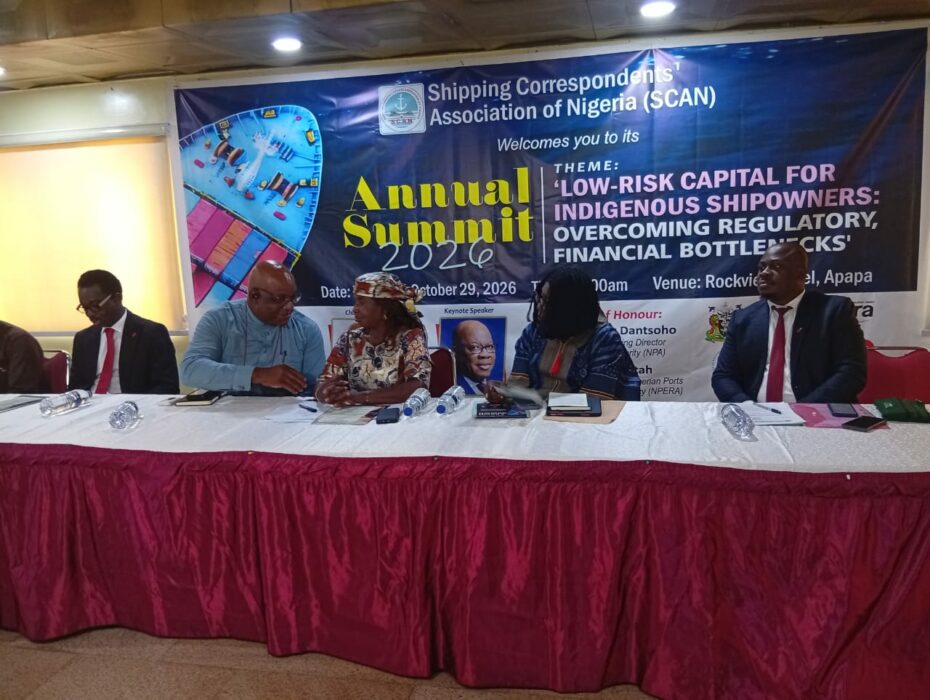
Omatseye, who was chairman of the 2026 Annual Summit of the Shipping Correspondents Association of Nigeria (SCAN), said the decision to convert the funds into naira was driven by the opportunity to earn significantly higher interest rates in the domestic market than was available on dollar deposits internationally.
Speaking at the summit, themed, “Low-Risk Capital for Indigenous Shipowners: Overcoming Regulatory and Financial Bottlenecks,” held in Apapa, Lagos, he explained that while interest rates in Nigeria stood between 23 and 25 per cent at the time, dollar-denominated investments offered interest rates of about one to two per cent.
The CVFF is a maritime financing scheme established to support indigenous shipowners in acquiring vessels and expanding their capacity to participate in coastal and inland shipping.
NIMASA is the regulatory agency responsible for regulating indigenous shipping in Nigeria, alongside its broader mandate to promote maritime safety, security and shipping development.
The fund has remained a major issue in Nigeria’s maritime sector, with indigenous shipowners seeking access to affordable, long-term financing to acquire vessels, create jobs and increase local participation in the country’s shipping trade.
However, Omatseye’s remarks underscore the importance of transparency in accounting for the fund, particularly in explaining its current balance, investment returns, currency exposure and the difference between its historical dollar valuation and its present value.
The clarification also raises questions about the need for clear public reporting on the fund’s financial position, including the amount accumulated, interest earned, exchange rate implications and the resources available for disbursement to qualified indigenous shipowners.
According to him, the strategy was to convert dollar receipts from the CVFF into naira to take advantage of the higher returns available in the domestic financial market.
He, however, said the subsequent depreciation of the naira significantly affected the dollar-equivalent value of the fund, warning that the original $350 million valuation could not be assumed to remain unchanged because the money was held in the local currency.
Omatseye said, “Interest rate at that time was quite high, 23 per cent, 24 per cent, 25 per cent. And interest rate in dollars was about one or two per cent. Dollar interest rate is very, very low internationally.
“So we could easily have kept the money in the dollar and just ended at one or two per cent interest rate. But for a reason best known to them, they said we cannot hold the money in dollars.
“They said because we are earning better interest rates in naira, every time we receive the money in dollars, we converted it to naira and earned a better interest rate on it.”
“But at the time, every last week of the month, when we do a sweep, we collect dollars, automatically change it to Naira. And all the money is placed in Naira. And then whatever Naira is at the date of exchange with us at that time.
“So if the exchange rate is $1,350 today, whatever Naira is there is what you exchange that. So you cannot be looking at $350 million as of 2019 to be the same $350 million today, because the money is held in Naira.”
The former NIMASA chief said the fund’s management practice involved converting dollar receipts into naira, with the proceeds placed in local currency accounts to earn higher interest.
He noted that the depreciation of the naira in 2023 changed the financial implications of the arrangement, making it difficult to equate the naira balance with the original dollar value of the fund.
“So every money collected in CVFF of three per cent is converted to naira, which was okay because we were earning 25 per cent. Guess what happened in 2023? Naira depreciated. So you cannot expect the naira we had at $179 at that time, which was $350 million, to be the same today,” he said.
Omatseye urged stakeholders to distinguish between the historical dollar valuation of the CVFF and the value of the naira-denominated funds at prevailing exchange rates.
He explained that the amount available in naira would have to be converted at the prevailing exchange rate to determine its current dollar equivalent, rather than relying solely on the original $350 million figure.
“When you guys speak of $350 million, CVFF is not held in dollars. It’s in naira, and at the present exchange rates, keep your realistic eye,” he said.
He added that the value of the fund in dollar terms would depend on the applicable exchange rate and the actual naira balance, noting that any increase in the fund’s nominal value would need to be established through verifiable records.
Omatseye further explained that the funds were routinely swept into naira accounts, with the conversion taking place at the exchange rate applicable at the time.
“So, at the time, every last week of the month, when we do a sweep, we collect dollars, automatically change it to naira. And all the money is placed in naira. And then whatever naira is at the date of exchange with us at that time,” he said.
Using the prevailing exchange rate as an illustration, he said the dollar value of the fund would be determined by converting the available naira balance at the rate applicable at the time of assessment.
He maintained that the original dollar valuation could not be used as a direct measure of the fund’s current worth without considering the currency in which the money was held and the effect of depreciation.
We’ve got the edge. Get real-time reports, breaking scoops, and exclusive angles delivered straight to your phone. Don’t settle for stale news. Join LEADERSHIP NEWS on WhatsApp for 24/7 updates →
Join Our WhatsApp Channel