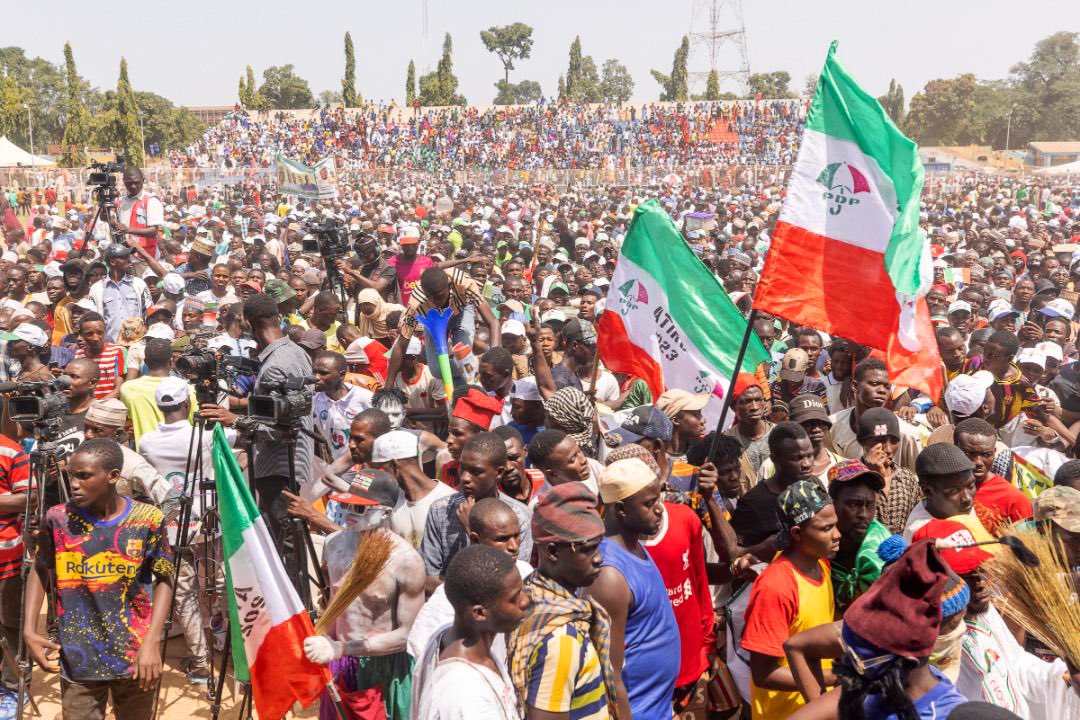
Nigeria’s 2027 presidential campaign officially begins, setting in motion another contest for the country’s most powerful political office. With the campaign season now open, Nigerians should demand something fundamentally different from what has too often passed for electoral politics: a contest of ideas, programmes and competence rather than a spectacle built around personalities, defections, ethnic calculations and religious mobilisation.
Nigerians are confronting one of the most difficult times in the nation’s history with cost-of-living crisis, insecurity, unemployment and inadequate electricity, and public confidence in political institutions at its lowest ebb. President Bola Tinubu’s administration will naturally seek to defend its record and persuade voters that its reforms require more time. On the other hand, the opposition will seek to convince Nigerians that the government has failed and deserves to be replaced. Both positions are legitimate in a democracy. What Nigerians should reject is a campaign in which accusations and slogans substitute for credible alternatives. Unfortunately, they have started. Both the ruling party and the opposition political parties are shifting the narratives to the most familiar frames – region, religion and personalities.
The issue is not whether the APC or the opposition are entitled to win elections. Both are. Nor should we avoid talking our identities or the personalities that formed these identities or legitimate political defections be prohibited. The concern is how political actors weaponized these to become campaign issues. Political parties should therefore publish their manifestos early and make them sufficiently detailed for public scrutiny. Nigerians deserve to know not just what candidates promise, but how they intend to finance those promises, when they intend to implement them and how their performance can be measured. A presidential manifesto should not be a collection of attractive phrases unveiled shortly before voting. It should be a contract of sorts with the electorate, containing clear priorities, timelines and measurable targets.
The parties and candidates should also be held to the commitment they made in the National Peace Accord signed ahead of the commencement of campaigns. Several presidential candidates, including Peter Obi and Omoyele Sowore, signed the accord, while President Tinubu was represented by the Secretary to the Government of the Federation, George Akume. The agreement commits political actors to peaceful and issue-based campaigns.
But a peace accord must be more than an annual ritual. Indeed, the criticism that such agreements can become symbolic gestures deserves serious consideration. If political actors violate the agreement through incitement, violence or inflammatory rhetoric, what happens next? Who investigates? Who determines responsibility? What sanctions apply? INEC, security agencies, political parties and civil society organisations should answer these questions before the campaign degenerates into another cycle of accusations and violence.
The same principle applies to the broader question of electoral competitiveness. The APC now controls 31 of Nigeria’s 36 states following a succession of political defections. While politicians are constitutionally entitled to change parties, such overwhelming concentration of political power should concern everyone who values competitive democracy.
This places an enormous responsibility on the Independent National Electoral Commission. The commission must protect the credibility of the vote, including the integrity of the Bimodal Voter Accreditation System, transparent result management and strict enforcement of electoral rules. The technological improvements introduced into Nigerian elections should not become objects of political suspicion; they should become instruments of public confidence. Every political party should know that it can win or lose through a process whose rules are transparent and consistently enforced.
The campaign must also address vote-buying and opaque campaign financing. Nigerians should not be reduced to electoral commodities through cash handouts or so-called empowerment programmes designed primarily to secure political loyalty. INEC and other relevant institutions must enforce campaign-finance rules and demand greater transparency in the sources and expenditure of campaign funds.
Above all, Nigerians deserve to hear the presidential candidates’ debate where the future of the country is thoroughly discussed. Rallies provide theatre; controlled media appearances provide talking points. Neither is a substitute for serious scrutiny. Major presidential candidates should commit themselves to live, substantive and unscripted debates in which they answer questions on the economy, insecurity, education, jobs, electricity, federalism and institutional reform.
The media also has a responsibility. It must resist becoming an amplifier of ethnic and religious propaganda, fabricated information and personality cults. The electorate needs journalism that interrogates manifestos, checks claim and compares competing policies rather than simply reproducing campaign rhetoric.
The 2027 election should therefore be more than a referendum on President Tinubu or a contest among opposition personalities. It should be a national conversation about what kind of Nigeria citizens want and which candidate has the most credible plan for building it.
The campaign has begun. The political class will ask Nigerians for their votes. Nigerians should first ask the political class a more important question: What exactly will you do with the power you are asking us to give you?
We’ve got the edge. Get real-time reports, breaking scoops, and exclusive angles delivered straight to your phone. Don’t settle for stale news. Join LEADERSHIP NEWS on WhatsApp for 24/7 updates →
Join Our WhatsApp Channel