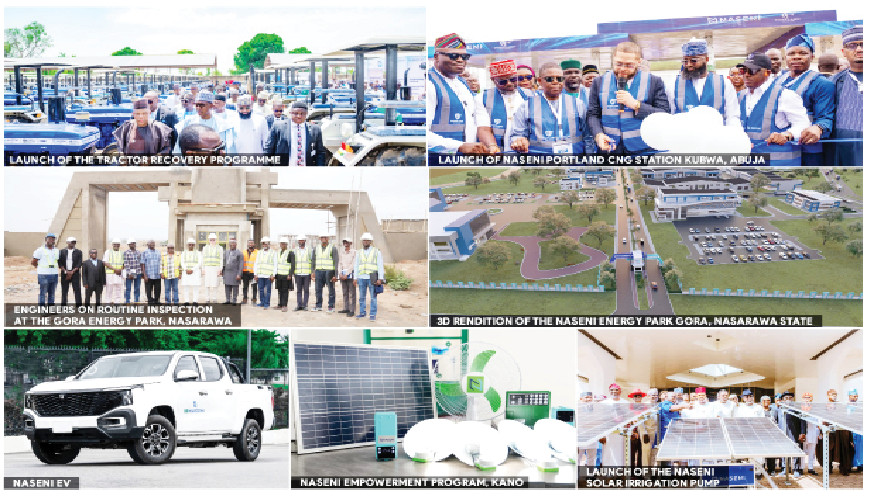
As President Bola Ahmed Tinubu GCFR marks his third year in office on 29th May, 2026, one of the recurring themes of his administration has been the push for industrialisation, local production and technological self-reliance under the Renewed Hope Agenda. At the centre of that drive is the National Agency for Science and Engineering Infrastructure (NASENI), an Agency under the Presidency that has increasingly moved many research-outcomes to market-oriented industrial interventions.
For decades, Nigeria’s industrial policies have revolved around reducing import dependence, encouraging local manufacturing, boosting small and medium-scale enterprises, and strengthening technological capability. From the National Industrial Revolution Plan to more recent local content and technology transfer initiatives, implementation has often remained the major challenge.
Under the Tinubu administration, NASENI has emerged as one of the institutions bridging the obvious gaps between policy formulation and practical industrial execution. The Agency, led by its young Executive Vice Chairman/Chief Executive Officer, Khalil Suleiman Halilu, has aligned many of its programmes with the administration’s economic diversification agenda, focusing on energy, agriculture, manufacturing, technology transfer and innovation.
President Tinubu incidentally is the Chairman, Governing Board of NASENI. He has repeatedly acknowledged the Agency’s growing role in driving industrial and socio-economic development. In marking his second year in office in 2025, the President commended NASENI’s “high impact projects and programmes” during the president’s broadcast, which according to him, were steering Nigeria towards socio-economic transformation.
One of the major shifts under the current NASENI Management is the transition from prototype development to commercialization. The Agency’s leadership describes this approach through the “3Cs” initiative of — Creation, Collaboration and Commercialization — aimed at ensuring that locally developed innovations move beyond laboratories into the market.
In practical terms, NASENI has introduced more than 44 market-ready products, including locally assembled laptops, tablets, smartphones, solar streetlights, clean energy cookstoves, electric tricycles, electric vehicles, water dispensers and air conditioners, etc.. The Agency argues that these products are part of a broader import-substitution strategy intended to conserve foreign exchange while building domestic industrial capacity.
Energy security has also become a major area of intervention. As Nigeria pushes alternative energy adoption, NASENI established two Compressed Natural Gas (CNG) Reverse Engineering Centres in Abuja to support vehicle conversion and local manpower development in CNG systems. NASENI is also developing a 40-hectare Solar Industrial Park in Gora, Nasarawa State, projected to become one of Africa’s largest renewable energy manufacturing hubs for solar panels, batteries and related components.
Such interventions align with Nigeria’s ongoing efforts to reduce dependence on imported energy technologies while promoting cleaner energy alternatives. Beyond infrastructure development, the local manufacturing of renewable energy components could help lower production costs and stimulate local supply chains.
In healthcare manufacturing, NASENI has established the NASENI-Troment Biotechnologies Rapid Diagnostic Kits production plant in Abuja. The facility has the capacity to produce up to 600 million rapid diagnostic kits annually, potentially reducing Nigeria’s dependence on imported diagnostic products and strengthening local health manufacturing capacity.
Agriculture and food security remain another major pillar of the Agency’s interventions. Through the Irrigate Nigeria Project, NASENI has deployed solar-powered irrigation systems targeted at enabling all-season farming for smallholder and large holder farmers. The Agency’s climate-resilient hydroponic (soilless) farming initiative in Lafia produced over 17 tonnes of vegetables including tomatoes, cucumbers and lettuce within its first year.
To deepen mechanised agriculture, NASENI is expanding Agricultural Machinery Equipment Development Institutes (AMEDI) across the six geopolitical zones while also establishing Agricultural incubation centres in tertiary institutions to support research and mechanisation.
These programmes are particularly significant at a time Nigeria faces rising food inflation, climate-related agricultural challenges and rural unemployment. According to development experts, the integration of renewable energy, mechanisation and innovation into agriculture could improve productivity while creating jobs along agricultural value chains.
On employment generation, NASENI estimates that its projects and skill acquisition programmes have facilitated more than 30,000 direct and indirect jobs. Part of this effort includes the revival of abandoned tractors through its National Asset Restoration Programme as well as local manufacturing initiatives tied to cooking stoves and clean energy products.
The Agency has also expanded youth-focused innovation programmes such as Innovate Naija, FutureMakers and DELT-Her, the latter being an initiative aimed at supporting women in engineering and technology through mentorship, grants and commercialization support. Technology and innovation stakeholders say such interventions are important for building a sustainable innovation ecosystem capable of producing indigenous solutions.
NASENI’s growing collaboration with other government institutions has also drawn attention. The agency signed over 50 Memoranda of Understandings (MoU) with public and private sector partners, including an agreement with the Bureau of Public Procurement to promote locally made products under the “Nigeria First Policy”.
The partnership, according to NASENI, will contribute to government savings running into billions of naira through local procurement and reduced import dependence. The Agency estimated that over ₦173 billion was saved between January and June 2025 through local price intelligence and procurement support.
Security and defence manufacturing have equally featured in the Agency’s activities. NASENI intensified collaboration with the Defence Industries Corporation of Nigeria (DICON) and the Department of State Services (DSS) towards local ammunition production and defence technology support. The efforts reflect Nigeria’s growing interest in strengthening domestic defence production capacity amid evolving security challenges.
While the interventions are promising, the long-term success of Nigeria’s industrialisation agenda will depend on consistency, funding, institutional coordination and the ability to scale projects beyond pilot stages. The need for stronger private sector participation, improved infrastructure and policy stability to sustain industrial growth will ensure agencies like NASENI achieve maximum impact for stable macroeconomic conditions and stronger manufacturing ecosystems.
Still, there is increasing acknowledgement that NASENI has become more visible within Nigeria’s industrial landscape under the current administration. The Agency’s shift towards product commercialization, local manufacturing and innovation-driven development has attracted recognition from both public institutions and industry groups. Leadership Newspapers named NASENI Environmental Impact Agency of the Year 2025, while Halilu also received honours for Outstanding Service in Innovations and Reforms from New Telegraph Newspaper and African Young Leadership award from Ghana-based African Leadership Magazine.
The broader lesson from NASENI’s recent trajectory is that industrial policy requires institutions capable of translating government policy ambitions into practical outcomes. While challenges remain, analysts say the Agency’s activities over the last three years provide insight into how science, engineering, innovation and local manufacturing can contribute to economic development when linked directly to national priorities.
As Nigeria continues to confront unemployment, import dependence and infrastructure deficits, stakeholders say the future focus must remain on scaling indigenous production, supporting research commercialization, expanding technology transfer and deepening local capacity development. Halilu himself recently summed up the Agency’s direction when he said: “At NASENI, our mandate is clear; move Nigeria from consumption to creation.”
We’ve got the edge. Get real-time reports, breaking scoops, and exclusive angles delivered straight to your phone. Don’t settle for stale news. Join LEADERSHIP NEWS on WhatsApp for 24/7 updates →
Join Our WhatsApp Channel