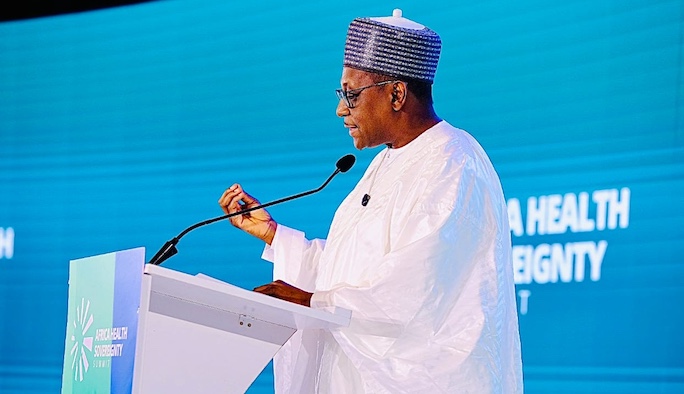
By Muhammad Ali Pate
The global economy is changing in ways that are easy to underestimate. For much of the last century, economic leadership rested on natural resources, manufacturing and, later, information technology. Today, another source of advantage is emerging. The convergence of health, artificial intelligence, biotechnology, data and digital technologies is creating new industries, attracting investment and reshaping how countries compete.
The implications extend beyond healthcare. Advances in artificial intelligence, genomics, biotechnology, digital diagnostics and health data are transforming scientific research, pharmaceutical development, advanced manufacturing and public services. Governments increasingly regard these capabilities as drivers of industrial growth, scientific advancement and long-term competitiveness.
The countries making the greatest progress are not necessarily those with the largest health budgets, but those that recognise that scientific progress depends as much on sound governance as on technology. Discovery flourishes where data are reliable, regulation is predictable and policy is consistent. Transformative industries grow where research, enterprise and investment reinforce one another.
Nigeria has reached such a moment. The question is no longer whether this transition will influence economic growth, but whether Nigeria will help shape that future or remain principally a consumer of technologies, standards and products developed elsewhere.
Against that backdrop, the Nigeria Health Sector Renewal Investment Initiative (NHSRII) is strengthening the governance, productive capacity and digital foundations of the health sector. President Bola Ahmed Tinubu’s decision to approve the establishment of the National Health Technology and Data Analytics Office at a time when health technology, artificial intelligence and data were moving rapidly from the periphery of health policy to the centre of economic strategy was an act of anticipatory statecraft. It gives Nigeria an institutional platform from which to engage an economic frontier whose significance is only beginning to unfold.
Lessons from Economic History
Countries rarely become leaders in emerging industries by chance. Those that do usually recognise structural change early enough to shape the conditions around it: infrastructure, regulation, skills, institutions and access to capital. Governments cannot determine which firms will succeed, but they can determine whether domestic enterprise enters a new market from a position of strength or does so only after the standards, technologies and value chains have been established by others.
Nigeria’s own experience bears this out. Crude oil transformed the country’s economic prospects, but the extent to which that wealth translated into wider development depended on the quality of policy, governance and investment that followed. Telecommunications offers a
clearer example. The reforms that expanded access to communications did more than connect millions of Nigerians; they created the infrastructure, regulatory confidence and market scale on which financial technology, electronic commerce, software development and digital media subsequently grew.
The technologies that reshape economies often begin within a particular sector before extending far beyond it. Railways altered commerce, electricity reorganised production and telecommunications transformed finance. Health technology is following a similar path, connecting healthcare with scientific research, biotechnology, advanced manufacturing, data infrastructure and artificial intelligence.
Nigeria now stands at such a point. The decisions taken while this field is still developing will determine whether the country converts its scale and scientific potential into knowledge, companies and intellectual property that create value at home and compete abroad.
Why This Moment Matters for Nigeria
Nigeria enters this transition with considerable advantages. It has Africa’s largest population, one of the continent’s largest healthcare markets, a rapidly expanding digital economy and a technology sector with growing regional influence. Its scale creates demand, while its youthful workforce, research institutions and entrepreneurial culture provide the capacity from which new industries can grow.
The Nigeria Health Sector Renewal Investment Initiative provides the framework for converting those advantages into sustained value. Reforms in primary healthcare, health insurance, human resources, regulation, digital systems and domestic manufacturing are strengthening the conditions within which new technologies can be developed, tested, financed and deployed at scale.
The Presidential Initiative for Unlocking the Healthcare Value Chain is expanding domestic production and attracting investment, while the National Digital Health Architecture is establishing the basis for interoperable systems and more effective use of health data. Nigeria has also demonstrated its capacity to develop digital health solutions with relevance beyond its borders. The Surveillance Outbreak Response Management and Analysis System, first developed in Nigeria and now used in several countries, is one example. The continued expansion of the District Health Information System reinforces the foundation for reliable data and better decision-making across the health sector.
Scientific and regulatory capability is advancing alongside these digital foundations. Clinical research is expanding, regulatory institutions are becoming more capable and reforms across the healthcare value chain are supporting the production of pharmaceuticals, diagnostics and medical products. Nigeria’s wider technology sector adds expertise in payments, software, logistics and digital platforms that can increasingly be applied to healthcare.
The National Health Technology and Data Analytics Office provides strategic coordination across health data, artificial intelligence, research and technology policy. Greater alignment across research, regulation, digital infrastructure, manufacturing, finance and service delivery will convert Nigeria’s scale into competitive advantage, and that advantage into products, platforms and enterprises that can compete across Africa.
Nigeria’s Place in Africa’s Health Technology Future
Nigeria’s opportunity extends beyond meeting domestic demand. Its population provides the scale, while its scientific institutions and technology sector provide the capability to develop, test and refine products before taking them to wider African markets.
Solutions built within Nigeria’s health system must contend with questions of affordability, logistics, infrastructure, geography and disease burden that are common across much of the continent. Firms that succeed under these conditions will possess knowledge and experience of considerable value in other African markets.
The African Continental Free Trade Area expands that opportunity by creating a larger commercial space for investment, production and trade. Access to those markets will depend on trusted regulation, interoperable standards, reliable data and the capacity to manufacture and deliver at scale. The reforms already under way in digital health, research, regulation and domestic production are reinforcing those capabilities.
Nigeria should therefore aim beyond becoming Africa’s largest market for health technologies. Its research institutions, manufacturers and technology firms can help shape the products, platforms and standards that serve the continent. That position would bring export earnings, investment, scientific partnerships and skilled employment, while deepening national capability across the wider economy.
– Prof Muhammad Ali Pate, CON, is the Coordinating Minister of Health and Social Welfare, Federal Republic of Nigeria.
We’ve got the edge. Get real-time reports, breaking scoops, and exclusive angles delivered straight to your phone. Don’t settle for stale news. Join LEADERSHIP NEWS on WhatsApp for 24/7 updates →
Join Our WhatsApp Channel