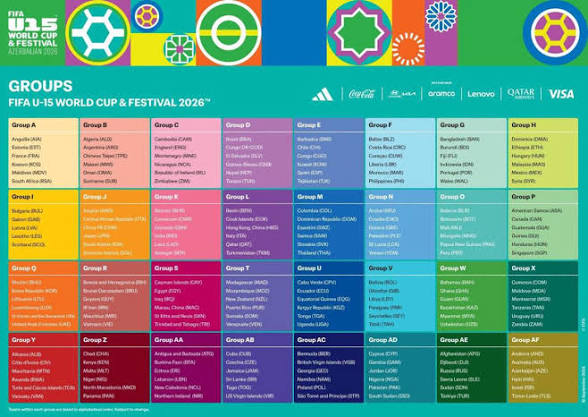
Nigeria will face Cyprus, Gambia, Jordan, Pakistan and South Sudan in Group GD of the inaugural FIFA U-15 World Cup & Festival 2026™, scheduled to take place in Azerbaijan from 24 to 30 October.
The tournament marks a major expansion of FIFA’s youth competitions, with all FIFA Member Associations eligible to participate following a decision by the FIFA Council in December 2025.
The maiden boys’ edition will bring more than 3,000 young players, coaches and officials to Baku, where almost 1,000 matches will be played across six matchdays.
Nigeria’s Group GD campaign will form part of an innovative tournament designed to give young players from countries with different football traditions regular international competition and exposure.
The competition will be played in an 8-a-side format, with matches consisting of two 20-minute halves. Each team will have 14 players and up to six staff members, while eligible players must have been born in 2011 or 2012.
Teams will initially compete in a round-robin qualification phase, playing four or five matches. Their results will determine their placement in one of six performance tiers for the second phase.
Unlike conventional youth tournaments, every participating team will continue playing until the final matchday, ensuring that all players receive a sustained competitive experience.
The winners of each tier will be crowned, with the Tier A winners becoming the FIFA U-15 World Cup & Festival champions.
FIFA Chief of Global Football Development Arsène Wenger said the tournament was created to address the disparity in international opportunities available to young players around the world.
“Talent exists everywhere, but young players do not always have the same opportunities to test themselves internationally,” Wenger said.
“This tournament is about providing them with that opportunity. By bringing teams from across the world together at U-15 level, we can give players meaningful matches, expose them to different styles and football cultures, and help them learn and develop through competition.”
Wenger also highlighted the wider developmental and cultural benefits of bringing young footballers from different countries together.
“Football can truly unite the world in a very powerful way at youth level,” he added. “Bringing young players together from different countries and cultures gives them an experience that goes beyond competition.”
The matches will be staged primarily at the Hovsan Competition Complex, which will accommodate up to 20 simultaneous games across multiple pitches. The opening match and the tier finals on 30 October will be played at the iconic Crystal Hall in Baku.
The tournament’s pitch dimensions will be 68m by 47m, while full-size goals measuring 7.32m by 2.44m will be used.
FIFA said the fixture schedule has been designed to balance competitive intensity with player welfare, with up to 10 matches scheduled per pitch each day.
The tournament also represents a new pathway for nations that traditionally find it difficult to qualify for FIFA competitions, allowing them to benchmark their youth programmes against teams from around the world.
The inaugural boys’ tournament will be followed by a girls’ edition in 2027, while FIFA plans to stage both competitions annually from 2028.
About 250 volunteers are expected to support the organisation of the Azerbaijan tournament, with the volunteer programme launched on 10 September by FIFA and the Association of Football Federations of Azerbaijan.
Azerbaijan’s selection as host also provides continuity ahead of the country’s role as co-host of the FIFA U-20 World Cup 2027™.
We’ve got the edge. Get real-time reports, breaking scoops, and exclusive angles delivered straight to your phone. Don’t settle for stale news. Join LEADERSHIP NEWS on WhatsApp for 24/7 updates →
Join Our WhatsApp Channel