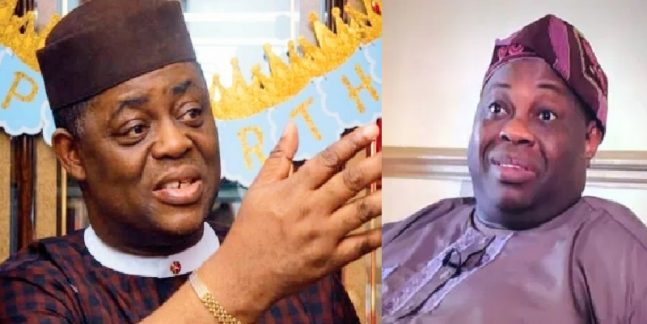
In healthier democracies, political disagreement sharpens ideas. In Nigeria, it increasingly sharpens tongues. The recent public spat between Dele Momodu, a veteran journalist, and Femi Fani-Kayode, a former minister, and ambassador -designate is less a clash of intellect than a descent into rhetorical amalarism. It is a spectacle—sore, sordid and shameful—that reveals more about the state of Nigeria’s political culture than about the men themselves. A roforofo gbasgbos by two self acclaimed Omoluabis.
At first glance, the quarrel appears ideological. Mr Momodu accuses President Bola Tinubu of authoritarian tendencies, invoking the dark memory of military rule as a cautionary parallel. Mr Fani-Kayode, now a loyal defender of the president, who just yesterday was a rabid tormentor of the same man, rejects the analogy as reckless and unfounded. This is, in principle, a legitimate disagreement. Democracies depend on such tensions: sceptics warn against excess; loyalists defend continuity.
Yet what should have been a contest of ideas quickly degenerates into something far less edifying. Mr Fani-Kayode’s rebuttal abandons argument for assault. His prose is littered with personal derision, theological absolutism and class-inflected sneers. Mr Momodu, for his part, responds in kind, trading critique for insult and replacing analysis with anecdote. The exchange collapses into a theatre of mutual contempt.
This is not dialectics. It is decay.
The tragedy lies not merely in the tone but in the squandered opportunity. Nigeria stands at a delicate juncture. Economic reforms are biting; public patience is thin; democratic institutions are under strain and many are being maimed by terrorists. A serious debate about the nature of power under Mr Tinubu—its limits, its excesses, its intentions—would be both timely and necessary. Instead, the public is served a diet of invective, gutterism, and shame.
Such conduct carries consequences. Political language is not neutral; it is formative. When prominent figures normalise abuse as discourse, they legitimise it as practice. Young Nigerians watching this exchange are not learning how to argue; they are learning how to insult. The lesson is corrosive: that politics is not a marketplace of ideas but a battleground of egos, where volume substitutes for substance.
There is also a deeper institutional malaise at work. Nigerian politics has long been personal rather than ideological. Parties are loose coalitions, not coherent philosophies. Loyalty is fluid; conviction is negotiable. In such a system, debate naturally gravitates toward personality rather than policy. The Momodu–Fani-Kayode affair is merely a vivid symptom of this structural deficiency.
Yet even by Nigeria’s robust standards of political theatre, this episode feels particularly debasing. Both men are products of privilege and exposure. They have traversed the corridors of media, power and influence. They understand, or ought to understand, the weight of their words. That they choose instead to indulge in public mudslinging suggests not ignorance but abdication.
The damage is subtle but real. Democratic culture is not sustained by elections alone; it depends on norms—civility, restraint, respect for dissent. When these erode, the system hollows out from within. What remains is a performative democracy, loud but shallow, vibrant but vacuous.
There is, of course, an audience for such spectacle. Outrage travels faster than reason; insult is more shareable than nuance. In the attention economy, provocation is profitable. But what is popular is not always what is healthy. A polity fed on constant outrage becomes desensitised to substance.
The irony is that both protagonists claim, in their own ways, to act in Nigeria’s interest. Mr Momodu casts himself as a defender of democratic memory; Mr Fani-Kayode as a guardian of political stability. Yet in abandoning reasoned argument, both undermine the very causes they profess to serve. Democracy is not defended by exaggeration, nor is it preserved by intimidation.
What, then, would a more constructive exchange have looked like? It would have interrogated policy rather than personality. It would have tested the analogy between civilian governance and military dictatorship with evidence, not emotion. It would have acknowledged complexity: that power can be both reformist and overreaching, both necessary and dangerous. Above all, it would have treated disagreement not as heresy but as a civic duty.
Nigeria deserves such conversations. Its citizens, especially its young, deserve better exemplars. Public figures need not agree; indeed, they should not. But they must argue as though the health of the republic depends on it—because it does.
For now, however, the country is left with a cautionary tale. When those entrusted with shaping public discourse choose spectacle over substance, they do more than embarrass themselves. They diminish the very idea of politics as a noble endeavour.
And in a nation already grappling with profound challenges, that is a luxury it can ill afford.
For Dele- Fani, it is an open sore to our collective resolve as a people. You exude shame.
Shamefully musing
We’ve got the edge. Get real-time reports, breaking scoops, and exclusive angles delivered straight to your phone. Don’t settle for stale news. Join LEADERSHIP NEWS on WhatsApp for 24/7 updates →
Join Our WhatsApp Channel