
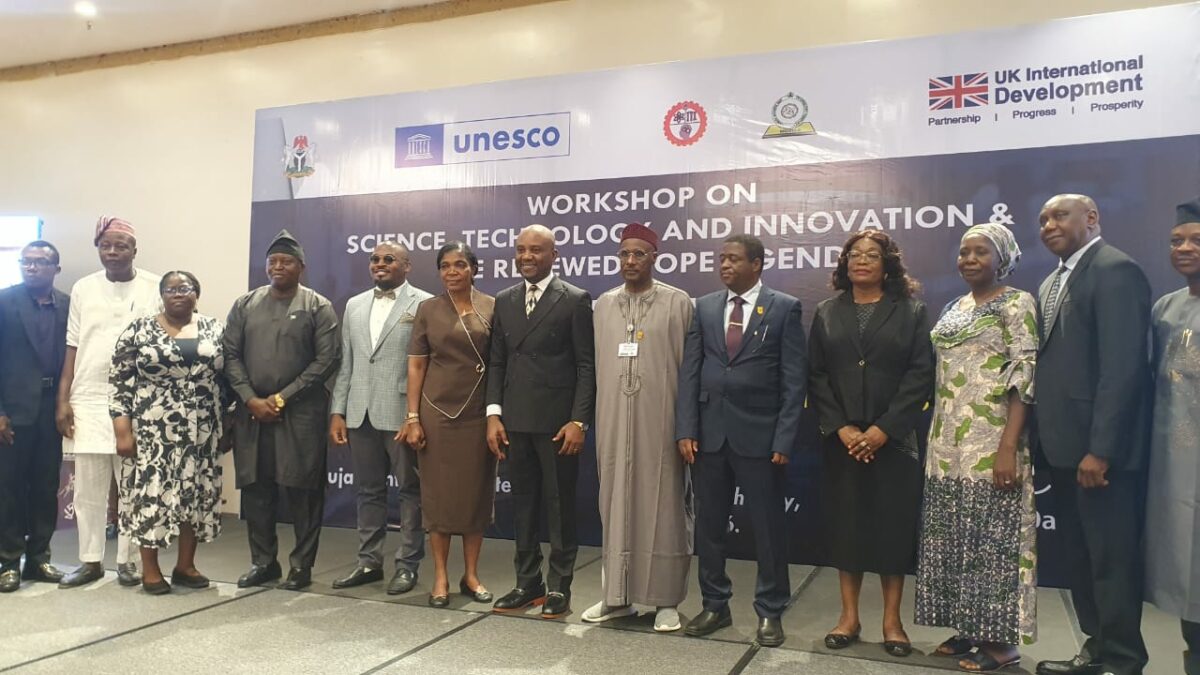
The Director-General and Chief Executive Officer of Sheda Science and Technology Complex, Dr. Magaji Da’u Aliyu, has called for stronger collaboration, legislation, and sustainable funding to reposition Nigeria’s Science, Technology and Innovation (STI) ecosystem for national development.
Aliyu made the call during the opening of a three-day National Concertation on Science, Technology and Innovation ecosystem for national development under the Renewed Hope Agenda, and the operationalisation of the National Research and Innovation Fund (NRIF), held in Abuja.
The event brought together officials of the Federal Ministry of Innovation, Science and Technology, development partners, private sector players, academia, research institutes, and innovation stakeholders to deliberate on strategies for strengthening Nigeria’s innovation ecosystem.
Aliyu said Nigeria had reached a critical stage where science, technology, and innovation must move beyond policy discussions to implementation capable of delivering measurable socio-economic impact.
According to him, despite the existence of several STI policies and frameworks, including the National Policy on Science, Technology and Innovation and the STI Roadmap, research outcomes have yet to translate significantly into industrial growth, job creation, and economic diversification.
He stressed the need for stronger coordination among research institutions, universities, industries, government agencies, and financing mechanisms to close the gap between research and commercial application.
He disclosed that SHESTCO, with support from UNESCO and the Foreign, Commonwealth and Development Office under the SANKORE Project, had worked on governance frameworks and operational guidelines to facilitate the implementation of the fund.
Aliyu also reaffirmed his commitment to advocating for the passage of the National Research and Innovation Council (NRIC) Bill, noting that proper legislation remained essential for sustainable innovation financing and governance.
He said the approval and support of the Federal Executive Council for the innovation framework signalled the federal government’s readiness to drive research commercialisation and innovation-led industrialisation under the Renewed Hope Agenda.
The stakeholders emphasised that research funding should be market-driven and connected directly to industry, commerce, and job creation rather than existing solely within academic institutions.
They also highlighted the need for private sector participation in innovation financing, saying government funding should serve as a catalyst to attract further investment into research and technology development.
Participants further stressed the importance of technology transfer, intellectual property management, Open Science, and innovation governance in building a globally competitive and impact-driven STI ecosystem.
The concertation is expected to produce actionable recommendations to strengthen Nigeria’s innovation system and accelerate the commercialisation of research outcomes for national development.
Dr. Kingsley Tochukwu Udeh, Honourable Minister of the Federal Ministry of Innovation, Science and Technology has intensified calls for the speedy passage and implementation of the National Research and Innovation Fund (NRIF) legislation to strengthen research commercialisation, industrial growth and economic development.
The meeting emphasised that proper legislation remained critical to building a sustainable national innovation ecosystem, adding that effective implementation of the roadmap would require collaboration among government agencies, academia, development partners, research institutes, technology hubs and the private sector.
Participants also highlighted the need for stronger private sector involvement in funding innovation, arguing that government resources alone would not be sufficient to drive large-scale research commercialisation.
According to them, private investment in innovation should be encouraged through profitability, return on investment and commercial opportunities linked to research outcomes. The stakeholders further noted that innovation and technology development should not be limited to universities and formal institutions alone, but expanded to include grassroots innovators and the informal sector.
They added that Nigeria’s development ambitions under the Renewed Hope Agenda would depend heavily on the country’s ability to leverage biotechnology, digital systems, green innovation and space technologies to drive industrialisation and economic diversification. The participants also stressed the importance of linking research outputs with market demands through commercialisation frameworks capable of transforming ideas into products, services and enterprises.
We’ve got the edge. Get real-time reports, breaking scoops, and exclusive angles delivered straight to your phone. Don’t settle for stale news. Join LEADERSHIP NEWS on WhatsApp for 24/7 updates →
Join Our WhatsApp Channel