“The best way to help Africans today is to help them to stand on their own feet. And the best way to do that is by helping them create jobs… Instead of young people waiting to get employment, they should create their own jobs and employ their peers” – Dr. Ngozi Okonjo-Iweala, Economist, Director-General of the World Trade Organization (WTO), and former Finance Minister of Nigeria,
By Chinyere Amalu-Ekwuazi
In Nigeria, unemployment rate is on the increase. According to the National Bureau of Statistics (NBS) Nigeria Labour Force Survey, official youth unemployment (ages 15–34) stands at 6.5%. While this figure reflects open unemployment under global ILO guidelines, the broader economic reality highlights a deeper structural issue: over 92% of working Nigerians operate in the informal sector, often underemployed or trapped in low-productivity manual labour.
Furthermore, roughly 13.8% of young Nigerians fall into the NEET category (Not in Employment, Education, or Training). Addressing this structural challenge requires moving beyond headline numbers to focus on job quality, technical productivity, and sustainable enterprise development—precisely this is where the National Agency for Science and Engineering Infrastructure (NASENI) interventions make a measurable difference.
Across Nigeria, a quiet industrial revolution is taking root within local communities and at the heart of this movement is NASENI led by its Executive Vice Chairman and CEO, Khalil Suleiman Halilu. By executing two targeted human-capital frameworks—the NASENI Skill Acquisition Programme (NSAP) and the NASENI Sustainable Empowerment Programme (NSEP)—the Agency is proving that technology and vocational mastery are essential drivers for nationwide prosperity and job creation.
The NASENI Skill Acquisition Programme (NSAP) and the NASENI Sustainable Empowerment Programme (NSEP) are two complementary capacity-building frameworks managed by the Agency. While both align with NASENI’s 3Cs principle of Creation, Collaboration, Commercialization to reduce unemployment, they differ significantly in scope, execution, and objectives.
Aligning Engineering Infrastructure with the Renewed Hope Agenda
Many Nigerians may be wondering why NASENI is carrying out the two complementary intervention programmes aimed at empowering the youths and communities with skills and supporting their daily livelihood, through science, technology and innovation. The target of the Agency is to drive President Bola Ahmed Tinubu’s Renewed Hope Agenda on industrialization and job creation.
The primary objectives of Renewed Hope Agenda centres on economic diversification, job creation, poverty alleviation and youth empowerment. NASENI has aligned its operational strategy directly with these national priorities through its 3Cs principles. Rather than letting research sit idle on lab shelves, the Agency translates technical knowledge into practical tools and marketable skills.
Core Differences of the Two Programmes
The NASENI Skill Acquisition Programme builds workforce capabilities from the ground up, focusing on hands-on technical, vocational, and engineering skills training. It targets youths, women, artisans, and students seeking technical capability building. It is a balanced mix of hardware distribution (tools/products) plus targeted training.
The NSAP builds foundational technical expertise by creating a qualified workforce in engineering, manufacturing and trade skills among Nigerian youths through electrical & electronics installation and repairs, solar panel installation & maintenance, mobile phone hardware repairs, welding & metal fabrication, dry food processing/packaging, and Plaster of Paris (POP), installation trainings.
The key deliverables are: certified technical expertise, startup toolkits, and STEM/innovation kits. The NSAP pays heavy emphasis on intensive instruction & lab/centre-based trainings utilizing regional NASENI Skills Acquisition Centres (NSACs), tech hubs, and specialized workshops, making participants immediately employable or capable of starting their own businesses.
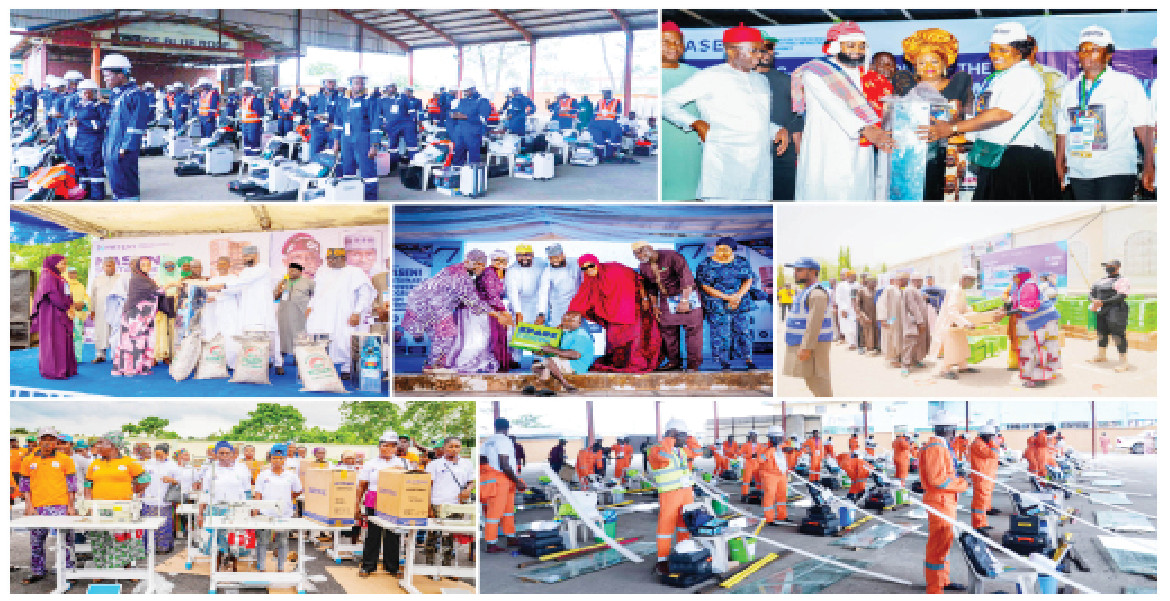
On the other hand, the NSEP is executed via community outreach events, zonal town halls and local distribution centres. It equips participants with NASENI-branded products (e.g., Solar Home Systems, Cookstoves) and starter packs and technology assets needed to convert skill sets into active, high-yield micro-enterprises, ensures deployment of technology, productive tools, and skills to grassroots communities. It is for artisans, small business owners, households, and grassroots community members.
The NSEP has directly improved productivity, household energy access, and immediate income generation through the distribution of NASENI Cookstoves, NASENI Home Solar Solutions, electrical support packs, and small-scale machinery-eliminating the high capital barrier that prevents new enterprise owners from launching operations.
The NSAP and NSEP are complementary programmes and addresses two of Nigeria’s most pressing challenges: youth unemployment and the infrastructure-to-market gap. By targeting different stages of economic development, they turn local technical potentials into measurable financial independence.
Bridging the Industrial Gap
Instead of relying on imported equipment, both initiatives teach Nigerians how to assemble, maintain, and adapt locally engineered technologies. It also directly moves NASENI’s research and development work out of the laboratory and into local markets and households, proving the viability of home-grown innovations.
Enhancing Energy Access and Grassroots Productivity
Interventions involving NASENI Home Solar Systems and clean-burning Cookstoves solve critical energy access challenges for off-grid communities and micro-enterprises. It supplies artisans and small businesses with modern tools that reduces manual effort, increases daily production, and lowers energy costs for small vendors.
Regional Inclusion and Poverty Reduction
Targeted Outreach: By deploying mobile, zonal empowerment editions alongside regional training centres, both initiatives reach underserved rural areas and small towns across Nigeria’s geopolitical zones.
Empowering Vulnerable Groups: Structured cohorts specifically target unemployed youth, women-led households, and informal sector artisans to help bring them into the formal economy.
Reaching Nigeria’s Geopolitical Zones and Key Socio-Economic Impacts
Through dedicated technical facilities—such as the newly commissioned NASENI Skills Acquisition Centre in Owerri, Imo State—and nationwide zonal cohorts (including recent editions in Ebonyi, Kano, Oyo and Lagos), NASENI equips youths and artisans with high-demand vocational skills.
By training participants in specialized areas such as solar installation and maintenance, modern welding and fabrication, Plaster of Paris (POP) installation, mobile phone hardware repair, and food processing, the Agency transforms job seekers into self-reliant service providers and enterprise owners.
Transitioning “From Learning to Earning”: A defining feature of NASENI’s intervention model is ensuring that practical skill training is immediately paired with functional tools and beneficiaries do not just receive instructional certificates; they are equipped with starter packs and specialized toolkits- this direct asset provision eliminates the startup capital bottleneck that frequently prevents trained technicians from entering the active market.
Democratizing Clean Energy and Lowering Operational Costs
NSEP directly addresses household energy poverty and operational overhead for informal sector workers by deploying NASENI-branded clean technologies such as NASENI Home Solar Solutions (Providing off-grid lighting, solar fans, and power packs) to extend working hours for small businesses and improve quality of life and NASENI Cookstoves-offering cleaner, fuel-efficient alternatives to traditional cooking methods, reducing health hazards and household fuel expenditure.
Strengthening Local Manufacturing and Reducing Import Reliance
By training local talent to assemble, service, and maintain engineering assets domestically, NASENI reduces Nigeria’s reliance on imported technical expertise and capital goods. This domestic capability strengthens micro, small, and medium-scale enterprises (MSMEs), building a resilient national industrial supply chain anchored on homegrown innovation.
Inclusive Regional Reach and Social Stability
By strategically executing interventions across Nigeria’s six geopolitical zones, NASENI brings the benefits of federal science and engineering infrastructure directly to grassroots communities, rural areas, and urban informal sectors. By providing productive, income-generating pathways for young men and women, the programmes discourage crime, reduce social redundancy, and improve household living standards.
A Model for Sustainable Development
By bridging the gap between local talent and functional technology, NASENI is building a self-reliant industrial workforce. Every technician trained in solar maintenance or modern fabrication adds strength to Nigeria’s domestic economy, reduces reliance on imported goods, and advances the goals of the Renewed Hope Agenda. Through continuous skill development and targeted asset distribution, NASENI demonstrates that engineering infrastructure can transform lives at the grassroots level and beyond.
We’ve got the edge. Get real-time reports, breaking scoops, and exclusive angles delivered straight to your phone. Don’t settle for stale news. Join LEADERSHIP NEWS on WhatsApp for 24/7 updates →
Join Our WhatsApp Channel