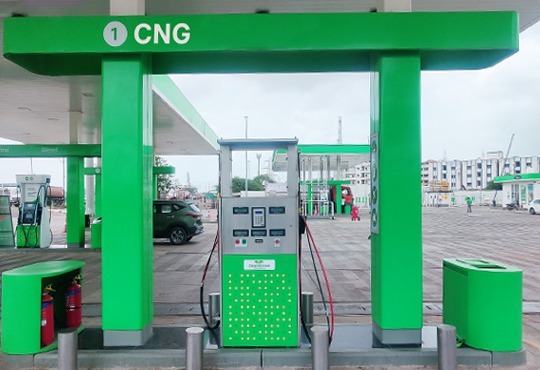
The National Association of Nigerian Traders (NANTS) has urged the federal government to extend its Compressed Natural Gas (CNG) transportation initiative to traders, saying the intervention would help slash rising logistics costs, reduce goods prices, and cushion the impact of fuel subsidy removal on businesses.
The national president of NANTS, Dr Ken Ukaoha, made the appeal on Tuesday at the FCT Traders’ Summit in Abuja, where he also called for improved market infrastructure, stronger security, and greater government support for traders.
Ukaoha said traders had remained among the hardest-hit groups since the removal of the fuel subsidy, as escalating transport costs continued to drive up the prices of goods and services across the country.
He lamented that although several organisations had benefited from the federal government’s CNG transport programme under President Bola Tinubu’s administration, traders, who move goods daily across Nigeria, had yet to be included.
He appealed to the government to provide traders with access to CNG buses and other affordable transport options through the association, insisting that the move would lower operating costs and ultimately benefit consumers.
“It is only imperative that this reconsideration is made urgently in the spirit of partnership in development that we share,” Ukaoha said.
The NANTS president also urged the federal government and the Federal Capital Territory Administration to improve basic facilities in markets, stressing that access to clean water and decent toilet facilities should be regarded as essential infrastructure.
He said many markets lacked the basic amenities needed to promote hygiene, public health, and a conducive business environment.
On insecurity, Ukaoha warned that persistent attacks on communities, highways, and markets had disrupted supply chains, increased the cost of doing business, and discouraged investment.
He said several traders had been killed while transporting goods across the country, while markets, including the Monday Market in Maiduguri, had suffered devastating attacks.
“The security of our markets is directly linked to the security of our nation’s economy,” he said, urging security agencies to strengthen surveillance around markets and major commercial routes.
Ukaoha pledged that traders would continue to support government economic policies through ethical business practices and efforts to keep prices affordable despite prevailing economic challenges.
He also commended the minister of the Federal Capital Territory, Nyesom Wike, for ongoing infrastructure projects across Abuja and satellite towns, saying improved roads and transport networks had boosted commercial activities.
Speaking at the summit, the public relations officer of the NANTS FCT Chapter, Joseph Chinedu Ihekire, dismissed allegations that traders were responsible for the persistent rise in the prices of goods.
He argued that inflation was being driven by rising transportation costs, electricity tariffs, and other economic pressures rather than deliberate price manipulation by traders.
“That is misinformation. The fault is not from us. Prices are high everywhere. If people talk about hoarding, what about transport operators that increase fares? Are they traders? What about filling stations that increase fuel prices? Are they traders?” he asked.
According to him, traders merely adjusted prices in line with higher purchase costs, transport expenses, and rent.
He urged the government to tackle the root causes of inflation by improving transportation, electricity supply, and education to reduce the cost of doing business.
Also speaking, the woman leader of the NANTS FCT Chapter, Dr Adebumi Rachel, appealed to the federal government to introduce accessible soft loans for traders, describing limited access to finance as one of the biggest challenges confronting small businesses.
She said the summit was designed to build the capacity of traders and help them appreciate their contribution to Nigeria’s economy.
“People see us as part of the informal sector, but many traders do not realise the value they add to the economy. Traders contribute to the country’s Gross Domestic Product every day,” she said.
Rachel noted that many traders were unable to obtain commercial bank loans because of stringent collateral requirements and urged the government to establish affordable credit schemes similar to those introduced during the COVID-19 pandemic.
She added that easier access to finance would enable traders to expand their businesses, increase their earnings, and create more economic opportunities.
“We are the heartbeat of the nation’s economy. Government should please support traders with soft loans because that is what will help businesses grow and create more opportunities,” she said.
We’ve got the edge. Get real-time reports, breaking scoops, and exclusive angles delivered straight to your phone. Don’t settle for stale news. Join LEADERSHIP NEWS on WhatsApp for 24/7 updates →
Join Our WhatsApp Channel