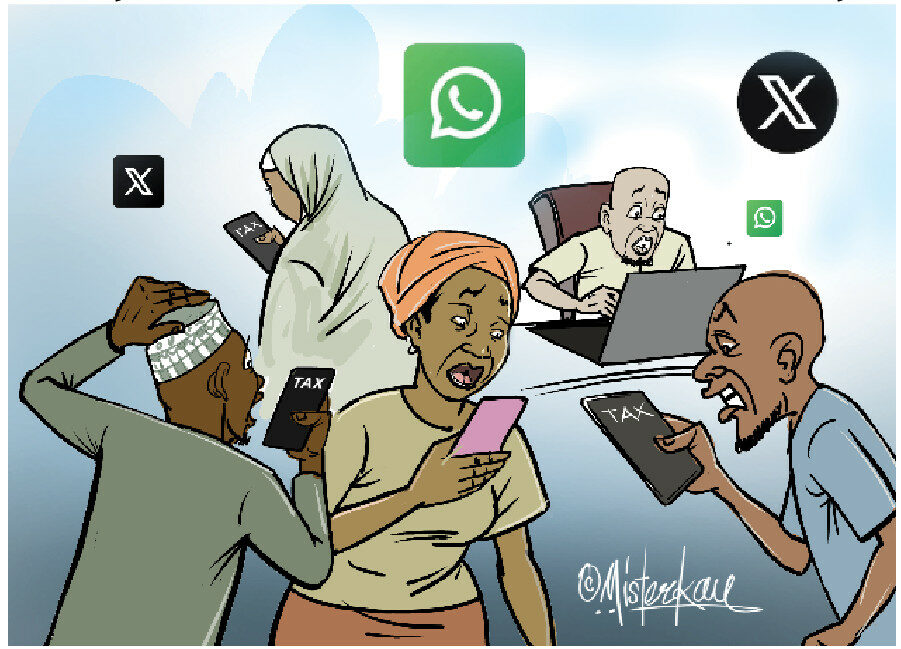
June 26, 2025, was a Thursday that promised nothing unusual—until President Bola Ahmed Tinubu signed the Tax Reform Bill into law. By evening, Nigerians discovered that fear travels faster than legislation. WhatsApp messages spread like wildfire, Twitter feeds overflowed with speculation, and it seemed as though every Nigerian simultaneously learned that their bank accounts were under siege.
In Onitsha, Chinyere, a small bakery owner, froze mid-knead at a broadcast claiming that every loaf she sold would now be taxed. Flour-coated hands suspended in the air, she whispered, “If they take from this my own, I may as well sell dreams instead of bread.” In Kano, Salman, a freelance digital marketer, scrolled through X to find another viral post warning that his side hustles would vanish into government coffers. Two thousand naira here, five thousand naira there, and his modest independence felt precarious, threatened by invisible forces he could neither see nor challenge.
In Jos, Nanpan, an electronics trader, read that market profits would no longer belong to traders. Batteries and wires lay scattered across his stall as he muttered, “This is worse than last year’s fuel subsidy chaos.” Meanwhile, in Ibadan, Olufunke, a boutique owner, froze mid-stitch, imagining auditors swooping into her small shop, seizing sewing machines, and harvesting dreams one stitch at a time.
Across the country, panic moved faster than the law itself. Almost all of it was fueled by rumours. These reactions reveal a deeper truth about Nigeria: fear does not arise in isolation. It thrives in the vacuum left by poor communication, limited stakeholder engagement, and a long history of broken promises. Citizens imagined the worst before they had the chance to understand the law.
The Silence of Stakeholders
The rollout of the Tax Reform Act was hampered by weak stakeholder engagement. The Presidential Committee on Tax Reform and tax authorities largely spoke over people’s heads. Public enlightenment was mostly confined to webinars, television briefings, and workshops in select urban centers, leaving the majority of Nigerians in the dark. Radio programs in local languages, town hall forums, school sensitizations, and context-specific outreach in markets and places of worship were mostly ignored. The spaces left vacant by these omissions were quickly filled by WhatsApp forwards and Twitter speculation.
In Bauchi, Halima, a microfinance agent, attended a webinar meant to clarify the law. By the end, she was more confused than before. Speakers cited jargon— “Effective Tax Rate,” “Assessable Profits”—without translating them into the realities of her daily transactions. She scrolled through her phone, rereading WhatsApp forwards for reassurance. In Lagos, Chuka, a software developer, faced the same frustration. Official communications arrived as dense PDFs and press releases, reactive rather than proactive, offering little practical guidance. Rumours thrived because no one had made the effort to meet citizens where they were.
Mistrust in the System
Mistrust has always been the most persistent challenge in Nigerian tax administration. For decades, policies were introduced, promises made, and follow-through was minimal. Multiple taxation, phantom levies, and stories of misused funds eroded confidence, leaving citizens wary of every new reform.
In Enugu, Ifeanyi, a mid-level banker, summed it up: “Even if the law is fair, I will not believe it until I see it in practice. Past experience teaches me to expect the worst.” Compliance is conditional on trust, and trust is scarce. This mistrust extends to the National Orientation Agency. In theory, NOA exists to educate citizens about public policy. In practice, it has been largely ceremonial, broadcasting slogans about civic responsibility while leaving ordinary Nigerians to navigate complex legislation alone. Its absence left fear, rumours, and panic unchecked.
Who Actually Pays
Despite the chaos, the law is structured, measured, and equitable. Low-income earners, students with part-time work, and many small businesses are largely exempt. Only earnings above designated thresholds, substantial business profits, and certain digital or investment income fall within its scope.
Ada, a bakery owner in Jos, registers her modest enterprise with confidence, knowing her profits remain below the taxable threshold. She can bake bread without fear of sudden deductions. In Kaduna, Tunde, a freelance digital artist earning in dollars, now operates legitimately, relieved of retroactive penalties that once made informal online work precarious. Babajide, a mid-level banker in Lagos, experiences predictable, proportional taxation. Only a portion of his salary is taxed, with no hidden clauses or surprise deductions.
Even high-income earners benefit from clarity, while low-income earners gain protection. The system is progressive, fair, and structured—but its effectiveness depends entirely on citizens understanding it. Awareness, engagement, and transparency are essential for turning a technically fair law into one that is trusted in practice.
The Panic Paradox
Rumours spread because knowledge was not communicated strategically. A viral message claimed that any bank transfer without a description would automatically be taxed. Nigerians responded with a mixture of humour and absurdity. In Ibadan, Nnamdi labelled every transfer “Chop Money,” while Chioma in Owerri renamed repayments “Future Investment Returns.” These actions were unnecessary, but they illustrate the anxiety that arises when a population is left uninformed.
The truth is far simpler: only declared taxable income matters. Personal gifts, casual repayments, and informal collections remain untouched. Panic thrived not because the law was harsh, but because citizens had to interpret complex statutes on their own. Many Nigerians still do not know that essential goods remain VAT zero-rated and that small businesses below thresholds face no corporate tax.
Repairing the Social Contract
A law is effective only when citizens trust both its fairness and the authority enforcing it. Taxes function when people believe in the legitimacy of the system and see accountability in practice. Stakeholder engagement must be genuine, not ceremonial. Workshops, webinars, and television briefings alone are insufficient. Radio programs in local languages, town hall forums, market discussions, and school sensitizations would have ensured clarity and participation.
Humour offers relief. Nigerians have long mastered laughing at themselves even amid real concern. Jokes about labelling every naira or imagining auditors behind counters remind us that panic often reflects communication failures as much as legislative realities.
The new tax law is not a predator. It is a tool for fairness, modernization, and transparency. Small businesses remain largely protected. Essential goods remain zero-rated for VAT. Compliance is simplified. Digital and freelance income is formally recognized.
Its success depends on engagement and trust. Citizens must understand obligations, maintain records, and participate actively. The government must communicate clearly, demonstrate accountability, and engage meaningfully. NOA could translate complex statutes into digestible guidance, but its absence has been keenly felt. Without proactive, context-specific public enlightenment, fear and rumours will continue to dominate.
Facts Over Fear
As 2026 begins, Nigerians must leave behind WhatsApp panic, Twitter exaggerations, and imagined raids. The social contract functions best when citizens are informed, engaged, and when contributions are transparent. Taxes are not theft. They are contributions to a society we all inhabit—investments in roads, schools, hospitals, and public services that support daily life.
Happy New Year, dear readers. May 2026 bring clarity, laughter, and trust restored. May your bank accounts, businesses, and small dreams remain intact, safe from rumours and reality alike. And may the lessons of 2025, a year defined by tax policy, guide us calmly through the months to come.
We’ve got the edge. Get real-time reports, breaking scoops, and exclusive angles delivered straight to your phone. Don’t settle for stale news. Join LEADERSHIP NEWS on WhatsApp for 24/7 updates →
Join Our WhatsApp Channel