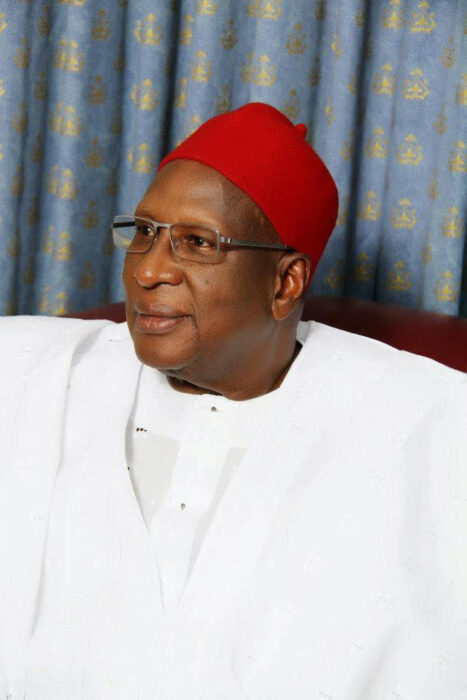
The death of Alhaji Bamanga Mahmud Tukur, former governor of old Gongola State and ex-national chairman of the Peoples Democratic Party (PDP), has brought to an end the long public career of one of Nigeria’s prominent political and business figures.
Tukur, who died on September 12, 2026, aged 90, spent more than five decades moving through public administration, politics, business and international economic affairs.
Born on September 15, 1935, in the present-day Adamawa State, Tukur came to national prominence through his career at the Nigerian Ports Authority (NPA), where he rose to become General Manager and Chief Executive.
He headed the NPA from 1975 to 1982, a period when the country’s ports were struggling with congestion arising partly from the massive cement importation programme of the era.
During his tenure, efforts were made to expand port capacity and improve facilities to meet Nigeria’s growing import and export requirements.
His departure from the NPA marked a major turning point in his career as he moved from public administration into partisan politics.
In the 1983 governorship election in Gongola State, Tukur contested on the platform of the National Party of Nigeria (NPN) and defeated former governor Abubakar Barde of the Nigerian People’s Party (NPP).
He assumed office as governor in October 1983, succeeding Wilberforce Juta.
His tenure, however, was one of the shortest in the history of Nigerian state governorships.
Barely three months after he assumed office, the military coup of December 31, 1983, brought the Second Republic to an end and terminated his administration.
Gongola State, which then covered a large part of present-day Adamawa and Taraba states, was later divided into the two states in 1991.
Interestingly, Tukur’s political history with former Vice President Atiku Abubakar dates back to this period.
Atiku was involved in Tukur’s 1983 governorship campaign in Gongola State, when the two men were on the same political side.
Three decades later, however, the relationship would take a dramatically different turn, as the two became involved in one of the most consequential internal battles in the PDP.
Following the collapse of the Second Republic, Tukur moved into the private sector and entrepreneurship.
He became associated with BHI Holdings and the DADDO group of companies and established himself as a major figure in Nigeria’s business community.
His activities soon extended beyond Nigeria, with his involvement in continental business organisations earning him prominence in African economic circles.
He served as President of the Africa Business Roundtable and later became Chairman of the NEPAD Business Group, among other positions.
But politics remained an important part of his life.
During the transition to the Third Republic, Tukur returned to the political arena and sought the presidency under the National Republican Convention (NRC).
In 1992, he was among the prominent politicians who contested the NRC presidential primary. He was unsuccessful in his bid for the party’s presidential ticket, in a contest that was eventually disrupted by the military government’s cancellation of the presidential primaries.
The 1992 contest was part of the wider transition programme initiated by the military administration of General Ibrahim Babangida, which had created the NRC and the Social Democratic Party (SDP) as the two officially recognised political parties.
Tukur’s participation in the presidential contest further demonstrated that his political ambitions had moved beyond Gongola State to the national stage.
He subsequently returned to government at the federal level.
Between 1993 and 1995, Tukur served as Minister of Industries under the military administration of General Sani Abacha, adding another chapter to a career that had already taken him from the NPA to a state governorship and the business world.
His journey into national partisan politics reached another major milestone in 2012 when he was elected national chairman of the PDP.
With the support of President Goodluck Jonathan, Tukur emerged as chairman of the then ruling party in March 2012.
His tenure, however, coincided with one of the most turbulent periods in the PDP’s history.
The party became increasingly divided over its leadership and political direction, with Tukur at the centre of the controversy.
The confrontation involving Atiku came to a head in 2013, when the former vice president joined seven PDP governors and other prominent members of the party in challenging the Tukur-led leadership.
The dispute eventually produced a breakaway faction known as the “New PDP”, with Abubakar Kawu Baraje as its chairman.
Atiku and the governors opposed Tukur’s leadership amid wider disagreements within the ruling party over its direction and internal management.
The crisis deepened as the 2015 general election approached, with the factional dispute becoming one of the most serious challenges to the PDP’s unity during its 16 years in power.
Tukur eventually resigned as national chairman on January 15, 2014, bringing his tenure at the head of the party to an end.
The episode represented a remarkable reversal in the political relationship between Tukur and Atiku, from allies during the 1983 Gongola governorship campaign to opponents three decades later in the PDP.
Tukur’s resignation did not mark the end of his involvement in national affairs.
He remained active in business and public affairs and continued to participate in national and continental initiatives.
He was also associated with the PDP Board of Trustees and retained influence within the party and the wider political establishment.
Beyond politics and business, Tukur accumulated a number of academic and national honours during his lifetime.
He was awarded an honorary Doctor of Laws degree by Benue State University and was a fellow of the Nigerian Institute of Transport Technology, Zaria.
He was also a recipient of the Commander of the Order of the Niger (CON), while he held the traditional title of Tafidan Adamawa.
Tukur’s career therefore traversed several important periods of Nigeria’s political and economic history , from the expansion of the country’s maritime infrastructure in the 1970s, through the turbulent politics of the Second Republic and successive military administrations, to the return of democratic rule and the political battles of the Fourth Republic.
His life also reflected the fluidity of Nigerian political alliances.
Men who stood together in one political contest could find themselves on opposing sides decades later, as happened with Tukur and Atiku.
From his years managing the nation’s ports, Tukur moved into the Gongola State Government House, then into business and the Federal Executive Council, before eventually reaching the leadership of Nigeria’s biggest political party.
For more than half a century, he remained a familiar figure in Nigeria’s public life, combining roles in administration, politics, business and continental economic organisations.
His death at 90 closes a long chapter in the history of Nigeria’s political establishment and leaves behind a career that stretched from the management of the country’s ports to the highest levels of state and party politics.
We’ve got the edge. Get real-time reports, breaking scoops, and exclusive angles delivered straight to your phone. Don’t settle for stale news. Join LEADERSHIP NEWS on WhatsApp for 24/7 updates →
Join Our WhatsApp Channel