From Hubert Ogunde’s travelling theatre to NTA’s Village Headmaster and the daring celluloid era, how a generation of brave storytellers built an industry before the term Nollywood existed, writes SAMUEL ABULUDE
The Nigerian film industry did not begin with Nollywood. Long before the term was coined, and long before home videos flooded the markets of Idumota and Upper Iweka, there was a film culture. In fact, the story of film in Nigeria predates the country’s independence.
Its earliest roots trace back to the travelling theatre movement of the 1950s and 60s. Men such as Hubert Ogunde, Duro Ladipo and Kola Ogunmola took Yoruba folklore, songs and moral lessons from village to village, from city to city. They were the first superstars, the first producers, and the first to show that Nigerians would pay to watch their own stories.
Then came a critical turning point. The period between 1966 and 1977 was arguably the most significant transition in our performance history. The country was in turmoil, yet creativity was booming. It served as the bridge connecting three great eras.
On one side was the golden era of that travelling theatre. On the other hand, there was television. In 1968, the Nigerian Television Authority (NTA) launched _The Village Headmaster_. It was Nigeria’s first real national soap, and for two decades it kept families glued to their black-and-white sets. It created our first TV legends.
At the same time, a new, ambitious dream was born: Indigenous Celluloid Cinema. This was the era of big-screen 35mm film. Filmmakers such as Ola Balogun, Eddie Ugbomah, and later Ade Love began to put Nigerian stories on celluloid. Films such as Ajani Ogun (1976) and Kongi’s Harvest (1970) showed that we could make cinema.
But the dream was fragile. The film industry, like the country, suffered under military rule. Harsh economic policies, the devaluation of the naira, a lack of funds, and a lack of cinemas made celluloid filmmaking almost impossible. Many filmmakers went bankrupt. The reels disappeared. By the late 1980s, cinema culture had almost collapsed.
From that collapse, Nollywood rose. In 1992, Kenneth Nnebue shot _Living in Bondage_ on VHS on a shoestring budget. He had no idea he was creating a revolution. The cheap video format sidestepped the problems of celluloid — no expensive film stock, no need for cinemas. The film could be shot quickly and sold directly on cassette.
Nigerians were hungry for their own stories, and they bought them by the millions. That singular success opened the floodgates. Suddenly, everyone was a filmmaker. A new, frenetic, can-do industry was born in the markets of Lagos and Onitsha.
Today, that industry has come a long way, from shaky VHS tapes to Netflix and Amazon Prime, and from Idumota to the Toronto International Film Festival. The pioneers have left the stage, but living legends such as Joke Silva, Jide Kosoko and Pete Edochie remain — a link between yesterday’s travelling theatre and today’s global cinema.
We profile some of the titans of the Nigerian film industry.
Stage Giants Of Travelling Theatre
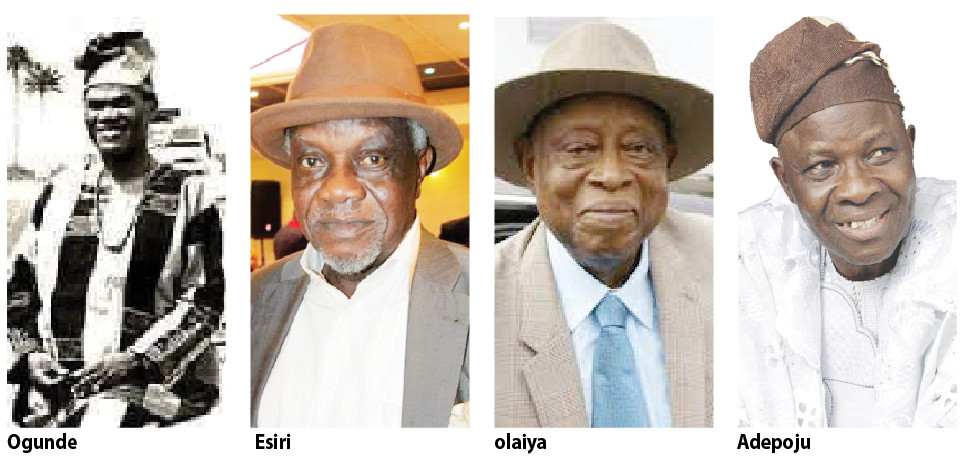
Hubert Ogunde
Regarded as a pioneer of the Nigerian film industry, the late Hubert Ogunde toured throughout Nigeria and West Africa with the Ogunde Concert Party during this decade before making his legendary celluloid films.
Duro Ladipo
Duro Ladipo performed his world-renowned Yoruba folk opera, Oba Koso, on local and international stages until his passing in 1978.
Kola Ogunmola
He was a leading figure of the Yoruba Travelling Theatre, famous for his iconic stage adaptation of Amos Tutuola’s The Palm-Wine Drinkard.
Moses Olaiya (Baba Sala)
Baba Sala formed the Alawada Group in 1966, pioneering television comedy and stage performances before transitioning to celluloid.
Oyin Adejobi
He ran one of the most prominent touring theatre troupes out of Osogbo, producing popular stage and television plays throughout the 1960s and 1970s.
Early Celluloid and Screen Pioneers
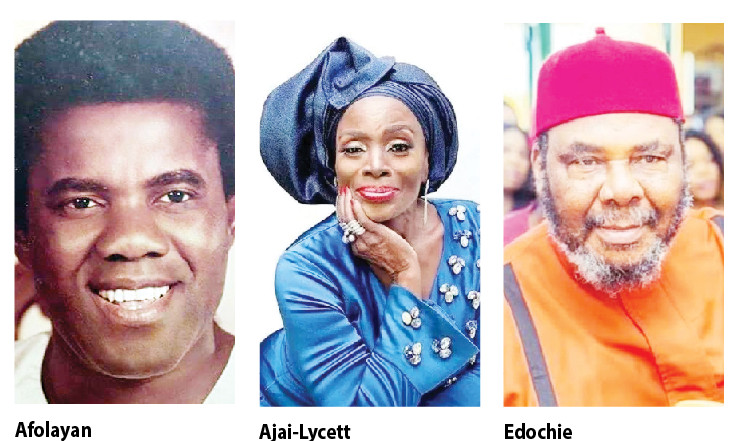
Adeyemi Afolayan (Ade Love)
Ade Love joined Moses Olaiya’s group in 1966, formed his own troupe in 1971, and starred in Ola Balogun’s landmark feature film, Ajani Ogun (1976).
Jab Adu
He starred in Francis Oladele’s early feature film, Kongi’s Harvest (1970), and played a core role in The Village Headmaster.
Orlando Martins
Orlando Martins was Nigeria’s first international film actor. He returned to Nigeria during this era to star in landmark local films such as Kongi’s Harvest (1970) and Things Fall Apart (1971).
Taiwo Ajai-Lycett
She is a living legend (85), an actress, journalist, television presenter and cosmetologist whose acting debut came in December 1966 in Wole Soyinka’s The Lion and the Jewel, a two-act comedy directed by William Gaskill at the Royal Court Theatre in London.
Eddie Ugbomah
He began his filmmaking and acting career in the mid-1970s, producing early Nigerian action films on celluloid, including The Rise and Fall of Oyenusi (1977).
Early Television Drama Actors (NTA Era)
Ted Mukoro
Ted played the original Headmaster when NTA launched The Village Headmaster in 1968.
Femi Robinson
He took over the iconic lead role of the Headmaster in The Village Headmaster from 1968 through the early 1970s.
Justus Esiri
Justus returned to Nigeria in the 1970s after training in Germany, becoming a staple of stage and television drama and later playing the Headmaster.
Zainab Bukky Ajayi
Bukky Ajayi joined NTA in 1966 as a presenter before transitioning to acting in landmark television dramas during the 1970s.
Lari Williams
Lari Williams actively performed on UK and Nigerian stages and television throughout the 1970s after returning from formal dramatic training in Britain.
Veterans Active During This Era
Taiwo Ajai-Lycett
Taiwo Ajai-Lycett is an actress, journalist, television presenter and cosmetologist whose acting debut came in December 1966 in Wole Soyinka’s The Lion and the Jewel, a two-act comedy directed by William Gaskill at the Royal Court Theatre in London.
Olu Jacobs
Olu Jacobs was an actor and film executive whose career began with appearances in several British television series and international productions before he returned to Nigeria to contribute to the Nigerian movie industry. He passed on 16 September 2026.
Lere Paimo (Baba Eda)
He featured prominently in Duro Ladipo’s troupe throughout the late 1960s and 1970s, including in plays such as Ogbori Elemosho.
Adebayo Salami (Oga Bello)
Oga Bello has been actively performing with the Young Concert Party, later known as Awada Kerikeri, since 1964.
Kareem Adepoju (Baba Wande)
Baba Wande was a core performer with the Oyin Adejobi Theatre Group throughout the late 1960s and 1970s.
Pete Edochie
He joined the Nigerian Broadcasting Corporation (NBC) in 1967 as a broadcaster and radio actor, paving the way for his screen acting career.
We’ve got the edge. Get real-time reports, breaking scoops, and exclusive angles delivered straight to your phone. Don’t settle for stale news. Join LEADERSHIP NEWS on WhatsApp for 24/7 updates →
Join Our WhatsApp Channel