
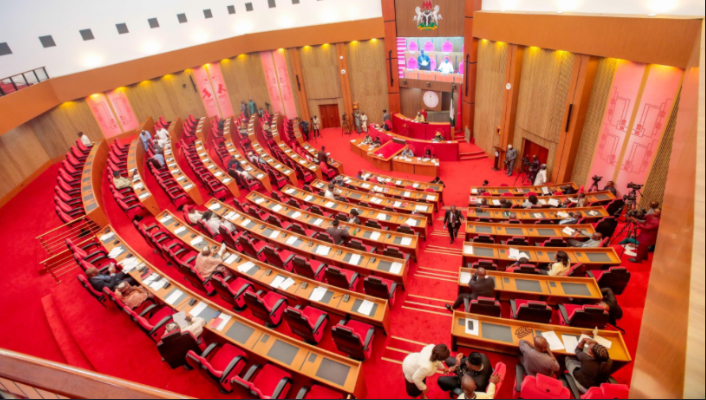
The Senate on Tuesday passed, for third reading, a bill seeking to strengthen regulatory oversight of Nigeria’s rapidly expanding financial technology sector by empowering the Central Bank of Nigeria (CBN) to regulate major fintech companies and other non-bank financial institutions.
The proposed amendment to the Banks and Other Financial Institutions Act (BOFIA), 2020, seeks to empower the apex bank to designate qualifying financial technology operators and other non-bank financial institutions as Systemically Important Institutions (SIIs), subjecting them to enhanced regulatory supervision.
The bill, SB. 959, titled A Bill for an Act to Amend the Banks and Other Financial Institutions Act, No. 5 of 2020, to Provide for the Designation, Registration and Enhanced Supervision of Systemically Important Institutions; and for Other Related Matters, was passed after clause-by-clause consideration at the Committee of the Whole.
The Chairman of the Senate Committee on Banking, Insurance and Other Financial Institutions, Senator Mukhail Adetokunbo Abiru (APC, Lagos East), presented the committee’s report during plenary presided over by Senate President Godswill Akpabio.
Abiru sponsored the legislation alongside members of the Senate Committee on Banking, Insurance and Other Financial Institutions.
Under the proposed framework, the CBN would be empowered to identify and designate qualifying non-bank financial institutions as systemically important based on factors such as their size, transaction volumes, customer base and interconnectedness with the wider financial system.
The legislation also provides for the establishment of an official register of designated institutions and for stricter regulatory requirements covering corporate governance, cybersecurity, technology risk management, and operational resilience.
Other key provisions include stress testing, data integrity assessments, enhanced regulatory reporting, and supervisory access to relevant information and operational systems of designated institutions.
The bill further seeks to strengthen beneficial ownership disclosure, improve transparency in ownership and control structures, and establish enforcement mechanisms and sanctions for institutions that violate regulatory requirements.
The proposed amendment is designed to address emerging vulnerabilities in Nigeria’s financial services industry, particularly the growing influence of large technology-driven financial service providers whose operations have become increasingly interconnected with the traditional banking system.
According to the committee’s report, the proposed legislation received broad support from regulatory authorities, government agencies, financial institutions and professional bodies during a public hearing conducted on March 4, 2026.
The CBN supported strengthening the statutory framework for supervising systemically important non-bank financial institutions, particularly large fintech operators whose transaction volumes, customer bases, and operational interconnectedness could have significant implications for financial stability.
The Federal Competition and Consumer Protection Commission (FCCPC) also supported stronger oversight but emphasised the need to maintain a clear distinction between prudential regulation, competition enforcement and consumer protection.
The commission urged appropriate coordination between the CBN and FCCPC to prevent duplication of regulatory responsibilities and ensure that the proposed framework promotes fair competition while protecting consumers.
Other institutions that supported the bill included the Nigeria Deposit Insurance Corporation (NDIC), Nigerian Communications Commission (NCC), Ministry of Finance Incorporated, Federal Ministry of Industry, Trade and Investment, Bank of Industry and Economic and Financial Crimes Commission (EFCC).
Several banks and other financial institutions also endorsed the proposed amendment.
The committee said stakeholders generally supported measures to strengthen financial stability, encourage responsible digital innovation, improve regulatory coordination, promote operational compliance and protect users of financial services.
It explained that a stakeholder-inclusive legislative approach was adopted to ensure that the proposed amendment reflected the concerns and recommendations of relevant institutions and members of the public.
The public hearing was preceded by advertisements in print and electronic media inviting memoranda from stakeholders and other interested members of the public.
The hearing was declared open on behalf of the President of the Senate by the Senate Chief Whip, Senator Mohammed Tahir Monguno (APC, Borno North).
The bill had earlier passed second reading on Thursday, December 4, 2025, and was then referred to the Senate Committee on Banking, Insurance and Other Financial Institutions for further legislative consideration.
The proposed amendment comes amid the rapid expansion of digital financial services in Nigeria, with fintech operators playing an increasingly significant role in payments, electronic transfers, and other financial transactions.
The legislation seeks to ensure that institutions whose operations could affect the wider financial system are subjected to appropriate regulatory supervision, regardless of whether they operate as conventional banks.
It is also expected to strengthen regulatory accountability, protect consumer confidence and ensure that technological innovation in the financial services industry does not undermine the stability and integrity of Nigeria’s financial system.
We’ve got the edge. Get real-time reports, breaking scoops, and exclusive angles delivered straight to your phone. Don’t settle for stale news. Join LEADERSHIP NEWS on WhatsApp for 24/7 updates →
Join Our WhatsApp Channel