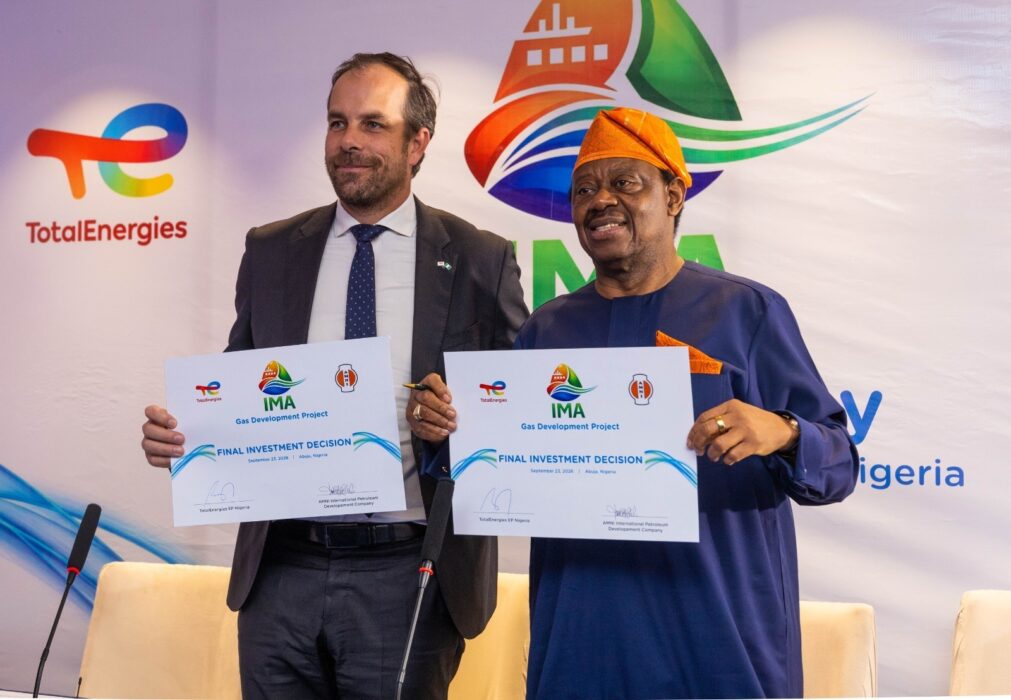
TotalEnergies and its partner AMNI International have signed the Final Investment Decision (FID) on the $800 million IMA gas development project offshore Nigeria, with first gas targeted for end-2028.
Speaking at the FID ceremony, in Abuja, on Wednesday, managing director/chief executive, TotalEnergies Upstream Companies in Nigeria, Matthieu Bouyer, described the decision as a defining moment born of nearly two decades of partnership with AMNI, and a clear vote of confidence in Nigeria’s oil and gas industry.
IMA is a shallow-water gas field located about eight kilometres offshore Bonny Island, designed to supply Nigeria LNG (NLNG). The field will produce 350 million standard cubic feet of gas per day, roughly a third of the output of NLNG’s Train 7, cementing the project’s significance to Nigeria’s gas supply chain.
The project is financed by seven institutions — Zenith Bank, Access Bank, United Bank for Africa, GTBank, Standard Bank, Standard Chartered Bank and First Abu Dhabi Bank — with more than 75 per cent of funding coming from Nigerian banks. All four main contract packages will be executed by Nigerian companies, with over 60 percent of the local workforce drawn from host communities, and total project value estimated at $2 billion to $4 billion over its lifetime.
TotalEnergies said the offshore platform will be unmanned and powered from shore, with zero routine and non-routine flaring and permanent methane-monitoring systems installed on site. TotalEnergies, present in Nigeria for over 60 years and accounting for 15–20 per cent of national output, said the project now moves into execution with safety, discipline and value-chain coordination as its priorities.
AMNI, a Nigerian-owned exploration and production company, holds 60 per cent of the project, while TotalEnergies holds 40 per cent and remains operator.
The Ima field, located offshore Nigeria in OMLs 112 and 117 in water depths of about 8 to 10 metres, was discovered in 1973 but stayed undeveloped for more than five decades.
Once developed, Ima will be connected to the existing Bonny Non-Associated Gas Plant on Bonny Island through an 18-inch, 23-kilometre multiphase pipeline. Its output is expected to meet about one-third of the gas supply requirement of Nigeria LNG’s Train 7 and generate an estimated $4 billion in value for Nigeria over the project’s lifespan.
Bouyer said all four major project packages will be handled by Nigerian contractors, and that more than 60 per cent of the workforce will be drawn from host communities, including Bonny, Finima and Andoni in Rivers State.
AMNI chairman, Tunde Afolabi, said the FID showed that Nigerian indigenous companies can partner with leading international firms to develop the country’s petroleum resources, and that indigenous participation should increasingly be judged by technical capability, financial discipline, governance and execution capacity rather than by ownership percentage alone.
The Chief Executive of the Nigerian Upstream Petroleum Regulatory Commission, Oritsemeyiwa Eyesan, said her engagement with the Ima project dated back more than a decade.
She said the project’s progression to FID reflected the impact of recent reforms and Executive Orders, assuring investors that the regulator would continue to remove regulatory obstacles and create an enabling business environment.
Special Adviser to the President on Energy, Olu Verheijen, said the project was significant not only for its gas production potential but also for its potential to convert Nigeria’s gas resources into investment, productive capacity and economic growth.
She noted that the Ima field was discovered in 1973 but remained undeveloped for decades, saying the development demonstrated that natural resources alone did not create prosperity.
Verheijen said the government’s reforms were aimed at creating conditions for capital, technology and enterprise to unlock stranded resources, generate jobs and expand industrial activity.
Rivers State governor, Sir Siminalayi Fubara, represented by his Chief of Staff, Sunny Ewule, said the FID affirmed confidence in the Niger Delta and Rivers State’s position as the region’s energy hub, citing improved security in the state’s waterways as a factor in attracting the investment. He said the project would deliver jobs, support the state’s gas-flaring reduction goals, and align with the state’s industrialisation agenda.
The Ima FID adds to a run of gas projects reaching investment decision under the current administration, reinforcing government claims that fiscal and regulatory reforms are drawing capital into a sector long constrained by underinvestment despite Nigeria holding one of Africa’s largest gas reserves. The heavy participation of Nigerian banks and contractors also signals deepening local financial and technical capacity to fund and execute large upstream projects, while the additional gas feedstock strengthens the supply outlook for Nigeria LNG’s Train 7 expansion.
We’ve got the edge. Get real-time reports, breaking scoops, and exclusive angles delivered straight to your phone. Don’t settle for stale news. Join LEADERSHIP NEWS on WhatsApp for 24/7 updates →
Join Our WhatsApp Channel