
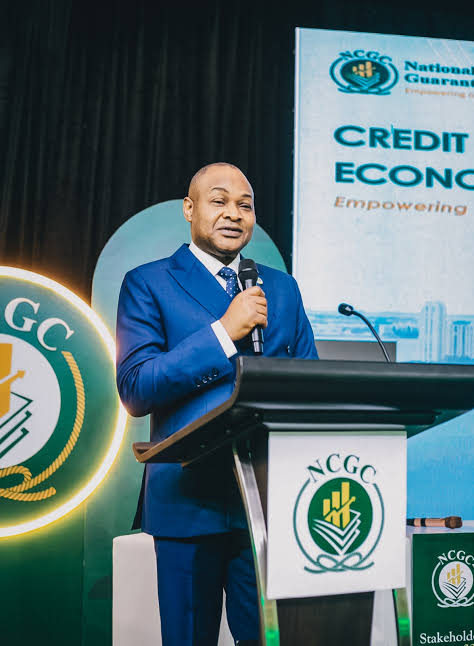
The National Credit Guarantee Company Limited (NCGC) has supported loans worth N64.13 billion to 174,495 borrowers across Nigeria, as the federal government intensifies efforts to expand access to finance for businesses and individuals.
The Managing Director and Chief Executive Officer of NCGC, Dr Bonaventure Okhaimo, disclosed this during a press briefing at the State House, Abuja.
Okhaimo said the loans were supported by guarantees valued at N30.19 billion, representing approximately N2.12 in lending for every N1 guaranteed by the company.
According to him, the programme performance report as of October 21, 2026, showed that the initiative had reached beneficiaries in all 36 states of the federation and the Federal Capital Territory through 19 participating financial institutions, including commercial banks, microfinance banks and development finance institutions.
He explained that NCGC was established to reduce lending risks for financial institutions and enable them to extend credit to businesses and individuals who might otherwise struggle to secure loans, particularly because of inadequate collateral.
The company does not lend directly to borrowers but provides partial guarantees to participating financial institutions, sharing the risk when eligible borrowers fail to repay their loans.
Responding to questions on whether the intervention was making loans more accessible or affordable, Okhaimo said the company’s primary mandate was to improve access to finance, while its guarantees could also help reduce borrowing costs.
He explained that banks determine interest rates by considering the cost of funds, inflation and other economic factors, as well as a risk premium attached to borrowers considered more likely to default.
According to him, the credit guarantee scheme is designed to address the risk premium by reducing the potential losses banks face when lending to small businesses.
He said the arrangement could encourage financial institutions to reduce the additional charges associated with lending to MSMEs, potentially making loans more affordable.
Okhaimo, however, clarified that NCGC did not determine the interest rates charged to beneficiaries because the participating financial institutions were responsible for lending the money.
He added that the company was also working with the Central Bank of Nigeria to explore ways credit guarantees could attract capital relief for lenders, a development that could further encourage lending to small businesses.
The NCGC chief executive said the intervention was particularly important for entrepreneurs whose businesses might be viable but who lacked the conventional collateral required by banks.
He cited young people working in the creative and technology sectors as examples of potential beneficiaries who might struggle to secure financing because they could not provide the traditional documentation and collateral demanded by lenders.
On the contribution of small businesses to the economy, Okhaimo said estimates of the contribution of micro, small and medium-sized enterprises varied depending on the economic indicator and source.
He distinguished between their contribution to employment and their contribution to gross domestic product, explaining that the figures often quoted for MSMEs did not necessarily measure the same thing.
The company’s performance report showed that women accounted for 74,503 borrowers, representing 42.7 per cent of the total beneficiaries.
Additionally, 22,616 borrowers, representing 12.96 per cent, accessed formal financing for the first time, while 7,731 beneficiaries were recorded under youth empowerment.
Okhaimo said trade and commerce, alongside agribusiness and agro-processing, accounted for more than 80 per cent of beneficiaries supported by the scheme.
He also confirmed that the company provided guarantees for agriculture, explaining that some of its initial beneficiaries were smallholder farmers brought into the programme through an agricultural aggregator operating in north-central Nigeria.
On employment, he disclosed that participating financial institutions reported 175,481 direct jobs associated with the borrowers supported by the scheme.
The company estimated a further 739,310 indirect jobs, bringing the total number of jobs impacted to 914,791.
Explaining the figures, Okhaimo said the direct employment numbers were based on information submitted by participating financial institutions, while indirect jobs were calculated using economic multipliers applied to different sectors.
He explained that the methodology considered the indirect economic activities generated by lending to businesses, including agricultural enterprises, while adjusting the estimates to reflect NCGC’s share of the lending risk.
The NCGC boss also highlighted the company’s GuaranteeHer initiative, a gender-responsive credit guarantee framework designed to improve access to financing for women-owned businesses.
Launched on July 29, 2026, and ceremonially unveiled at the company’s first-anniversary stakeholders’ forum on September 3, the initiative is designed to strengthen existing women-focused lending programmes operated by participating financial institutions.
Rather than introduce an entirely new lending product, GuaranteeHer provides an additional risk-sharing framework for existing initiatives, including Access Bank’s W Initiative, FirstBank’s FirstGem, FCMB’s SheVentures, Sterling’s Smart Women and Fidelity’s FundHer.
Under the programme, NCGC targets more than N100 billion in lending over five years, financing at least 20,000 women-owned MSMEs and supporting 150,000 jobs.
The initiative provides for guarantee coverage of up to 70 per cent of eligible loan exposure, with a maximum obligor limit of N50 million per borrower.
An NCGC official said the programme was designed to address barriers women entrepreneurs face in accessing bank loans, particularly the difficulty of providing conventional collateral.
The official added that data from the women-focused initiatives referenced during the briefing showed zero non-performing loans in the portfolios under discussion.
On loan defaults and the company’s financial exposure, an NCGC representative said the company was prepared to honour valid claims submitted by participating financial institutions within 30 days.
The representative, however, disclosed that no participating financial institution had filed a claim for payment as of Tuesday’s briefing.
The official also explained that credit guarantees could reduce some of the expenses associated with securing conventional loans, including certain costs related to perfecting collateral and registering security arrangements.
Such expenses, the representative said, could increase the overall cost of borrowing for businesses that are required to provide conventional collateral.
By reducing dependence on such arrangements, the guarantee scheme could help lower some borrowing-related costs, although the interest rates charged would still be determined by the lending institutions.
Established by the Federal Government on May 29, 2025, with the approval of President Bola Tinubu, NCGC was licensed by the Central Bank of Nigeria on August 9, 2025, and operates under the supervision of the Federal Ministry of Finance.
The company has a capital base of N100 billion, with equal 25 per cent stakes held by the Bank of Industry, Ministry of Finance Incorporated, Nigeria Sovereign Investment Authority and Nigerian Consumer Credit Corporation (CREDICORP).
NCGC also maintains partnerships with institutions including the Small and Medium Enterprises Development Agency of Nigeria (SMEDAN), the Central Bank of Nigeria, the Bank of Industry, the National Insurance Commission, the Nigeria Deposit Insurance Corporation and the Nigerian Agricultural Insurance-related support ecosystem, alongside other development partners.
The company is also working with the Federal Ministry of Women Affairs and Social Development on GuaranteeHer and with NIRSAL on a co-guarantee framework for agribusiness.
Okhaimo said the company would deepen access to credit for women, young people, MSMEs and productive sectors, expand its network of participating financial institutions, strengthen its capital base and digitise its guarantee management processes.
He added that NCGC would continue to provide capacity-building support to help businesses become credit-ready, including through its Credit Advantage Series, which is scheduled to feature the Nigeria Revenue Service on October 28, 2026.
He said the company’s ultimate objective was to ensure that viable Nigerian businesses were not denied access to credit solely because they lacked sufficient collateral.
We’ve got the edge. Get real-time reports, breaking scoops, and exclusive angles delivered straight to your phone. Don’t settle for stale news. Join LEADERSHIP NEWS on WhatsApp for 24/7 updates →
Join Our WhatsApp Channel