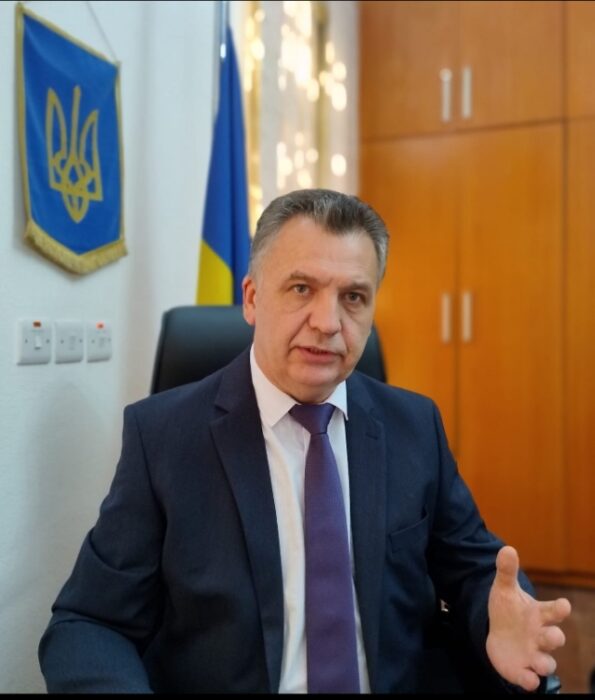
Ukraine’s Ambassador to Nigeria, Ivan Kholostenko, has accused Russian forces of using hazardous chemical substances against Ukrainian troops, saying 14,009 incidents were recorded between February 2023 and September 2026.
Kholostenko, who cited figures from Ukraine’s Ministry of Defence, said the reported incidents involved munitions containing hazardous chemical substances, while Ukrainian servicemen sought medical attention in 6,021 cases after experiencing symptoms of chemical exposure of varying severity.
He said Russian forces allegedly deployed the substances during offensive operations to force Ukrainian soldiers out of fortified positions and shelters.
“Russia deliberately uses toxic chemical substances against Ukrainian soldiers, attempting to achieve its military objectives through methods prohibited under international law. These are not isolated incidents but a systematic practice,” the ambassador said.
Kholostenko said the alleged use of chemical agents had also been examined by the Organisation for the Prohibition of Chemical Weapons (OPCW), which oversees the implementation of the Chemical Weapons Convention.
According to him, the OPCW conducted three technical assistance visits to Ukraine, during which two independent OPCW-designated laboratories confirmed the presence of CS, a riot control agent, in samples examined.
He explained that although CS was used in some law enforcement operations for riot control, its use as a method of warfare was prohibited under the Chemical Weapons Convention.
The ambassador said the laboratory findings supported Ukraine’s concerns about the alleged use of prohibited chemical substances on the battlefield.
However, he acknowledged that the specific laboratory findings related to the samples examined and did not, on their own, establish responsibility for every incident recorded by Ukrainian authorities.
Kholostenko also accused Russia of attempting to shift responsibility for alleged violations by submitting complaints to the OPCW concerning chemical substances purportedly discovered in parts of the Donetsk region under Russian occupation.
He questioned the reliability of the materials submitted by Moscow, arguing that they had been collected and prepared without independent international oversight.
According to him, this raised concerns about the origin, integrity and authenticity of the evidence.
“Once again, we are witnessing Russia’s familiar tactics: committing violations, denying responsibility and accusing those who suffer from its actions,” he said.
The ambassador argued that international organisations must rely on consistent verification standards and independent evidence when investigating allegations of chemical weapons-related violations.
He warned that attempts to undermine international verification mechanisms could weaken global efforts to prevent chemical warfare and erode confidence in international agreements.
Kholostenko said the implications of the allegations extended beyond Ukraine, stressing that compliance with international rules governing chemical weapons was essential to global security.
The Chemical Weapons Convention, which entered into force in 1997, prohibits the development, production, acquisition, stockpiling, transfer and use of chemical weapons. The OPCW is responsible for overseeing the implementation of the treaty.
The Ukrainian envoy called on states parties to the convention to protect the independence and impartiality of the OPCW and ensure that allegations of violations were assessed using consistent verification standards.
He also urged the international community to support efforts to hold Russia accountable for alleged violations of international law.
“The world has already paid too high a price to learn why the use of chemical weapons must be prohibited. We cannot allow Russia to disregard these lessons,” Kholostenko said.
He maintained that accountability was necessary to uphold international law and prevent further alleged violations, warning that weakening the institutions responsible for monitoring compliance could have consequences far beyond the war in Ukraine.
We’ve got the edge. Get real-time reports, breaking scoops, and exclusive angles delivered straight to your phone. Don’t settle for stale news. Join LEADERSHIP NEWS on WhatsApp for 24/7 updates →
Join Our WhatsApp Channel