Last week, I was in Addis Ababa as part of the delegation led by Vice President Kashim Shettima for the Nigeria-Ethiopia Nutrition Leadership Exchange. I came back home with one question that has refused to leave me alone. If Ethiopia can feed itself, what exactly is our excuse?
Like many Nigerians who travel a lot, I know Bole International Airport well. Ethiopian Airlines has turned Addis into Africa’s waiting room, and I have spent more hours than I care to admit in that transit hall. But this was only my second proper visit to Ethiopia. The first was 10 years ago, when I was part of Senator Shehu Sani’s delegation that took a group of clerics on a tour of some Ethiopian cities.
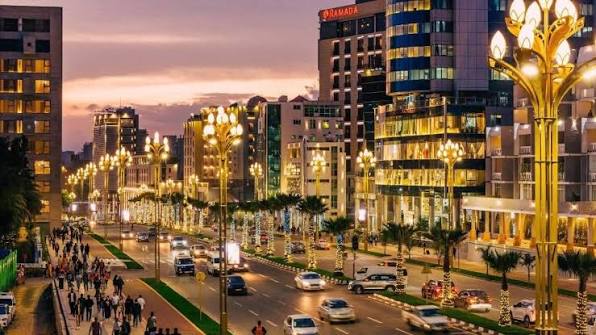
Ten years is a long time, and it shows. Driving through Addis this time around, I had to look twice. In the course of this job, I have visited a fair number of European cities, and I can say without fear of contradiction that parts of Addis can hold their own against some of them. The roads, the flyovers, the order on the streets. Our Ethiopian brothers have not been sleeping.
The delegation was a heavy one. Governors Umar Namadi of Jigawa, Dauda Lawal of Zamfara, Ademola Adeleke of Osun and Alex Otti of Abia were there, alongside the Coordinating Minister of Health and Social Welfare, Prof. Muhammad Ali Pate, and the ministers of agriculture, budget, water resources and education. I will be honest. When I see that many governors and ministers board a plane together, my first instinct as a journalist is to be suspicious. By the third day, I had to revise that instinct a little.
On day one, Vice President Shettima announced that Nigeria will accelerate work on a National Food and Nutrition Bill to protect nutrition financing and keep interventions alive across successive administrations. He said the law would strengthen the Federal Government’s Nutrition 774 Initiative and deepen a compact among the federal, state, and local governments, starting at the community level. With nutrition committees already set up in 32 State Houses of Assembly, he argued, there is no better time to give the response legal backing.
Mind you, this is the part I want Nigerians to pay attention to. As I have said previously on this page, our problem has never been a shortage of plans. Our problem is continuity. Every new government arrives with its own programme, its own slogan and its own committee, and whatever the last man started is abandoned on the shelf. Malnourished children cannot be held hostage to whoever happens to be sitting in Aso Rock. If a law ties the hands of future governments and guarantees the money, that is progress. Let the National Assembly treat this bill with the urgency it deserves, and not let it rot in committee the way so many good bills have.
Day two was the field trip, and for me, it was the most instructive part of the whole exchange. We drove for more than an hour out of Addis, into the Oromia Regional State, to visit wheat, banana, and papaya farms.
Here is what struck me. On some of those lonely stretches of road, nobody in our convoy was looking over his shoulder. There was no fear of bandits jumping out of the bush. Compare that to a farmer in Zamfara, Katsina or parts of my own Niger State who has to pay a levy to bandits before he is allowed to harvest his own crops. Compare it to the Abuja-Kaduna road, which many people still avoid whenever possible. Security is the first fertiliser. No farmer plants where he is afraid to sleep.
On both sides of the road, you could see vast stretches of land given over to farming. Up on the mountains, there were large wind turbines generating power for the economy. And I kept thinking about home. Nigeria has more arable land than Ethiopia. Niger State alone has the largest land area in the country and hosts the Kainji, Jebba, and Shiroro dams. We have the land, the water and the sunshine to grow enough wheat and grains for a good part of Africa. And yet here we were, learning from a country that was importing its wheat not long ago.
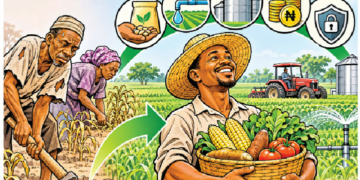
Vice President Shettima put it well at the farms. According to him, food dependency compromises a nation’s sovereignty, and so long as a country cannot feed itself, it cannot call itself sovereign. He described Ethiopia as a success story worthy of emulation and said Nigeria intends to embrace improved seeds, mechanisation and climate-smart agriculture.
The numbers he cited are worth repeating. Ethiopia has moved from importing about $1 billion worth of wheat every year to producing enough for its own people, with surplus going to Djibouti and Kenya. Let that sink in.
Meanwhile, we are still spending billions of dollars importing wheat to bake our bread and make our noodles and semovita, and every time the naira slides, the price of a loaf follows it.
To be sure, some will argue that Ethiopia is no paradise, and they will be right. The country fought a bloody war in Tigray that ended less than four years ago, it is still dealing with unrest in Amhara, and its people have their own share of economic hardship. But that argument cuts both ways. If a country carrying all of that baggage can grow its way out of wheat imports, then what is stopping Nigeria? It is not land. It is not rainfall. It is not brains. It comes down to political will and the discipline to stay on one course for more than one election cycle.
Day three was about turning lessons into commitments. Zamfara State Governor, Dauda Lawal, read the Nigeria Governors’ Forum (NGF) Addis Ababa Commitment on Nutrition, in which the governors of the 36 states pledged to launch a nationwide nutrition emergency and set up a National Nutrition Intervention Fund to drive the Nutrition 774 Initiative in every local government area.
They also promised to strengthen domestic financing, deepen accountability at the grassroots and adopt a unified framework for nutrition planning and budgeting.
For the federal agencies, Dr. Muyi Aina disclosed that the Federal Government will start targeted nutrition interventions in two states with a high burden of stunting before expanding to others. Ministers and federal agencies will work with the governors to share out responsibilities and bring communities and development partners on board.
I want to commend this two-state approach. It is the most sensible thing I have heard in Addis. Nigeria has a bad habit of launching everything everywhere at once, spreading money so thin that nobody can measure anything, and then declaring victory at a press conference. Start small, measure honestly, fix what is broken, then scale. That is how serious countries do it.
Now, the accountability part, because somebody has to say it. We have heard declarations of war on hunger before. We have seen communiqués forgotten before the delegates landed back in Abuja. A nutrition emergency declared in Addis Ababa means nothing to a stunted child in Gusau, Dutse, or Aba until it shows up as a line item in the 2027 budgets of the 36 states. And let us not forget that 2027 is an election year. Campaign season has a way of swallowing money meant for other things. I hope the governors will prove me wrong.
There is also the question of local governments. The presence of the ALGON president on this trip was not an accident, because Nutrition 774 lives or dies at the council level. If governors keep a tight grip on local government funds, as many have for years, the community-level response they promised in Addis will remain a beautiful sentence in a document.
So what should we be watching for? The Federal Government should quickly name the two pilot states and publish baseline stunting figures alongside clear targets, so that Nigerians can hold everyone to account a year from now. The National Food and Nutrition Bill should be transmitted to the National Assembly before the end of this year. The governors should show us the money for the intervention fund in their budgets, state by state, in black and white. And farmers deserve to know when the improved seeds the Vice President talked about will reach them.
Nigeria already has more than one in three children under five who are stunted. That is a future workforce, a future army and a future electorate whose growth has been cut short before they can spell their names. No amount of flyovers and stadiums will make up for that.
I left Addis with mixed feelings. I was impressed by what Ethiopia has achieved and encouraged by the seriousness I saw among our own officials. But I was also sad, because everything Ethiopia has, we have in greater measure. We have more land, more water, more people and more money. What we have lacked is the patience to see one thing through to the end.
Nigeria has what it takes to be the leading light of Africa. We have known this for 66 years. The question is whether this delegation will be remembered as the moment we stopped talking and started planting, or as one more trip abroad with nice photographs. These are the issues.
We’ve got the edge. Get real-time reports, breaking scoops, and exclusive angles delivered straight to your phone. Don’t settle for stale news. Join LEADERSHIP NEWS on WhatsApp for 24/7 updates →
Join Our WhatsApp Channel