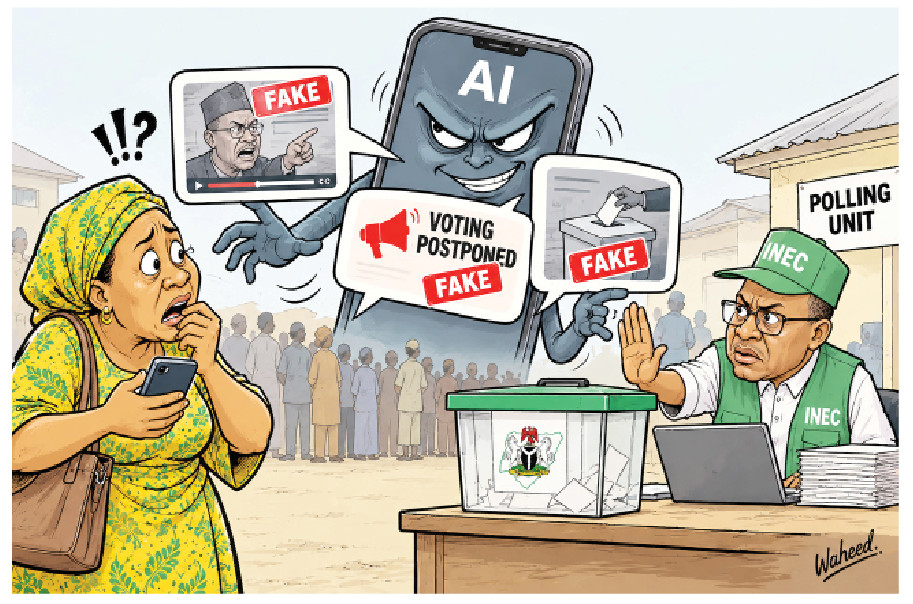
A voice message arrives on election morning. It sounds like an INEC official announcing that voting has been postponed. A woman in Mbiama, Kontagora, Ife or Ogoja, having arranged transport and prepared to queue, stays home. The message is false. By the time she discovers the truth, voting has ended.
Elsewhere, a fabricated video appears to show a candidate insulting a community. Anger spreads faster than the correction. Even after the deception is exposed, resentment remains.
These situations are hypothetical, but the danger is clear: an election can be distorted without altering a ballot. Misinformation can mislead people about when to vote, whom to trust, or what happened at their polling unit, and it can manipulate their choices before counting begins.
Nigeria must prevent artificial intelligence from becoming another tool for electoral manipulation or an excuse to avoid responsibility.
That possibility gave urgency to the recent AI and Democracy Forum in Abuja, convened by Yiaga Africa, INEC, the Centre for Journalism Innovation and Development, and Dataphyte Foundation. Its question was pointed: “Will Algorithms Determine the 2027 Vote?” For ordinary voters, the issue is simpler: will technology protect my choice or help somebody steal it?
Human oversight must mean accountability
Nigerians may reasonably ask why AI deserves attention when intimidation, vote-buying, tallying manipulation and impunity already threaten elections. AI did not create these weaknesses. It cannot excuse misconduct or repair institutions unwilling to enforce their rules. It can, however, make familiar abuses faster, broader, and more credible.
The response should be neither panic nor blind enthusiasm. Any use of AI affecting voting rights or election results must remain open to scrutiny, challenge and correction.
INEC’s assurance that people will retain authority over important electoral decisions is welcome. Yet officials can remain nominally in charge while accepting whatever software recommends. Oversight matters only when they understand the evidence, check conclusions and can reject them. Institutional honesty remains indispensable.
Imagine software flagging a voter as having registered twice. It may expose wrongdoing or be mistaken. Before excluding that citizen, someone must examine the evidence, explain the decision, and provide a fair opportunity to challenge it. “The computer said so” cannot settle a question of rights.
The same applies to results. If software reading a polling-unit result sheet mistakes a three for an eight, who checks the entry? Which record resolves a disagreement? Who corrects the error, and when?
A wrong digit can change a total. An unexplained discrepancy can persuade a community that its votes have disappeared. Nigerians should not need technical qualifications to understand how results travel from polling units to final declarations.
INEC must explain who records figures, verifies them, corrects mistakes and answers for failures. Assurances that a system works cannot replace evidence that it worked in a particular case. Independent testing, trained staff, enforceable contractor obligations and practical backups must precede deployment. When technology fails, citizens deserve explanations and remedies.
Defending truth without silencing citizens
Even reliable administration cannot protect a voter persuaded to stay home by a fabricated announcement.
AI deception threatens elections in two directions. It can make events that never happened appear real. It can also let politicians dismiss authentic evidence of misconduct by declaring, “It is AI.”
We could face campaigns in which people believe false evidence and reject genuine evidence. Citizens may judge recordings by political allegiance rather than authenticity, until some abandon verification altogether.
That exhaustion is dangerous. Democracy suffers when people believe lies; it also suffers when they conclude that truth is unknowable and participation pointless. Protecting elections therefore requires protecting the ability to establish what happened.
The proposed Electoral Information Integrity Coalition could help if it produces more than statements. Election officials, journalists, fact-checkers, civil society, and telecommunications companies need agreed procedures to detect dangerous falsehoods, verify claims, and correct them promptly.
An English denial buried on a website will not neutralise a false postponement message circulating through a local-language WhatsApp group. Corrections must reach affected communities through trusted voices, community radio, shareable audio and familiar networks, while people can still act.
The boundary must be firm: criticism of INEC is not automatically disinformation. Neither is investigative reporting, an observer’s findings or a citizen’s account of wrongdoing. Protecting voters must never justify silencing them. Those checking claims must disclose their evidence and correct their mistakes.
Parties face a revealing test. Condemning a fabricated video attacking your candidate is easy. Rejecting one that damages your opponent requires principle.
Candidates should reject deceptive impersonation, label campaign material substantially created or altered by AI, and correct fabrications circulated in their interest. Parties should establish consequences before electoral competition makes dishonesty convenient.
Platforms must also demonstrate that safeguards work for Nigerians. Can voters report fabricated recordings easily? Will responses arrive before damage spreads? Are Nigerian languages covered? A reporting button offers little protection if no one responds in time.
Making responsibility impossible to evade
Local innovation deserves encouragement, alongside scrutiny. Homegrown tools may help observers organise reports and voters obtain reliable information. Their origin does not establish reliability, nor does an award prove election readiness. Testing, privacy protection and honest explanations of limitations must come first.
Civil society organisations publishing independent findings owe the public similar transparency about sources, verification and corrections. Demands for openness carry greater authority when those making them practise it.
Citizens, too, should pause before forwarding. Messages are not true merely because friends, religious leaders or political allies share them. Alarming claims about voting arrangements require confirmation through established electoral channels. Correct falsehoods wherever we circulated them.
But public education cannot substitute for institutional safeguards. Citizens cannot investigate every recording while electoral bodies, parties and companies evade their duties.
Before 2027, Nigerians deserve four answers. Where will INEC use AI, and who supervises each application? How can voters challenge decisions affecting their rights? What will parties and platforms do about deceptive campaign material? How will corrections reach affected people quickly, in languages they understand?
Answers must come early enough to expose and repair weaknesses. Election morning is too late to assign responsibility for a fabricated postponement notice. A disputed result is the wrong moment to discover that nobody can explain how an error is corrected.
These obligations should be visible before campaigning intensifies. INEC should publish a clear account of proposed applications, the decisions they support and the officials responsible. Parties should identify who handles complaints about campaign deception. Platforms should explain how urgent electoral reports are escalated. Independent observers should be able to examine whether promised safeguards operate in practice. None of this requires disclosing information that would compromise security. It requires enough openness for the public to distinguish preparation from publicity, and enough clarity for someone whose rights are threatened to find an authorised person to act before the harm becomes irreversible.
Responsibility must not disappear between INEC, contractors and platforms. Citizens seeking redress should not be passed between organisations that blame one another.
AI can improve access to information, identify threats and support scrutiny of evidence. Its democratic value depends on whether citizens can understand decisions, check evidence and secure timely corrections.
Return to the woman who stayed home. Celebrating technological progress cannot restore her lost vote. In 2027, technology must strengthen Nigerians’ authority to choose their leaders and demand proof that their votes were faithfully counted.
– Dr Dakuku Peterside is an expert in leadership and management turnaround.
We’ve got the edge. Get real-time reports, breaking scoops, and exclusive angles delivered straight to your phone. Don’t settle for stale news. Join LEADERSHIP NEWS on WhatsApp for 24/7 updates →
Join Our WhatsApp Channel