BY NSE ANTHONY-UKO Abuja AND CHIKA IZUORA Lagos
Consumer advocacy groups have called on the federal government to base the renewal of electricity distribution companies’ (DisCos) licences on verifiable performance, after all 11 DisCos missed their loss-reduction targets in the first and second quarters of 2026.
The groups said the companies’ continued failure to reduce aggregate technical, commercial and collection (ATC&C) losses raised questions about their efficiency, financial sustainability and accountability ahead of the expiry of their licences in 2028.
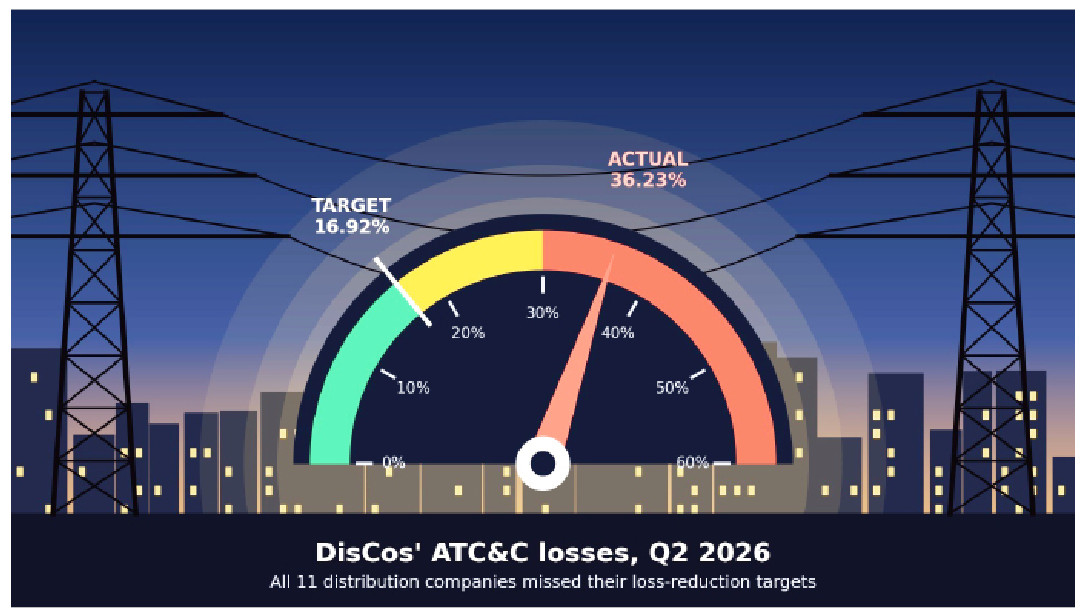
Data from the Nigerian Electricity Regulatory Commission (NERC) showed that the DisCos recorded a combined ATC&C loss of 36.23 per cent in the second quarter of 2026, against a target of 16.92 per cent.
The shortfall meant the companies could not earn about N129.07 billion of the revenue assumed in their tariffs, representing 17.60 per cent of expected revenue.
NERC’s rule is that a DisCo which fails to meet its allowed loss level cannot recover the full revenue on which its tariff was based.
The licences of the DisCos, issued for 10 years and later extended by five years, are due to expire in 2028.
Recall that the former minister of Power, Adebayo Adelabu, had said in October 2025 that poorly performing DisCos would not have their licences renewed. The decision now rests with the new Minister of Power, Joseph Tegbe.
LEADERSHIP did not get a response from Tegbe on his stance at the time of filing this story, despite sending an enquiry to his office.
NERC reports covering January 2025 to June 2026 showed limited progress in reducing losses across the sector.
The combined ATC&C loss of the DisCos stood at 37.03 per cent in 2025 and 36.84 per cent in the first half of 2026, a reduction of only 0.5 per cent.
Over the same period, the loss target was reduced from 20.54 per cent to 16.92 per cent, widening the gap between actual performance and target from 16.49 to 19.92 percentage points.
Only Eko DisCo met its target in 2025, recording a loss of 16.13 per cent against a target of 16.88 per cent.
Although collection efficiency improved by 3.1 per cent and the national metering rate rose by 7.4 per cent, the ATC&C losses, which determine how much revenue DisCos can recover, remained largely unchanged.
The executive director of the Peering Advocacy and Advancement Centre in Africa (PAACA), Jamila Umar, said licence renewal should be based on evidence, applicable laws, measurable improvement and consumer protection.
She said the missed targets raised concerns about efficiency, financial sustainability and regulatory accountability.
Umar acknowledged that ATC&C losses improved from 37.44 per cent in the first quarter to 36.23 per cent in the second quarter, while collection efficiency rose to 81.06 per cent. However, she said the gap between performance and target remained substantial.
She said the DisCos’ performance should be assessed alongside electricity supply constraints, metering gaps, energy theft, billing efficiency and consumers’ ability to pay. She, however, maintained that those factors should not excuse persistent underperformance.
Umar said several licences were expected to expire in September 2028, adding that renewal should be guided by the law, measurable improvements and consumer protection, with investment matched by accountability and reliable service.
Also speaking, the president of the Nigerian Consumer Protection Network (CPCN), Kunle Kola Olubiyo, said the DisCos’ failure to meet their service level agreements justified a review of whether they should retain their licences beyond 2028.
He said that, nearly a decade after the 2013 privatisation of the power sector, the DisCos had not fulfilled key commitments, especially regarding widespread metering and operational transparency.
Olubiyo said despite government interventions and funding from the Central Bank of Nigeria, many DisCos remained technically and financially weak.
He cited poor tracking systems, weak conflict-resolution mechanisms and failure to meet service level agreements as reasons for a licence review.
He also criticised the National Mass Metering Programme, alleging that some meter vendors and DisCos failed to capture the Global Positioning System (GPS) coordinates of installed meters, thereby making it difficult to verify installations.
According to him, advanced metering infrastructure and grid telemetry would help reduce meter bypass, illegal connections and estimated billing, while improving collection efficiency and giving regulators real-time information on network performance.
Olubiyo further said that, despite tariff increases, some DisCos had failed to invest adequately in basic infrastructure, leaving communities to raise funds to repair faulty transformers. He attributed some of the problems to weak internal governance and political interference in DisCo boards.
Performance across DisCos
The combined ATC&C loss improved from 37.44 per cent in the first quarter of 2026 to 36.23 per cent in the second quarter, but remained 19.31 percentage points above the target.
Port Harcourt DisCo recorded the largest improvement over the 18-month period, reducing its loss by 6.77 percentage points from 39.60 per cent to 32.83 per cent. Benin DisCo followed, cutting its loss by 7.46 percentage points from 44.29 per cent to 36.83 per cent.
Yola DisCo reduced its loss by 9.7 per cent to 55.26 per cent, while Abuja, Kaduna, Jos and Enugu recorded smaller improvements.
However, four DisCos recorded higher losses. Eko’s loss rose from 16.13 per cent to 20.62 per cent, while Ikeja’s increased from 20.22 per cent to 24.86 per cent. Ibadan’s loss rose to 44.11 per cent.
Kano DisCo recorded the sharpest deterioration, with its ATC&C loss rising by 8.79 percentage points from 44.63 per cent to 53.42 per cent. Its loss increased from 45.08 per cent in the first quarter to 60.43 per cent in the second quarter.
Kaduna remained the furthest from its target, exceeding it by 50.49 percentage points. Jos was 38.80 percentage points above target, while Kano was 35.97 percentage points above.
Ibadan, Yola, Enugu, Abuja, Ikeja and Eko also exceeded their targets by varying margins. Only Benin and Port Harcourt narrowed their gaps meaningfully.
Billing efficiency, which measures the proportion of energy received that is billed to customers, fell from 81.14 per cent to 78.96 per cent.
In the second quarter, the DisCos received electricity worth N946.57 billion but billed only N744.67 billion, leaving unbilled energy valued at N201.90 billion.
Jos recorded the sharpest decline in billing efficiency, falling from 82.09 per cent to 71.14 per cent. Ikeja, Eko, Kano, Port Harcourt and Ibadan also recorded declines.
Benin, Enugu, Kaduna, Yola and Abuja improved, but Kaduna and Yola still billed the lowest proportion of the energy they received.
Collection efficiency, which measures the proportion of billed amounts actually collected, improved from 77.60 per cent to 79.99 per cent. The DisCos collected N603.64 billion out of the N744.67 billion billed in the second quarter.
Jos, Port Harcourt, Yola, Kaduna, Benin, Ikeja, Abuja, Eko and Ibadan improved their collection performance. However, Kano’s collection efficiency fell from 61.34 per cent to 54.81 per cent, while Enugu’s dropped to 74.85 per cent.
In the second quarter, Kano collected only 47.74 per cent of the amount it billed, the lowest in the sector. Benin, Ikeja and Eko recorded the highest collection rates.
Payments to the market
Remittance to the Nigerian Bulk Electricity Trading Company (NBET) and the Market Operator declined slightly from 94.80 per cent to 94.00 per cent.
In the second quarter, the DisCos owed N410.38 billion upstream but paid N385.44 billion, leaving N24.94 billion unpaid.
Eko, Ikeja and Port Harcourt remitted 100 per cent of their obligations in both periods, while Benin improved to full remittance in the second quarter.
Kano’s remittance performance fell sharply to 76.17 per cent, and to 67.28 per cent in the second quarter alone. Yola and Ibadan also recorded declines.
Kaduna and Jos improved, but their remittance levels remained far below those of other DisCos. Abuja and Enugu recorded near-full remittance.
Metering gap persists
The national metering rate rose from 57.27 per cent at the end of 2025 to 61.51 per cent as of June 30, 2026.
Yola, Kaduna, Kano, Benin, Jos and Ibadan recorded notable improvements in metering. Port Harcourt and Abuja also improved, while Eko, Ikeja and Enugu recorded marginal gains.
The DisCos installed 972,040 meters in 2025 and 777,255 meters in the first half of 2026. However, installations fell by 17.97 per cent in the second quarter compared with the first quarter, to 350,270 meters.
At the first-half installation pace, it would take about three years to meter the remaining 4.85 million customers, longer than the period remaining before the licences expire.
Metering accounted for 58.85 per cent of the 92,407 complaints received in the second quarter. Complaints increased in Kaduna, Yola and Kano compared with the first quarter.
Viability concerns
The performance data showed that Kano was the only DisCo in which ATC&C losses, billing efficiency, collection efficiency, and remittance performance all worsened.
Kaduna presented another major concern. Its ATC&C loss remained almost unchanged, while it remitted only about half of what it owed the market.
NERC said ASI Engineering, which took over the operations of Kaduna DisCo in June 2024, added more than N118.6 billion in debt. The commission said it planned to bring in a new core investor within 12 months, who would inherit a licence with about two years remaining.
A former Minister of Power and Special Adviser to the President on Power, Lanre Babalola, said operational inefficiencies in the sector continued to raise electricity costs for consumers.
Speaking at the third Abuja Policy Lab, organised by the German Embassy under the theme, “Fueling the Future: How to Power Nigeria”, Babalola said ATC&C losses of about 40 per cent, alongside inefficiencies in electricity generation, increased the cost passed to consumers.
He said he spearheaded the development of the Multi-Year Tariff Order during his time in office.
Adelabu had also said that a minimum capital requirement, once legislated, would form part of the criteria for licence renewal, and that DisCos would be required to present performance improvement plans.
We’ve got the edge. Get real-time reports, breaking scoops, and exclusive angles delivered straight to your phone. Don’t settle for stale news. Join LEADERSHIP NEWS on WhatsApp for 24/7 updates →
Join Our WhatsApp Channel