By Donald Kumun
For more than four decades, residents of Naka and surrounding communities in Gwer-West Local Government Area of Benue State, lived with a harsh paradox: fertile land and vibrant human capital, but no reliable access to clean water. Generations grew up trekking long distances to seasonal streams, shallow wells, and muddy ponds.
In the dry season, water sources shrank into contaminated puddles. In the rainy season, flooding washed debris and pathogens into open supplies. Waterborne diseases were common, productivity was hampered, and women and children bore the brunt of daily water collection.
That history is now undergoing a decisive reversal.
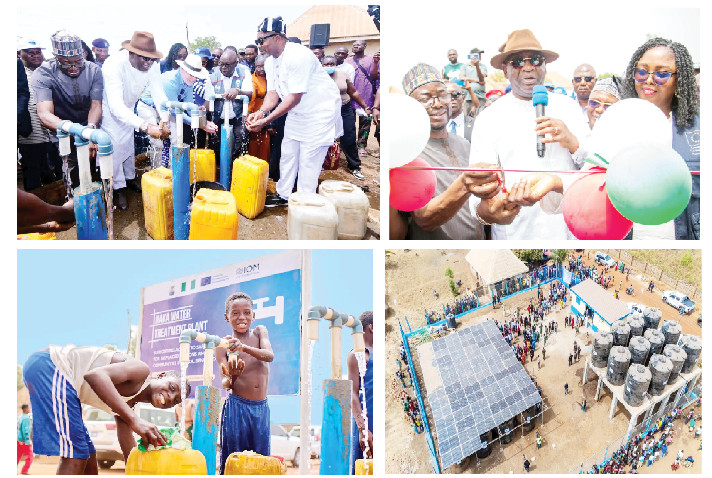
On February 19, 2026, Governor Hyacinth Iormem Alia commissioned a 500,000-litre-per-day water treatment plant in Naka, marking what many residents describe as the most transformative public utility intervention in Gwer-West in 40 years.
The project, delivered in partnership with the European Union and humanitarian agencies, is designed to serve approximately 35,000 people daily — including internally displaced persons (IDPs) and host communities.
The commissioning formed part of a broader high-level visit by Nigerian federal authorities and international development partners, including the International Organization for Migration and the European Union. It coincided with the launch of Benue State’s Contingency Plan for Emergency Response (2026–2028), a framework aimed at strengthening preparedness, coordination, and rapid response to disasters and displacement crises.
Water scarcity in Gwer-West has long been more than an inconvenience; it has shaped patterns of poverty and vulnerability. Naka, the local government headquarters, historically relied on outdated and dysfunctional boreholes installed decades ago. Many collapsed due to poor maintenance and erratic power supply.
Surface water sources became overstretched as population growth outpaced infrastructure investment.
Over the past decade, insecurity and communal violence in parts of Benue — Nigeria’s “Food Basket of the Nation” — further compounded the crisis. Waves of displacement placed additional strain on fragile water systems.
According to state authorities, Benue currently hosts approximately 460,000 internally displaced persons, making it one of the largest IDP-hosting states in Nigeria after Borno. Gwer-West is among the most affected local government areas.
For displaced families settling in camps and informal host communities, access to potable water became both a humanitarian and public health emergency.
Outbreaks of diarrhoeal diseases and sanitation-related illnesses underscored the urgency for durable solutions.
From Emergency Relief to Structural Reform, Governor Alia’s administration framed the Naka water plant not as an isolated intervention, but as part of a strategic pivot toward resilience. The newly launched Contingency Plan for Emergency Response 2026–2028 integrates disaster preparedness, humanitarian coordination, and infrastructure investment. New data management facilities at the State Emergency Management Agency and the Ministry of Humanitarian Affairs are expected to enhance real-time planning and accountability.
In Naka, the water treatment plant represents tangible infrastructure. With a production capacity of 500,000 litres per day, it dramatically exceeds the fragmented borehole systems that previously defined local supply. Treated water will now reach households through structured distribution networks, significantly reducing dependence on unsafe sources.
The Governor described access to water as a fundamental human right and positioned the project as a fulfillment of a long-standing social obligation to Gwer-West residents. For a community accustomed to promises, the physical presence of a functioning plant offers visible proof of delivery.
The European Union, through its humanitarian arm ECHO, and the International Organization for Migration provided technical and financial support, underscoring the importance of aligning humanitarian relief with development planning.
Federal authorities, represented by the Minister of Humanitarian Affairs and Poverty Reduction, Dr. Bernard Doro, commended the state’s leadership-driven approach, noting that sustainable humanitarian response requires government coordination rather than fragmented aid.
EU Ambassador Gautier Mignot emphasized Benue’s strategic importance as Nigeria’s second-largest host of displaced persons and reaffirmed European support for water, shelter, and sanitation projects designed to stabilize vulnerable communities.
The model adopted in Gwer-West blends emergency assistance with durable solutions. Alongside the water plant, new shelter units have been handed over to IDPs, and peacebuilding frameworks are nearing completion to encourage safe returns and social cohesion.
According to the Executive Chairman of the local government, Hon. Victor Ormin, for the residents of Naka, the impact is immediate and deeply personal as he said time once spent fetching water can now be redirected toward farming, schooling, and income generation. Health risks linked to untreated water are expected to decline.
Tensions between host communities and displaced families over scarce resources may ease as supply expands.
Rolling back a 40-year water crisis is not merely about pipes and pumps. It signals a shift from reactive governance to preventive planning — from emergency firefighting to structured resilience.
As the government is determined to sustain the gains, the Naka water treatment plant could become a model for similar interventions across conflict-affected regions of Nigeria.
In Gwer-West, where water scarcity once symbolized neglect, it now stands as evidence of possibility — that with political will, international partnership, and community engagement, even decades-old challenges can be confronted and reversed.
Donald Kumun, is the Principal Special Assistant to the Benue state Governor on Print Media and writes from Makurdi the State Capital of Benue.
We’ve got the edge. Get real-time reports, breaking scoops, and exclusive angles delivered straight to your phone. Don’t settle for stale news. Join LEADERSHIP NEWS on WhatsApp for 24/7 updates →
Join Our WhatsApp Channel