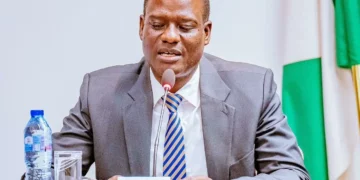
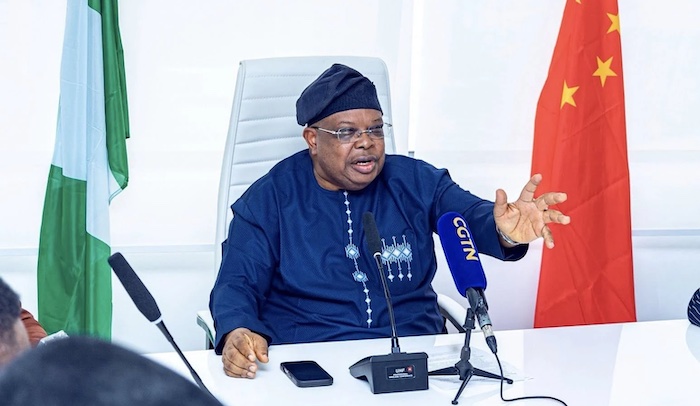
Nigeria’s minister of Power, Joseph Olasunkanmi Tegbe, has come under intense criticism after claiming that some Nigerians had asked him to “slow down” improvements in electricity supply because their freezers were now working continuously.
The minister’s comment, made on Wednesday in Abuja while commissioning a 3-megawatt solar hybrid power project at Yakubu Gowon University, formerly the University of Abuja, triggered a wave of reactions from Nigerians who questioned the claim against the backdrop of persistent power outages across the country.
Tegbe said some areas that previously went without electricity for as long as three months were now enjoying up to 18 hours of supply.
According to him, some consumers had contacted him to complain that their freezers were freezing continuously.
“Places that didn’t have light at all for three months are now having 18 hours of light. Some areas called me to say, look, I should slow down, that everything in their freezer is freezing. That is what a freezer is meant to do. Let it freeze the food that needs to be frozen,” Tegbe said.
But the remark immediately came under fire on social media, with several Nigerians challenging the minister to reconcile the claim with their experiences of prolonged outages and unreliable electricity supply.
Broadcast journalist, Rufai Oseni (@ruffydfire), was among those who reacted, saying: “Minister of Power, I have not had power since yesterday; no light in my freezer! All the block don turn water.”
Oseni’s comment captured the central criticism from several respondents who argued that the challenge confronting most consumers was not excessive electricity supply but inadequate and unreliable power.
Another X user, Joe Nwachukwu (@nwachukwu_42826), questioned the minister’s reference to Nigerians asking him to slow down the supply.
“Which Nigerians, maybe in your own house or your neighbour.
Which state did you visit?” he asked, while also questioning the wider state of electricity supply in the country.
GB (@genebext) also challenged the minister’s account, saying there had been no stable electricity supply in the user’s area for more than a week.
The user argued that consumers could switch off appliances if electricity became excessive, but questioned why Nigerians should be discussing excess power when many households and businesses were still struggling with unreliable supply.
Similarly, Kamuzu (@freshboycastle) said consumers could simply switch off their appliances if supply became too much, questioning the basis for presenting such a situation as a major concern.
UG Praise (@UgoPraise10) described electricity supply in the user’s area as “epileptic”, challenging the government to demonstrate sustained improvements in supply beyond selected locations.
The criticism also extended to the cost of electricity and the wider burden on households and businesses.
Káçhïï_O (@kachii_0) argued that Nigerians were not benefiting sufficiently from government policies, pointing to rising electricity costs and the pressure they were placing on consumers.
Veteran journalist Dr Reuben Abati also questioned the minister’s account, arguing that claims that Nigerians were complaining about having too much electricity did not reflect the experiences of many households that continue to depend on generators.
Abati pointed to the rising cost of diesel and the financial burden of alternative power sources, while also urging the minister to be cautious about statements that could further anger consumers already facing a high cost of living.
He further questioned the government’s plans around electricity subsidies and called attention to the affordability challenges confronting households.
NERC Data Shows Wider Capacity Challenge
Available official data also presents a more complex picture of Nigeria’s electricity supply.
The Nigerian Electricity Regulatory Commission’s April 2026 Operational Performance Factsheet showed that an average of 4,286 megawatts was available for dispatch from 13,625MW of installed grid-connected generation capacity during the month.
This represented a plant availability factor of 31 per cent, while NERC said the average available capacity utilised was 4,048MWh/h.
The figures do not necessarily invalidate the minister’s claim that some locations have experienced longer hours of supply, but they highlight the difference between improvements in particular distribution areas and the wider capacity available across the national electricity system.
Tegbe himself acknowledged some of the structural challenges facing the sector, noting that parts of Nigeria’s electricity infrastructure are more than four decades old.
He said the government was replacing and phasing out ageing infrastructure while also tackling vandalism of critical power assets.
The controversy has consequently shifted the debate from whether some communities have recorded improvements in supply to whether such gains are sufficiently widespread and reliable to justify claims of a broader turnaround in the power sector.
For many of the Nigerians reacting to the minister, the issue is not whether a freezer should freeze, but whether households and businesses can depend on electricity consistently enough to reduce their reliance on generators and expensive diesel.
The contrasting accounts have also placed renewed focus on the gap between official assessments of improvements in electricity supply and the day-to-day experience of consumers across different parts of the country.
We’ve got the edge. Get real-time reports, breaking scoops, and exclusive angles delivered straight to your phone. Don’t settle for stale news. Join LEADERSHIP NEWS on WhatsApp for 24/7 updates →
Join Our WhatsApp Channel