
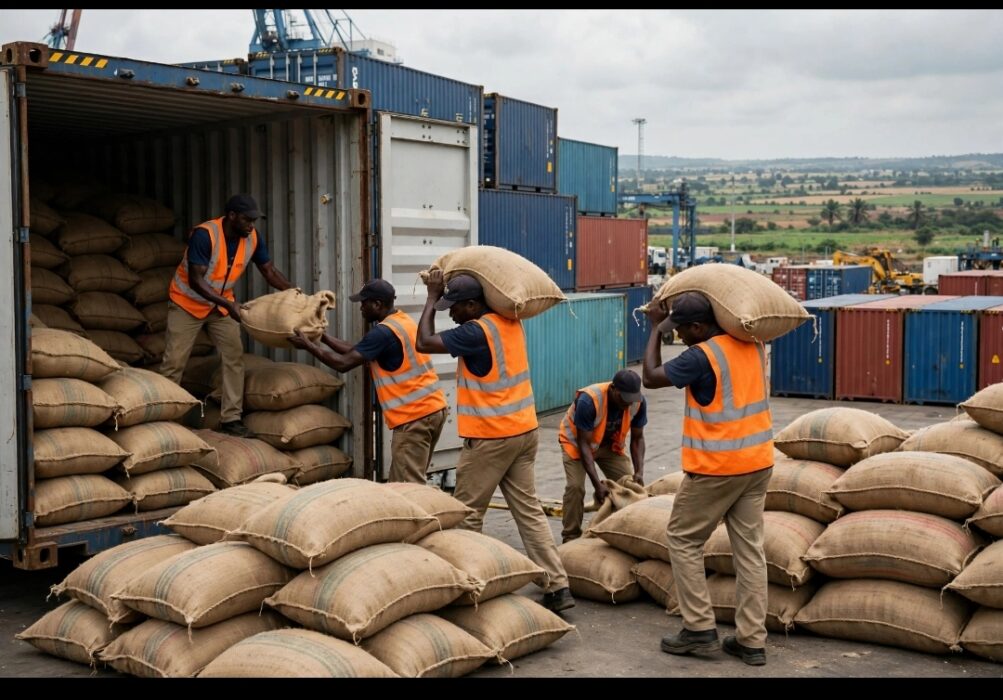
Nigeria’s decision to liberalise food imports to ease shortages and contain rising prices is threatening the competitiveness of local farmers, agricultural stakeholders have warned, as the country’s food import bill rose to $1.19 billion in the first half of 2026.
Data from the Central Bank of Nigeria’s (CBN) Q2 2026 Statistical Bulletin showed that foreign exchange utilisation for food imports increased by 11.41 per cent from $1.07 billion in the corresponding period of 2025.
Stakeholders said that while import waivers and liberalisation may provide short-term relief from food shortages and high consumer prices, continued reliance on foreign supplies could depress farmgate prices, discourage investment in agriculture and weaken Nigeria’s long-term food security.
They warned that local producers were already struggling with insecurity, high transportation costs, rising input prices and post-harvest losses, making it increasingly difficult for domestically produced food to compete with imported alternatives.
The CBN data showed that food import spending stood at $232.05 million in January 2026, an 8.89 per cent year-on-year increase. It fell by 22.90 per cent to $150.87 million in February, before rising to $153.73 million in March.
Spending surged by 54.28 per cent to $217.74 million in April and further to $220.26 million in May, before moderating slightly to $212 million in June. The figures showed increases in five of the six months, with February recording the only decline.
On a quarterly basis, expenditure fell by 2.57 per cent to $536.65 million in the first quarter but rebounded by 26.38 per cent to about $650 million in the second quarter.
Chief Executive Officer of the Centre for the Promotion of Private Enterprise (CPPE), Dr Muda Yusuf, said the rise in food imports reflected the government’s response to supply shortages caused by insecurity and disruptions to domestic production.
According to him, farmers in major food-producing areas across the North, Middle Belt and South-West have struggled to access their farms due to banditry and kidnapping, creating significant supply gaps.
He said the situation had previously pushed the country close to a food crisis, prompting the government to grant import waivers and liberalise imports of rice, maize, wheat and other grains to supplement local supplies and ease pressure on consumers.
However, Yusuf cautioned that relying on imports as a long-term food security strategy could damage domestic agriculture by reducing the prices farmers receive for their produce and discouraging investment in farming.
“Sustained importation could erode rural incomes, weaken farmers’ capacity to expand production and undermine the resilience of Nigeria’s food system,” he said.
He called for a compensation mechanism, such as a guaranteed minimum price, to protect local farmers from losses arising from import-induced price declines.
Yusuf said the sustainable solution to the country’s food security challenges lies in raising agricultural productivity, addressing insecurity, improving storage infrastructure and reducing production costs.
Corroborating the concerns, farmer and stockbroker Tunde Oyediran said the rising food import bill reflected the difficulties confronting local producers, particularly the high cost of transporting produce and purchasing farm inputs.
Oyediran, who operates a farm in Oyo State, said the monthly figures also reflected seasonal variations in domestic food supply.
“As someone who plays in the capital market and also owns a farm in Oyo State, I see this $1.19 billion food import bill from both sides. February showed a decline because it was harvest season, but April surged 54.28 per cent to $217.74 million because by then local silos had emptied and post-harvest losses had set in,” he said.
He explained that high logistics and input costs were making locally produced food increasingly uncompetitive against imported alternatives, even where domestic farmers had sufficient produce.
“Transporting a bag of produce from Oyo to Lagos now costs about N18,000 due to diesel, while fertilizer has risen from N28,000 last year to N45,000 this year. So even when we produce, our produce struggles to compete at retail with imported food,” Oyediran said.
He warned that unless the cost of domestic production was addressed, Nigeria’s dependence on imported food could persist, with adverse consequences for agricultural investment, rural employment and the country’s foreign exchange position.
Oyediran, however, cautioned against an outright ban on food imports, arguing that the government should instead direct more resources towards addressing the structural constraints facing local agriculture.
He said improved security in farming communities, mechanisation and investment in storage infrastructure would enable farmers to increase output, reduce post-harvest losses and compete more effectively with imported food.
“If we channel part of this foreign exchange into security for farming communities, mechanisation and storage infrastructure, Nigerian farmers have the capacity to feed the country and reduce this import dependence,” he said.
We’ve got the edge. Get real-time reports, breaking scoops, and exclusive angles delivered straight to your phone. Don’t settle for stale news. Join LEADERSHIP NEWS on WhatsApp for 24/7 updates →
Join Our WhatsApp Channel