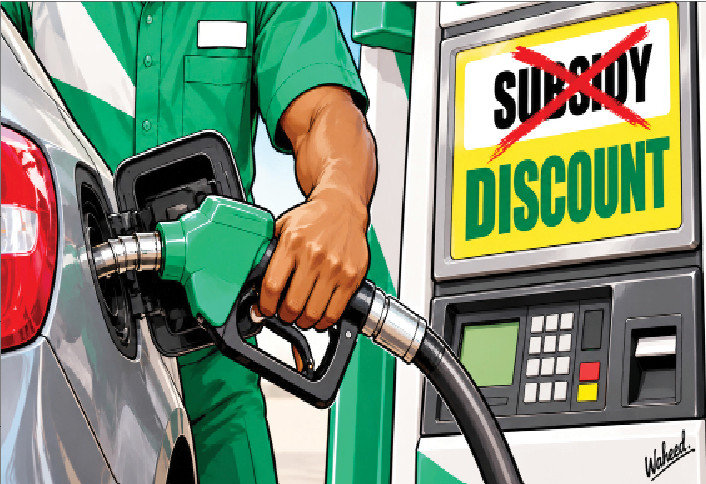
Nigeria’s fuel subsidy debate has returned, wearing a different name. This time, the Federal Government (FG) insists it is not bringing back the subsidy regime abolished in May 2023. Instead, NNPC Retail is offering a temporary petrol discount, while the government negotiates a mechanism to moderate price increases.
The distinction may be economically defensible. But for millions of Nigerians struggling with transport fares, food prices, school fees and the rising cost of survival, the immediate question is simpler: will petrol become more affordable, and for how long?
On October 8, 2026, the FG announced additional measures to cushion households and businesses against rising fuel costs amid global market volatility. NNPC Retail agreed to forgo its retail profit margin for 30 days, while the government proposed a negotiated ceiling of N1,350 per litre on petrol landing or ex-gantry costs. The following day, NNPC clarified that its existing discount would continue until October 31 across its retail outlets nationwide.
RELATED: 30-Day Petrol Discount: ‘Will It Reduce Poverty?’ — Obi Blasts Tinubu
These measures have reopened a politically sensitive conversation about subsidy, deregulation and the responsibility of government to protect citizens from economic shocks. The issue is not simply whether the government has restored a policy it abandoned. It is whether the new arrangement offers meaningful relief, operates transparently and avoids recreating the problems that made the old subsidy regime unsustainable.
The Politics of Naming Things
In May 2023, the President announced the removal of the petrol subsidy. The decision was defended as necessary to stop the diversion of public funds, reduce fiscal pressure and free resources for investment in infrastructure and social services.
The consequences for ordinary Nigerians were immediate and severe. Transport costs rose, businesses faced higher operating expenses, and the prices of food and other essentials followed. Subsequent interventions, including wage awards and other relief measures, struggled to keep pace with the cost-of-living crisis.
Against this background, the government’s insistence that a discount is not a subsidy deserves examination rather than automatic acceptance or dismissal.
There is a genuine economic distinction. A conventional fuel subsidy involves government resources being used to bridge the gap between the cost of supplying petrol and the price paid by consumers. NNPC’s announced discount, by contrast, is to be funded from the company’s retail margin. If implemented as described, it does not require the government to reimburse the difference from the Federation Account.
Fuel pricing in Nigeria has never been merely an economic question; it is deeply political. Subsidy removal was presented as a difficult but necessary decision, with Nigerians asked to endure immediate hardship in exchange for long-term fiscal gains. Now, as the cost of living continues to bite, the government is offering relief while insisting that it has not reversed its earlier position. The political balancing act is clear: ease public pressure without appearing to retreat from a flagship reform.
Relief for Thirty Days, Uncertainty Beyond
For households already stretched by rising prices, a temporary discount is welcome. Every naira saved on transport or fuel for a small business matters. Yet the structure and accessibility of this intervention raise important questions.
Reports from Abuja on October 9 indicated that motorists paying directly at the pump were still being charged N1,405 per litre, while customers using NNPC’s mobile application paid N1,339. This suggests that accessing the advertised discount may require a digital payment rather than being automatically reflected in the pump price.
So, what happens to consumers without smartphones, reliable internet access, digital payment facilities or the confidence to use an app? What about rural communities where access to participating stations is limited? A discount that depends on digital access risks excluding precisely the people who may need relief most.
There is also the question of coverage. NNPC Retail’s intervention applies to its outlets; it does not establish a uniform national pump price. Independent marketers and other retailers continue to operate under market-based pricing arrangements. Consequently, the benefits may vary considerably depending on where people live, work and buy fuel.
The government’s proposal to moderate landing costs presents a different challenge. Under the proposed arrangement, suppliers would absorb costs above the negotiated ceiling and recover the shortfall when conditions improve. The intention is to smooth price fluctuations rather than suppress market prices indefinitely.
In principle, this could reduce the disruptive effects of sudden price spikes. But it raises practical questions. How will deferred costs be calculated and independently verified? What happens if prices remain elevated for months? Will future consumers pay more to compensate for earlier losses? Who bears the risk if the expected recovery never materialises?
The Cost of Reform Must Be Shared
The broader lesson is that deregulation does not absolve government of responsibility for economic welfare. Markets can improve efficiency and encourage investment, but they do not automatically protect low-income households from shocks.
The real test of reform is whether its benefits reach citizens, especially those least able to absorb higher costs. This requires more than temporary price adjustments. It demands credible public transport alternatives, reliable mass transit, support for small businesses, improved public services and targeted social protection.
The proposed price-moderation mechanism should therefore be accompanied by clear safeguards. Government should publish the criteria for determining the ceiling, disclose the financial obligations created by the arrangement and establish independent monitoring. Any deferred supplier losses must not become an opaque liability that eventually lands on taxpayers.
The National Assembly also has a responsibility to scrutinise the arrangement, particularly if it creates contingent public liabilities or involves public assets and revenues. Nigerians should not discover the true cost of a temporary intervention years later through unexplained deductions, mounting obligations or reduced public investment.
Equally important is accountability for the savings generated by subsidy removal. If the argument for ending the subsidy was that the resources could be redirected towards development, citizens should be able to trace those resources to measurable improvements in health, education, transport, social protection and infrastructure.
The government cannot indefinitely ask Nigerians to endure the costs of reform without demonstrating its dividends. Nor should citizens be forced to choose between fiscal responsibility and basic economic survival.
The government has a legitimate interest in protecting the gains of reform. Citizens have an equally legitimate interest in seeing those gains reflected in their daily lives. Both objectives must be pursued together.
Beyond the Pump
Nigeria needs an honest conversation about energy pricing, public expenditure and social protection. Reintroducing a blanket ‘fuel discount’ without confronting its historical weaknesses would be a mistake. Equally, treating every demand for relief as an attempt to reverse reform would be an abdication of government’s responsibility.
The immediate discount may provide a useful cushion. The proposed price-smoothing mechanism may also offer a practical response to global volatility, provided its design is transparent and its risks properly managed. But neither should become a substitute for a coherent, long-term plan to make energy affordable and the economy less vulnerable to external shocks.
Government must also communicate clearly. Nigerians should know what they are entitled to, where the discount applies, how long it lasts and what happens afterwards. If the intervention ends on October 31 without an extension, a published assessment should explain what it achieved and why the policy is changing.
Ultimately, it does not matter whether the government calls this a discount, a subsidy or price modulation; what matters is whether the intervention delivers fair, measurable and sustainable relief for Nigerians.
We’ve got the edge. Get real-time reports, breaking scoops, and exclusive angles delivered straight to your phone. Don’t settle for stale news. Join LEADERSHIP NEWS on WhatsApp for 24/7 updates →
Join Our WhatsApp Channel