The Nigerian Midstream and Downstream Petroleum Regulatory Authority (NMDPRA) has urged the NNPC Retail Ltd and other petroleum products retail outlets to match the efficiency and use of technology in new self-service fuelling system with strong safety standards and a firm commitment to environmental protection.
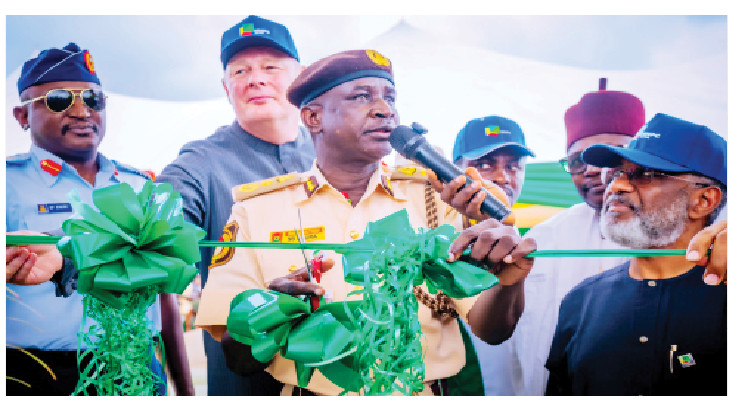
The NMDPRA chief executive, Mr Rabiu Umar, gave the charge at the commissioning of NNPC Retail’s self-service smart station in Abuja on Thursday.
Umar, represented by the executive director, Health, Safety, Environment and Community, Dr Mustapha Lamorde, said the commissioning marked more than the addition of another retail outlet, describing the facility as an integration of technology-driven services into Nigeria’s evolving downstream petroleum industry.
The station was developed through a partnership involving NNPC Retail, the Nigerian Immigration Service (NIS), African Motor Works (AMW) and other development partners. It provides self-service fuel dispensing, electric-vehicle charging, liquefied petroleum gas (LPG) dispensing, an automated car wash and vehicle-servicing facilities.
He said the industry was increasingly embracing efficiency and technology in service delivery.
“However, we would like to match efficiency and the use of technology with safety, environmental stewardship and also a good commitment to our environment,” Umar said.
The NMDPRA chief executive congratulated NNPC Ltd., NNPC Retail, its management and staff on the milestone, and encouraged the company to sustain its partnerships and replicate the initiative across the country.
Speaking earlier, the executive vice president, Downstream, NNPC Ltd., Mumuni Dagazau, described the Abuja facility as the first of several smart stations planned nationwide.
Dagazau said the company was targeting the deployment of between 50 and 70 similar stations across Nigeria within the next six months.
“We are hoping to roll out a significant number, probably about 50 to 70 of these types of stations within the next six months. So this is what you’ll be seeing going forward from NNPCL,” he said.
He explained that the initiative was designed to transform conventional filling stations into energy and mobility hubs offering petrol, electric-vehicle charging, LPG and compressed natural gas (CNG) services, as well as car washes and food outlets.
“What the whole concept is, we are trying to turn from a filling station to an energy hub,” Dagazau said.
He said the self-service model would enable customers to dispense fuel themselves, including at night, while assuring that the initiative would create rather than eliminate jobs.
According to him, the new facilities would require personnel to manage automation, EV charging and other services.
“What NNPC does is create jobs. What this does is create jobs. You have an energy hub today. If you look at the average filling station and you look at the energy hub, you will find more people in the energy hub than you will find in the filling stations,” he said.
Dagazau added that more smart stations were being planned for Abuja and Kano ahead of the nationwide rollout. He also said NNPC was upgrading its existing outlets as part of a broader review of NNPC Retail’s operations.
“We are going to modernise our stations. The customer deserves a better quality of service and we are delivering that quality of service,” he said.
He said the fast chargers at the Abuja facility could charge an electric vehicle in about 30 to 40 minutes, depending on the vehicle type and the battery level.
Also speaking, the executive director, Retail Operations and Mobility, NNPC Ltd., Shettima Baba-Kukawa, said the facility had a storage capacity of 180,000 litres of Premium Motor Spirit and 45,000 litres of Automotive Gas Oil.
He said the station had 16 PMS pumps, two AGO pumps and six EV charging points installed in partnership with AMW. The facility is powered by a solar-energy system with a capacity of more than 200 kilowatts.
Other services at the station include a quick-service restaurant, coffee shop, automated car wash, service bay, auto-care centre, mini-mart, supermarket, LPG dispensing and a planned CNG conversion centre.
Baba-Kukawa said the station would operate 24 hours daily and allow customers to dispense fuel without assistance if they preferred the self-service option.
“Transactions are done on their phone app and concluded by dispensing the exact amount of fuel they purchased into their tanks,” he said.
He explained that customers using the self-service option would be required to download the NNPC Retail app, create and fund a wallet, and generate a code authorising the exact quantity of fuel to be dispensed.
However, customers unable to use the digital system would still be able to access assistance from station personnel.
On his part, the managing director of NNPC Retail, Huub Stokman, said the company’s transformation was being driven by the deregulation of the downstream petroleum sector and the commencement of operations at the Dangote Refinery.
He said consumers were demanding competitive prices, faster service, digital payment options and new energy solutions, including EV charging and CNG.
“Above all, especially the younger generation, they want us to deliver it in a sustainable way, hence the fact that you also see that this station is completely solar-powered,” Stokman said.
He said NNPC Retail would continue to invest in technology, partnerships and new energy solutions, while acknowledging the contributions of the NIS, AMW and other partners to the project.
The Comptroller-General of the NIS, Kemi Nanna Nandap, represented by the Deputy Comptroller, Bashir Daura, said the partnership would support the Service in fulfilling some of its mandates.
She reaffirmed the NIS’s commitment to the collaboration.
We’ve got the edge. Get real-time reports, breaking scoops, and exclusive angles delivered straight to your phone. Don’t settle for stale news. Join LEADERSHIP NEWS on WhatsApp for 24/7 updates →
Join Our WhatsApp Channel